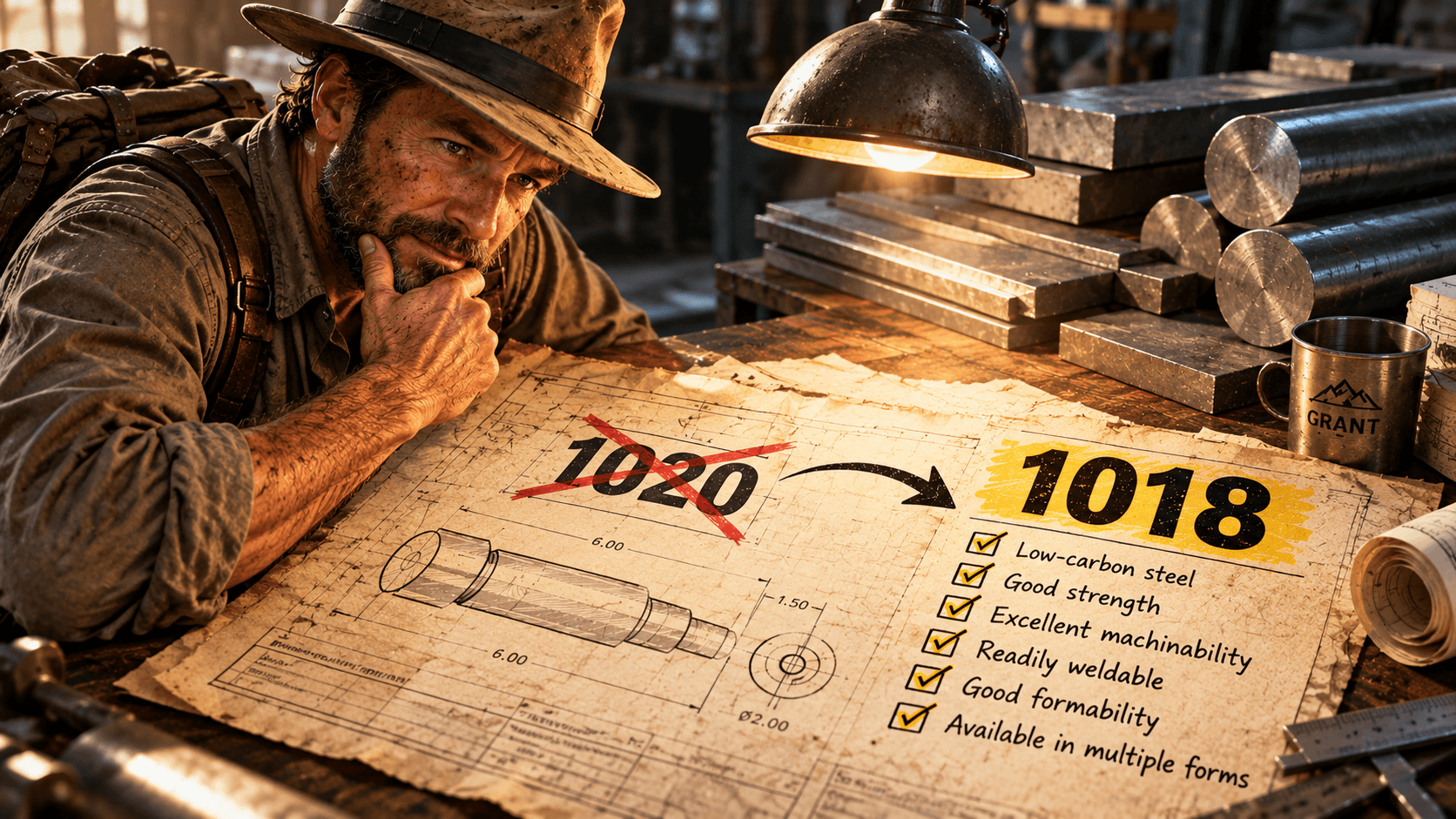
What Replaced 1020 Steel?
October 6, 2026
Grant’s Field Journal
Mission: Track down what happened to a once-familiar carbon steel grade
Terrain: Legacy specifications, modern equivalents and material availability
Difficulty: ★★★★☆
Status: Trail still exists
You pull up an old drawing.
Everything looks straightforward until you reach the material callout:
1020 steel.
You send it to a supplier.
Then another.
The responses start coming back:
We don't stock that.
Can you use something else?
Engineering will need to approve an alternative.
Which raises an obvious question:
What replaced 1020?
The answer is a little more complicated than naming another grade.
First, 1020 Didn't Disappear
AISI/SAE 1020 is a low-carbon steel designation with nominal carbon content around 0.20%. The grade itself still exists and is still produced in various forms.
But that doesn't mean your supplier has it sitting on a rack.
And that's where this expedition gets interesting.
Depending on the product form, dimensions, specification and condition you need, 1020 may simply not be a commonly stocked choice anymore.
So when someone says, "We can't get 1020," they may really mean:
"We can't readily get the exact 1020 you're asking for."
So, What Replaced It?
There isn't one universal answer.
1020 has no single drop-in replacement for every application.
That's important because a material substitution isn't just about finding another grade with a similar name or carbon content.
You need to understand why 1020 was specified in the first place.
Was it selected for:
Strength?
Machinability?
Weldability?
Formability?
Chemistry?
A particular product form?
Availability at the time the drawing was created?
The answer determines which trail you follow next.
Expedition Stop #1: 1018
One grade you'll frequently encounter in the same conversation is 1018.
Like 1020, 1018 is a low-carbon steel, and the two can have similar characteristics depending on product and processing.
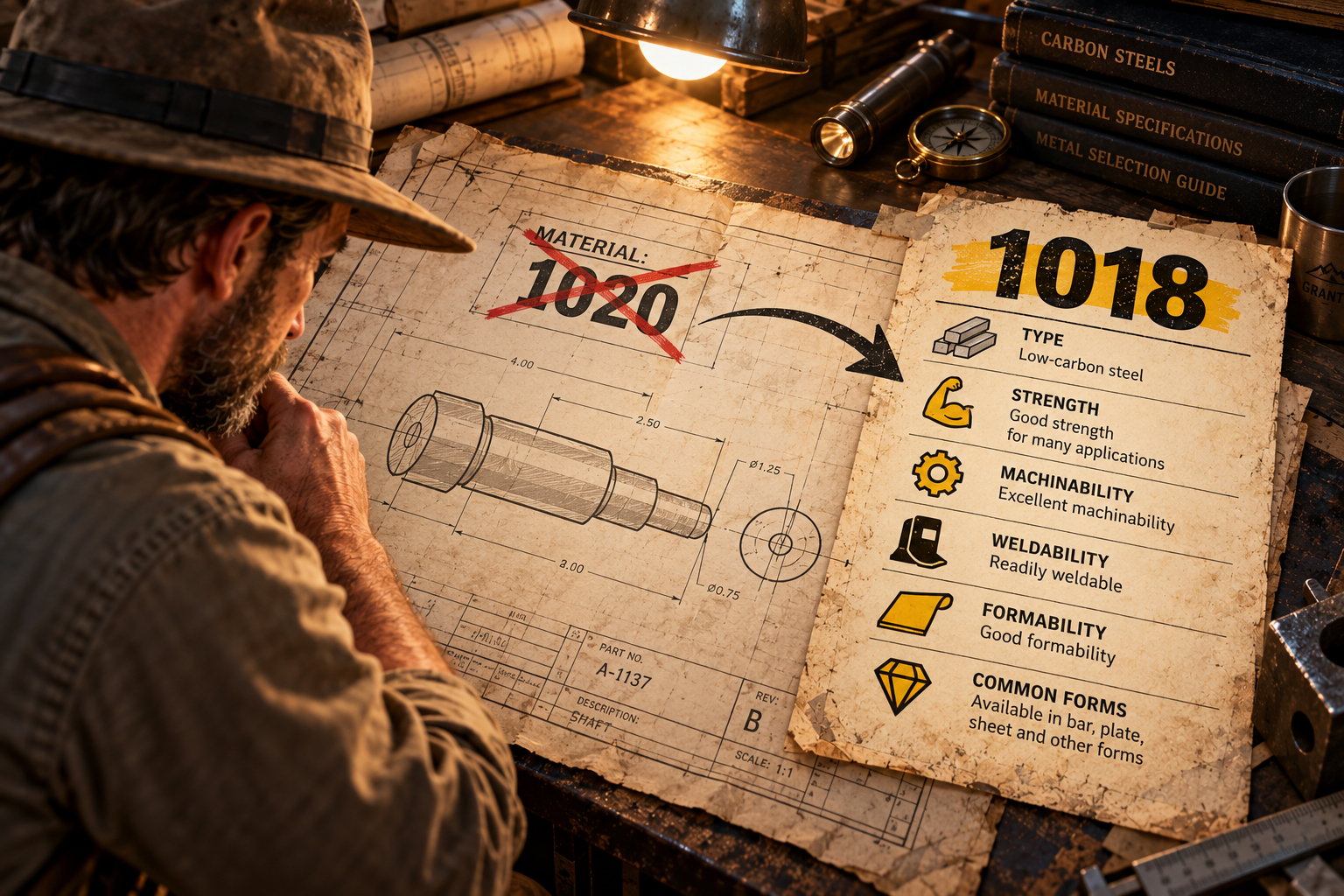
That does not automatically make 1018 a substitute for 1020.
But if an old print specifies 1020 and the application doesn't depend on a requirement unique to that material, 1018 may be one of the grades worth evaluating with engineering.
Grant's note: "Similar" and "equivalent" are not the same thing.
That's a distinction worth remembering anytime you're dealing with legacy specifications.
Expedition Stop #2: Look Beyond the Grade Number
Here's where buyers can get trapped.
The search starts with:
I need 1020.
But a better question may be:
What does this part actually require the material to do?
Imagine the original engineer needed a readily weldable, machinable low-carbon steel.
Decades ago, 1020 may have been the logical choice based on what was commonly produced and stocked.
Today, another readily available material may meet the application's requirements.
But you can't determine that from the grade number alone.
Chemistry, mechanical properties, manufacturing method, condition and governing specification can all matter.
Expedition Stop #3: Product Form Changes the Map
"1020 steel" isn't a complete sourcing description.
Are you looking for:
Round bar? Plate? Sheet? Tube? Forging?
That matters because the availability of a particular grade can vary dramatically between product forms.
A grade that's relatively easy to source as bar might be difficult to locate as plate in the exact dimensions you need.
And another product form may commonly be sold under a different specification or grade convention altogether.
That's why simply Googling "1020 replacement" can send you down the wrong trail.
The replacement question has to start with the actual part.
The Old-Drawing Problem
This is where Grant encounters 1020 most often.
A manufacturer has been making the same component for years—sometimes decades.
The drawing hasn't changed.
But the metal supply chain has.
Materials that were readily stocked when the print was created may now be produced less frequently, stocked in fewer sizes or replaced in everyday distribution by materials with greater market demand.
The print stayed frozen in time.
Availability didn't.
And suddenly purchasing is being asked to find yesterday's material in today's supply chain.
Sound familiar?
You've encountered another form of Unobtainium.
Don't Rewrite the Print at the Purchasing Desk
This part is important.
If the drawing specifies 1020, purchasing shouldn't simply decide:
"1018 looks close enough."
A potential alternative needs to be evaluated against the requirements of the application and approved by the appropriate engineering or technical authority.
Depending on the part, that review could involve:
Chemistry. Mechanical properties. Heat treatment. Weldability. Machinability. Formability. Dimensional requirements. Applicable specifications.
Sometimes the answer will be simple.
Sometimes it won't.
But finding an available material is only half the expedition.
Making sure you can actually use it is the other half.
Grant's Checklist: When You Can't Find 1020
Before sending another dozen RFQs, gather the clues:
What does the drawing actually specify?
Grade alone, or a governing specification too?
What product form do you need?
Bar, plate, sheet, tube or something else?
What size and quantity do you need?
Sometimes those are the real sourcing obstacles.
What properties matter to the application?
Understanding why 1020 was selected can help engineering evaluate alternatives.
Can another readily available grade work?
Possibly—but get the appropriate technical approval.
Does the drawing itself need updating?
If purchasing repeatedly struggles with the same legacy callout, the long-term solution may be an engineering review rather than another sourcing expedition.
The Explorer's Takeaway
So, what replaced 1020?
Nothing—and potentially several things.
There isn't a universal modern grade that automatically replaces it.
That's actually the bigger lesson.
When an old specification becomes difficult to source, don't immediately hunt for a one-for-one replacement.
Ask:
What did the engineer need this material to do?
Once you understand that, you can begin evaluating materials that satisfy the requirement and make sense in today's supply chain.
Because sometimes the material isn't obsolete.
The assumption that there's only one acceptable material is.
Having Trouble Finding 1020?
Give Grant the clues:
Grade. Specification. Product form. Size. Quantity. Application.
Metals Suppliers Online can help investigate what's available and identify potential paths forward when a legacy material becomes difficult to source.
Any material substitution should be reviewed and approved by the appropriate engineering or technical authority.
Challenge Grant →