Cobalt
Cobalt FSX 414
Applications
FSX-414 is primarily used for first-stage nozzle segments and stationary vane applications in industrial and aviation gas turbines, where it is exposed to the highest gas path temperatures. It is also used in marine gas turbine guide vanes, high-power gas turbine guide blades (operating temperatures below 900°C / 1652°F), and precision investment-cast components for aerospace and power generation. Additional applications include petrochemical equipment and energy conversion devices.
Corrosion Resistance
FSX-414 exhibits excellent resistance to oxidation and hot corrosion due to its high chromium content (27–31%). The oxidation resistance is sufficient that the alloy is used in gas turbine first-stage nozzle applications without a protective oxidation coating. The combined additions of nickel and chromium provide excellent resistance to both oxidizing and corrosive environments, including hot gas corrosion and sulfidation at elevated temperatures.
Hot Workability
FSX-414 is primarily processed as an investment cast alloy for precision components such as turbine nozzle segments and guide vanes. The alloy can also be produced by AOD/VOD/VIM melting followed by electroslag refining (ESR) or vacuum arc remelting (VAR) for special purposes. Bars and forgings are also produced and are typically supplied in the solution-annealed condition.
Other Comments
FSX-414 is a proprietary cobalt-based superalloy historically associated with General Electric gas turbine products, particularly first-stage nozzle hardware. It is a solid-solution-strengthened alloy, in contrast to gamma-prime-strengthened nickel-base superalloys. The solidus temperature is approximately 1343°C (2449°F) and the liquidus is approximately 1365°C (2489°F) as determined by differential thermal analysis. The alloy is available in powder form for additive manufacturing (LPBF, EBM, DED), thermal spray coatings, and investment casting applications. It offers superior high-temperature oxidation resistance, creep resistance, and high-temperature strength compared to standard cobalt alloys such as Stellite 6 or Haynes 188.
Principle Design Features
FSX-414 is a cobalt-based solid-solution-strengthened cast superalloy. Strengthening is achieved primarily through carbide precipitation (M6C, M7C3, and M23C6 carbides) rather than gamma-prime precipitation as seen in nickel-base superalloys. The alloy contains high levels of chromium (27–31%) for oxidation and corrosion resistance, tungsten (6.5–7.5%) for high-temperature mechanical properties and solid-solution strengthening, and nickel (9–12%) to enhance resistance to oxidizing and corrosive environments. The alloy exhibits a stable single-phase austenitic matrix and does not precipitate topologically close-packed (TCP) phases during long-term high-temperature service, contributing to excellent microstructural stability.
Weldability
FSX-414 has excellent weldability for a cast cobalt-based superalloy. Cracks in gas turbine nozzles are routinely repaired by tungsten arc welding (TIG/GTAW) using cobalt-based filler metals. Transient liquid phase (TLP) diffusion bonding is also widely used for repair. Welded specimens exhibit yield and ultimate tensile stresses comparable to unwelded base metal, though toughness of welded specimens may be somewhat lower than unwelded material.
Known Forms
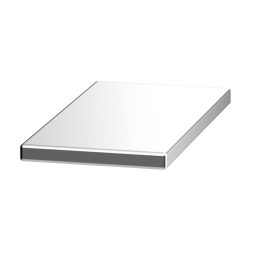
Flat Bar
Powder
Ring
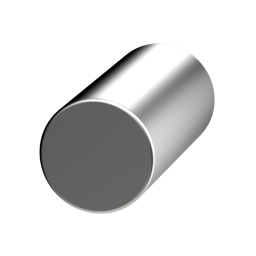
Round Bar
Specialty Form
Additional Data
Chemical Elements
| Carbon | 0.2 - 0.3 |
| Chromium | 27 - 31 |
| Cobalt | Balance |
| Iron | 0 - 2 |
| Manganese | 1 max |
| Nickel | 9 - 12 |
| Phosphorus | 0.035 max |
| Silicon | 1 max |
| Sulfur | 0.015 max |
| Tungsten | 6.5 - 7.5 |
Physical Properties
Density: 0.3lb/in³
Melting Point: 2449°F