Nickel
Nickel Haynes 188 (tm)
Applications
While primarily employed in the aerospace industry, this alloy has found uses in commercial industrial applications including land-based gas turbines. Generally found in hot sections of engines in burner cans, ducting and afterburner components. In recent years, it has been eclipsed by Alloy 230 for many applications due to improved properties.
Cold Workability
This alloy can be readily cold formed using all common techniques. Its high work hardening rate will require intermediate annealing for extensive deformation.
Forgeability
Soak thoroughly at 2150 F (1175 C), followed by rapid post-work cooling.
Formability
This alloy has good ductility and may be readily formed by all conventional methods. Because the alloy is stronger than regular steel it requires more powerful equipment to accomplish forming. Heavy-duty lubricants should be used during cold forming. It is essential to thoroughly clean the part of all traces of lubricant after forming as embrittlement of the alloy may occur at high temperatures if lubricant is left on. The alloy will work harden rapidly and intermediate annealing may be required for extensive forming operations.
Heat Treatability
Solution heat treat at 2150 F (1175 C) and cool rapidly. Annealing at temperatures below this may cause carbide precipitation resulting in deleterious effects on properties.
Machinability
Conventional machining techniques used for iron based alloys may be used. This alloy does work-harden during machining and has higher strength and "gumminess" not typical of steels. Heavy duty machining equipment and tooling should be used to minimize chatter or work-hardening of the alloy ahead of the cutting. Most any commercial coolant may be used in the machining operations. Water-base coolants are preferred for high speed operations such as turning, grinding, or milling. Heavy lubricants work best for drilling, tapping, broaching or boring. Turning: Carbide tools are recommended for turning with a continuous cut. High-speed steel tooling should be used for interrupted cuts and for smooth finishing to close tolerance. Tools should have a positive rake angle. Drilling: Steady feed rates must be used to avoid work hardening due to dwelling of the drill on the metal. Rigid set-ups are essential with as short a stub drill as feasible. Heavy-duty, high-speed steel drills with a heavy web are recommended. Feeds vary from 0.0007 inch per rev. for holes of less than 1/16" diameter, 0.003 inch per rev. for 1/4" dia., to 0.010 inch per rev. for holes of 7/8"diameter. Milling: To obtain good accuracy and a smooth finish it is essential to have rigid machines and fixtures and sharp cutting tools. High-speed steel cutters such as M-2 or M-10 work best with cutting speeds of 30-40 feet per minute and feed of 0.004"-0.006" per cutting tooth. Grinding: The alloy should be wet ground and aluminum oxide wheels or belts are preferred.r 1/4" dia., t0 degrees to the joint. For Short-Circuiting-Transfer GMAW a typical voltage is 18-22 with a current of 75-150 amps and a wire feed of 8-10 inches per minute. Submerged-Arc Welding: Generally submerged-arc welding should be avoided. This weld process involves high heat input and may lead to cracking of the alloy workpiece.
Principle Design Features
This is a cobalt-nickel-chromium-tungsten alloy designed for high temperature strength and resistance to oxidation at temperatures up to 2000 F(1095 C).
Weldability
This alloy can be readily welded using MIG, TIG, electron beam and resistance techniques.
Known Forms
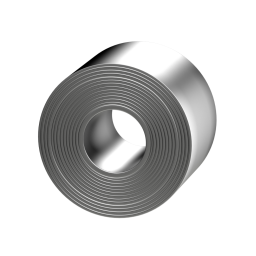
Coil
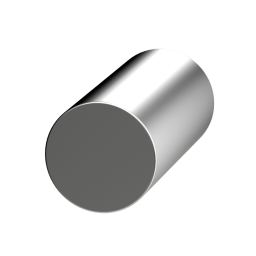
Disc
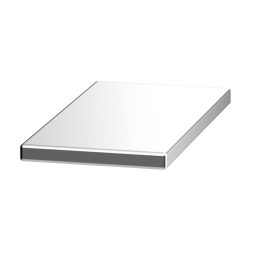
Flat Bar
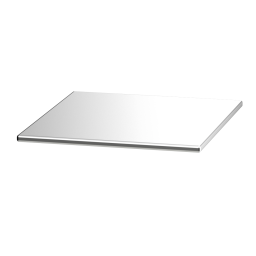
Foil
Hollow Bar
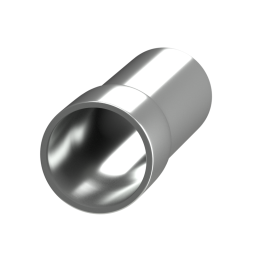
Pipe
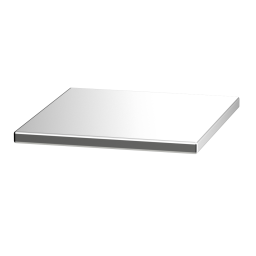
Plate

Rectangle Tube
Ring
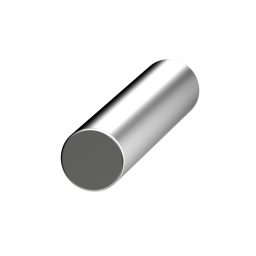
Rod
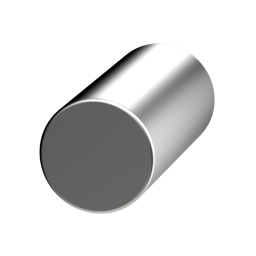
Round Bar
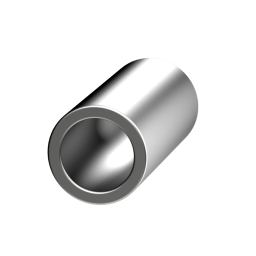
Round Tube
Sheet
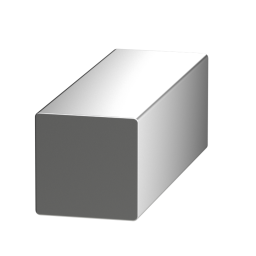
Square Bar
Strip
Additional Data
Specifications
5608,5772,B50A712,B50TF74,B50TF74A,1042,R330188Chemical Elements
| Boron | 0.015 nom |
| Carbon | 0.05 - 0.15 |
| Chromium | 20 - 24 |
| Cobalt | Balance |
| Iron | 3 max |
| Lanthium | 0.02 - 0.12 |
| Manganese | 1.25 max |
| Nickel | 20 - 24 |
| Silicon | 0.2 - 0.5 |
| Tungsten | 13 - 15 |
Physical Properties
Density: 0.324lb/in³
Electrical Resistivity: 554µΩ·cm
Melting Point: 2425°F
Specific Gravity: 8.97
Specific Heat: 0.101BTU/lb·°F
Mechanical Properties
Modulus of Elasticity – Tension: 33.6MSI
Thermal Conductivity
| Condition | Temperature | Conductivity |
|---|---|---|
| Annealed | 70 °F | 7.2 BTU/hr·ft·°F |
Thermal Expansion
| Condition | Min | Max | Expansion Coefficient |
|---|---|---|---|
| Annealed | 70 °F | 200 °F | 6.5 μin/in·°F |
| Annealed | 70 °F | 400 °F | 7 μin/in·°F |
| Annealed | 70 °F | 800 °F | 7.7 μin/in·°F |
| Annealed | 70 °F | 1000 °F | 8.2 μin/in·°F |
| Annealed | 70 °F | 1400 °F | 9 μin/in·°F |
| Annealed | 70 °F | 1800 °F | 9.9 μin/in·°F |
| Annealed | 70 °F | 2000 °F | 10.2 μin/in·°F |
Rupture Test Data
| Condition | Form | Temperature | Time | Rupture Strength |
|---|---|---|---|---|
| Solution Annealed | Sheet | 1600 °F | 100 hrs | 15 KSI |
| Solution Annealed | Sheet | 1400 °F | 100 hrs | 33 KSI |
Mechanical Test Data
| Form | Sheet |
| Condition | Solution Annealed |
| Temperature | 70°F |
| Elongation | 56% |
| Tensile Strength | 139 KSI |
| Yield Strength | 70 KSI |
| Form | Sheet |
| Condition | Solution Annealed |
| Temperature | 1200°F |
| Elongation | 61% |
| Tensile Strength | 103 KSI |
| Yield Strength | 44 KSI |
| Form | Sheet |
| Condition | Solution Annealed |
| Temperature | 1400°F |
| Elongation | 43% |
| Tensile Strength | 92 KSI |
| Yield Strength | 42 KSI |
| Form | Sheet |
| Condition | Solution Annealed |
| Temperature | 1600°F |
| Elongation | 73% |
| Tensile Strength | 61 KSI |
| Yield Strength | 38 KSI |