Stainless
Stainless Alloy 20
Annealing Procedure
Soak thoroughly at 1725-1850 F(941-1010 C), water quench.
Applications
Good availability at both the mill and distributor levels have made this a popular choice for a wide variety of applications. Included among these are: equipment for the manufacture of synthetic rubber, plastics, organic and heavy chemicals, pharmaceuticals, solvents and explosives, petroleum products, etc. Also employed in heat exchangers, mixing tanks, metal cleaning and pickling equipment and process piping.
Cold Workability
This alloy can be successfully cold formed using all common practices. Its elevated strength may require higher forming pressures.
Forgeability
Soak thoroughly at 2100-2250 F(1149-1232 C). Re-heat when temperature drops below 1800 F(982 C). After forging, reheat and soak completely at 1725-1850 F(941-1010 C) and quench rapidly in water or oil.
Formability
To obtain maximum ductility, heat material to 2100 F(1149 C). Understand, however, that this process will adversely affect the stability of the material. Without this process, the material can be satisfactorily formed albeit with a high work hardening rate.
Hardening Procedure
This material may only be hardened by cold work.
Hot Workability
This alloy can be successfully hot formed using forces similar to those required by austenitic stainless steels.
Machinability
Superior finishes may be obtained using set-up and process speeds and feeds normally employed in austenitic stainless steels such as 316 and 317. Slow speeds and heavy, constant feeds are the rules in working this alloy.
Principle Design Features
This alloy is a columbium stabilized material that combines excellent corrosion resistance with elevated mechanical properties and relatively easy fabrication. It particularly excels in resisting corrosion to hot sulfuric acids when compared to conventional stainless steels such as 316.
Weldability
Most commonly used welding methods with the exception of oxyacetylene welding have been successfully employed with this alloy. The presence of columbium tends to minimize the precipitation of carbides in the heat affected zone, so the material may, in most cases , be used in the "as welded" condition. Pre-heating is not required.
Known Forms
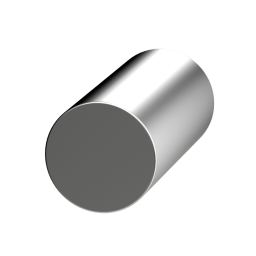
Angle
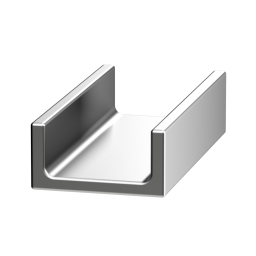
Channel
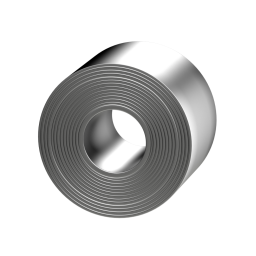
Coil
Disc
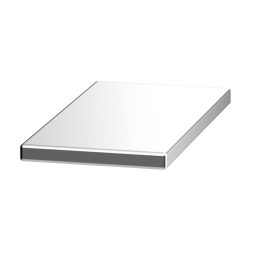
Flat Bar
Foil
Hexagon Bar
Hollow Bar
Pipe
Plate
Precision Ground Bar
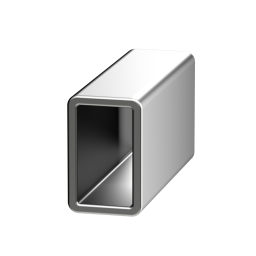
Rectangle Tube
Ring
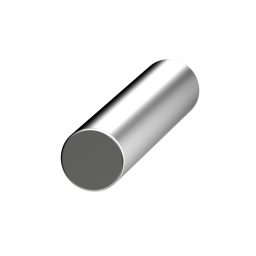
Rod
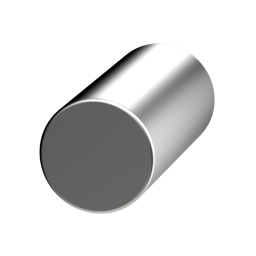
Round Bar
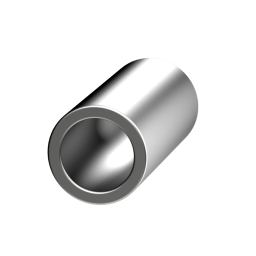
Round Tube
Sheet
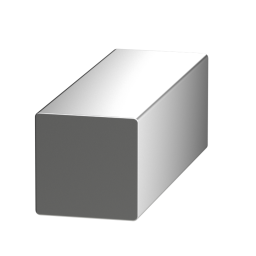
Square Bar
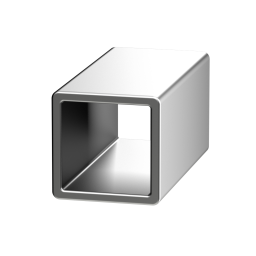
Square Tube
Standard Beam
Strip
Tee
Additional Data
Specifications
664,B366,B462,B463,B464,B468,B471,B473,B474,B475,B729,2.4660,N08020Chemical Elements
| Carbon | 0.07 max |
| Chromium | 19 - 21 |
| Copper | 3 - 4 |
| Iron | Balance |
| Manganese | 2 max |
| Molybdenum | 2 - 3 |
| Nickel | 32 - 38 |
| Phosphorus | 0.045 max |
| Silicon | 1 max |
| Sulphur | 0.035 max |
Physical Properties
Density: 0.292lb/in³
Electrical Resistivity: 651µΩ·cm
Poissons Ratio: 0.31
Specific Gravity: 8.055
Specific Heat: 0.12BTU/lb·°F
Mechanical Properties
Modulus of Elasticity – Tension: 28MSI
Relative Magnetic Permeability: 1.002μᵣ
Thermal Conductivity
| Condition | Temperature | Conductivity |
|---|---|---|
| Annealed | 120 °F | 8.46 BTU/hr·ft·°F |
Thermal Expansion
| Condition | Min | Max | Expansion Coefficient |
|---|---|---|---|
| Annealed | 70 °F | 212 °F | 8.16 μin/in·°F |
| Annealed | 70 °F | 390 °F | 8.37 μin/in·°F |
| Annealed | 70 °F | 842 °F | 8.83 μin/in·°F |
| Annealed | 70 °F | 1652 °F | 9.83 μin/in·°F |