
What Is Dual-Certified Stainless Steel?
September 21, 2026
Grant’s Field Journal
Mission: Decode what 304/304L and 316/316L really mean
Terrain: Stainless steel grades, chemistry and certifications
Difficulty: ★★★☆☆
Status: Two grades. One piece of metal.
You're looking for stainless steel and come across something that seems odd:
304/304L
Or maybe:
316/316L
Two grades listed for the same material.
Is it 304? Is it 304L? Is it somehow both?
Welcome to the world of dual-certified stainless steel.
Fortunately, this expedition is easier to navigate than it first appears.
First, What Does Dual Certified Mean?
Dual-certified stainless is material that meets the requirements for two closely related grades and is certified accordingly.
A common example is 304/304L. Another is 316/316L. Industry certification documents show stainless products identified with these paired designations.
The "L" is an important clue.
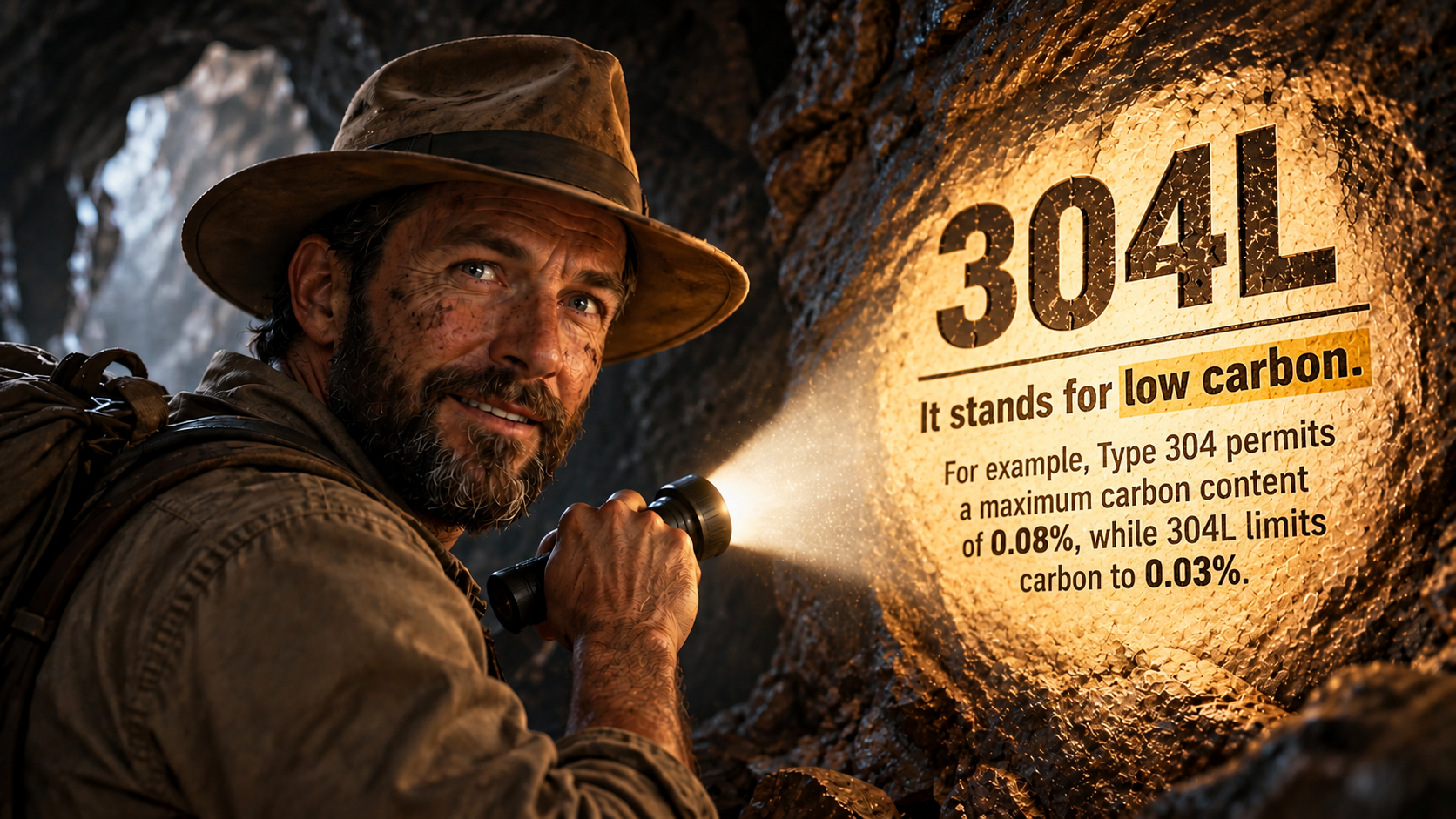
It stands for low carbon.
For example, Type 304 permits a maximum carbon content of 0.08%, while 304L limits carbon to 0.03%.
That difference may look small.
But in stainless steel, small differences in chemistry can matter.
Expedition Stop #1: Why Lower the Carbon?
Welding introduces heat.
And heat can create problems for certain stainless steels.
The lower carbon content of 304L helps minimize carbide precipitation during heat exposure such as welding, improving resistance to intergranular corrosion. That's one reason 304L is widely used in applications requiring good weldability, according to stainless mill Outokumpu.
So if low carbon has advantages, why not simply call everything 304L?
That's where the second half of the certification comes into play.
Expedition Stop #2: How Can One Piece Be Both?
Think of the requirements as overlapping territories on Grant's map.
A particular heat of stainless can have chemistry that satisfies the tighter carbon limit of the L grade, while also satisfying the applicable requirements necessary for certification to the standard grade.
When the material meets the requirements of both, the documentation may identify it as:
304/304L
or
316/316L
That's dual certification.
Grant's note: Two names don't mean you're getting two different metals. You're looking at material certified as meeting two grade requirements.
Expedition Stop #3: Why Does This Matter to a Buyer?
Flexibility.
Imagine one drawing calls for 304 and another calls for 304L.
Dual-certified inventory can potentially satisfy either requirement when the applicable specification and purchase requirements allow it.
That can simplify inventory and give buyers access to a broader pool of usable material rather than maintaining completely separate inventories for two closely related grades.
You'll see the pairing in the real supply chain, too. For example, Bureau Veritas certification documentation for Outokumpu identifies rolled products in 304/304L and 316/316L.
But there's an important word in all of this:
Certified.
Expedition Stop #4: Check the Paperwork
Don't assume that material is dual certified simply because the grades are closely related.
Check the material certification.
The documentation should establish the actual grade or grades to which the material has been certified and the applicable specification.
This becomes especially important when you're buying material for applications with strict engineering, customer, regulatory or traceability requirements.
304 and 304L are distinct grade designations. Outokumpu, for example, identifies 304 as UNS S30400 and 304L as UNS S30403.
Dual certification doesn't erase those distinctions.
It tells you that the particular material has been certified to meet both sets of applicable requirements.
Don't Confuse "Dual" With "Duplex"
Here's an easy wrong turn.
Dual-certified stainless steel and duplex stainless steel are NOT the same thing.
Dual certification refers to material being certified to two grade requirements.
Duplex describes a family of stainless steels with a microstructure containing both ferrite and austenite—typically in roughly equal proportions.
Two completely different trails.
Don't let the names send you in the wrong direction.
Grant's Checklist: Before You Buy
When you see a designation such as 304/304L or 316/316L, ask:
What grade does my drawing actually specify?
What specification must the material meet?
Is dual-certified material acceptable for the application?
Does the material certification show both grades?
Are there additional chemistry, mechanical-property or customer requirements?
Do I need complete traceability?
If you're unsure whether dual-certified material satisfies a drawing or specification, get approval from the appropriate engineering or technical authority before making a substitution.
The Explorer's Takeaway
Dual-certified stainless isn't two mysterious alloys combined into one.
It's much simpler:
One material. Two sets of grade requirements. Certified to both.
For buyers, that can mean greater sourcing flexibility.
But as with almost every specialty-metal expedition, the certification matters.
Don't stop at the label.
Follow the paperwork.
Because sometimes the difference between material you found and material you can actually use is what's written on the cert.
Looking for Dual-Certified Stainless?
Tell Grant what you're trying to find:
Grade. Specification. Form. Size. Quantity. Certification requirements.
Metals Suppliers Online can help explore the sourcing options when the usual search comes up empty.