Stainless
Stainless 304-L
Annealing Procedure
Solution annealing is performed by heating to 1850–2050°F (1010–1120°C), followed by rapid cooling (water quench or forced air). 1900°F (1040°C) minimum is commonly recommended to fully dissolve chromium carbides and restore maximum corrosion resistance. The work surface should be clean prior to annealing, and a protective atmosphere (vacuum, hydrogen, or inert gas) is recommended to prevent oxide scale formation. Post-weld annealing is not routinely required for 304L due to its low carbon content.
Applications
Type 304L is widely used in food processing equipment (including dairy, brewing, and beverage machinery), kitchen equipment and sinks, pharmaceutical and chemical processing vessels, pressure vessels and heat exchangers, architectural trim and molding, water filtration and petroleum refining systems, woven or welded screens for mining and quarrying, automotive and aerospace structural components, and fasteners (nuts, bolts, screws, washers). Its low carbon content makes it the preferred choice for heavy welded assemblies and for components exposed to corrosive environments after welding, such as tanks and piping systems.
Cold Workability
Type 304L has good cold workability. It can be cold rolled, cold drawn, and cold formed. Cold working significantly increases tensile and yield strength. Part of the austenitic structure may be transformed to martensite during cold working, which can introduce slight magnetic response. Intermediate annealing may be required for severe deformation to relieve work hardening.
Corrosion Resistance
Type 304L provides excellent corrosion resistance in a wide range of atmospheric, chemical, food, textile, and petroleum industry environments. Corrosion resistance is conferred by a self-healing chromium oxide passive film on the surface. The low carbon content makes 304L superior to standard 304 in resistance to intergranular (weld decay) corrosion, particularly in welded structures. However, 304L is susceptible to pitting and crevice corrosion in warm chloride environments, and to stress corrosion cracking at temperatures above approximately 140°F (60°C). It is generally considered resistant to pitting in water containing up to about 400 mg/L chlorides at ambient temperature. For chloride-heavy or marine environments, Type 316L (with molybdenum) is the preferred upgrade. Continuous service in the 800–1580°F (425–860°C) sensitization range is not recommended where subsequent aqueous corrosion resistance is important, though 304L is significantly more tolerant of this range than standard 304.
Formability
Type 304L exhibits excellent formability in the annealed condition. It can be readily drawn, spun, bent, and roll-formed into complex geometries. Like all austenitic stainless steels, 304L work-hardens significantly during cold working; intermediate annealing stages may be required for severe multi-step forming operations to relieve work hardening and prevent tearing or cracking. Higher-nickel variants can be specified to enhance deep drawing performance.
Heat Treatability
Type 304L cannot be hardened by heat treatment. As an austenitic stainless steel, it does not undergo a martensitic transformation upon cooling and therefore does not respond to conventional hardening heat treatments. Strength can only be increased by cold working.
Hot Workability
Type 304L can be hot worked (forged, rolled) in the temperature range of approximately 1700–2300°F (925–1260°C). Material should be reheated if the temperature drops below the lower limit during working. After hot working, solution annealing followed by rapid quenching is recommended to restore optimal corrosion resistance and mechanical properties.
Machinability
Type 304L has reasonable machinability, though its austenitic structure causes it to work-harden rapidly during machining. Best results are achieved by keeping cutting edges sharp at all times, using feeds and speeds that prevent rubbing or riding on the workpiece surface, taking cuts deep enough to get below the work-hardened layer, employing chip breakers to manage swarf, and using copious amounts of cutting fluid to manage heat at the cutting edge (low thermal conductivity concentrates heat at the tool tip). Slower cutting speeds and higher feed rates are generally recommended compared to carbon steels.
Other Comments
Type 304L (UNS S30403) is frequently dual certified as 304/304L, meaning the heat meets the 304L maximum carbon limit (≤ 0.030%) while also satisfying the 304 minimum mechanical strength requirements. This dual certification is achieved in practice through controlled nitrogen additions, which strengthen the steel without raising carbon. 304L is also known by the European designation EN 1.4307. It is the most widely used stainless steel in the world and the standard choice for welded fabrications where post-weld corrosion resistance must be maintained.
Other Physical Properties
Type 304L is non-magnetic in the annealed condition (magnetic permeability approximately 1.02 max at H=200 Oersteds) but may become slightly magnetic as a result of cold working due to partial transformation of austenite to martensite. Poisson's Ratio: 0.30. Modulus of elasticity in torsion: approximately 11.2 × 10³ ksi (77 GPa). Electrical resistivity at elevated temperatures: approximately 78 µΩ·cm at 212°F, 86 µΩ·cm at 392°F, 100 µΩ·cm at 752°F.
Principle Design Features
Type 304L is the low-carbon variant (C ≤ 0.030%) of the standard Type 304 austenitic stainless steel. Its defining feature is resistance to sensitization — the precipitation of chromium carbides along grain boundaries — which can occur in Type 304 when heated in the range of 800–1500°F (425–820°C). The reduced carbon content effectively eliminates this risk, preserving corrosion resistance in and around weld heat-affected zones without requiring post-weld annealing. The austenitic microstructure provides excellent ductility, toughness, and non-magnetic properties in the annealed condition. Through controlled nitrogen additions, 304L commonly meets or exceeds the mechanical strength requirements of standard Type 304, enabling widespread dual certification as 304/304L.
Weldability
Type 304L has excellent weldability by all standard fusion methods including TIG (GTAW), MIG (GMAW), MMA (SMAW), SAW, and resistance welding (RSW). Gas welding is not recommended. Post-weld heat treatment (annealing) is generally not required due to the low carbon content, which prevents sensitization in the weld heat-affected zone. For heavy sections where there is an elevated risk of stress corrosion cracking or fatigue, stress relief treatment may still be considered. The recommended filler metal for welding 304L is ER308L (or E308L electrode). Fabrication tools must be dedicated to stainless steel and thoroughly cleaned prior to use to prevent cross-contamination.
Known Forms
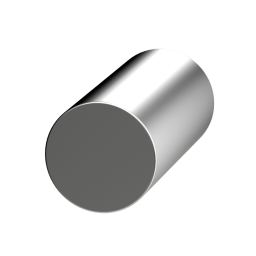
Angle
Bolt
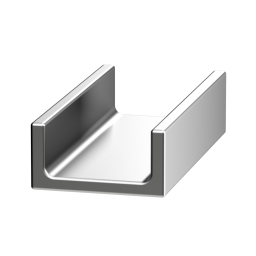
Channel
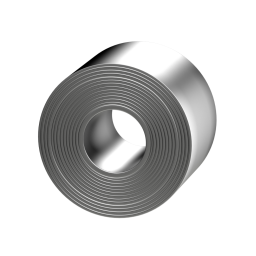
Coil
Disc
Expanded Sheet
Fitting
Flange
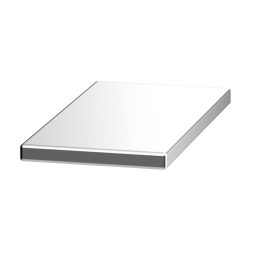
Flat Bar
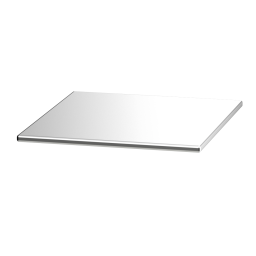
Foil
Grating
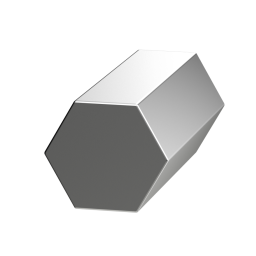
Hexagon Bar
Hollow Bar
Nut
Perforated Sheet
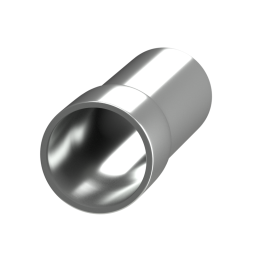
Pipe
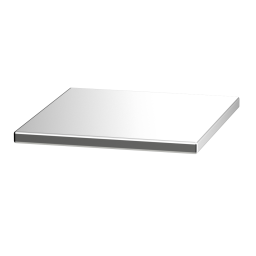
Plate
Powder
Precision Ground Bar
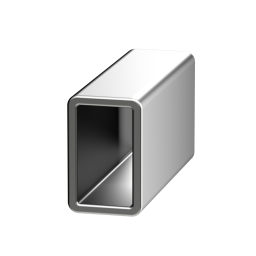
Rectangle Tube
Ring
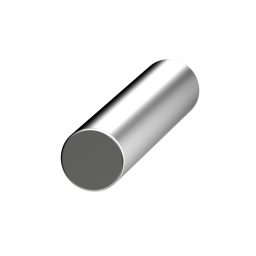
Rod
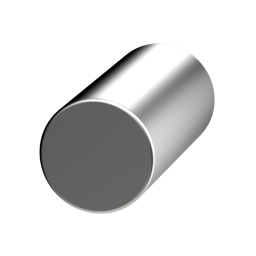
Round Bar
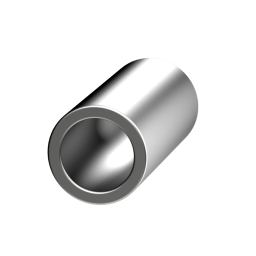
Round Tube
Screw
Sheet
Specialty Form
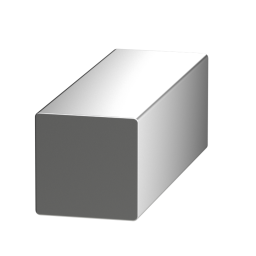
Square Bar
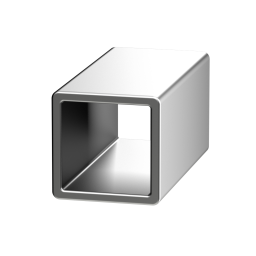
Square Tube
Standard Beam
Strip
Tee
Threaded Rod
Treadplate
Valve
Washer
Wide Beam
Wire Flat
Wire Round
Wire Square
Additional Data
Specifications
5511,5513,A240,A276,A312,A479,A580,A666,S30403,SA-240,SA-312,SA-479,SA-276,5647,QQ-S-763Chemical Elements
| Carbon | 0.03 max |
| Chromium | 18 - 20 |
| Iron | Balance |
| Manganese | 2 max |
| Nickel | 8 - 12 |
| Nitrogen | 0.1 max |
| Phosphorus | 0.045 max |
| Silicon | 0.75 max |
| Sulfur | 0.03 max |
Physical Properties
Density: 0.285lb/in³
Electrical Resistivity: 72µΩ·cm
Melting Point: 2550°F
Modulus of Elasticity: 28MSI
Specific Heat: 0.12BTU/lb·°F
Mechanical Properties
Poisson's Ratio: 0.3
Thermal Conductivity
| Condition | Temperature | Conductivity |
|---|---|---|
| Annealed | 212 °F | 9.4 BTU/hr·ft·°F |
| Annealed | 932 °F | 12.4 BTU/hr·ft·°F |
Thermal Expansion
| Condition | Min | Max | Expansion Coefficient |
|---|---|---|---|
| Annealed | 32 °F | 212 °F | 9.4 μin/in·°F |
| Annealed | 32 °F | 600 °F | 9.6 μin/in·°F |
| Annealed | 32 °F | 1000 °F | 10.2 μin/in·°F |
| Annealed | 32 °F | 1200 °F | 10.4 μin/in·°F |
Mechanical Test Data
| Form | Plate |
| Condition | Annealed |
| Temperature | 70°F |
| Brinell Hardness | 201 HB |
| Elongation | 40% |
| Rockwell Hardness | B92 |
| Tensile Strength | 70 KSI |
| Yield Strength | 25 KSI |
| Form | Sheet |
| Condition | Annealed |
| Temperature | 70°F |
| Brinell Hardness | 201 HB |
| Elongation | 40% |
| Rockwell Hardness | B92 |
| Tensile Strength | 70 KSI |
| Yield Strength | 25 KSI |
| Form | Strip |
| Condition | Annealed |
| Temperature | 70°F |
| Brinell Hardness | 201 HB |
| Elongation | 40% |
| Rockwell Hardness | B92 |
| Tensile Strength | 70 KSI |
| Yield Strength | 25 KSI |
| Form | Coil |
| Condition | Annealed |
| Temperature | 70°F |
| Elongation | 55% |
| Rockwell Hardness | B80 |
| Tensile Strength | 85 KSI |
| Yield Strength | 35 KSI |