Aluminum
Aluminum 2017
Aging Procedure
This alloy ages normally at room temperature to produce optimum mechanical properties.
Annealing Procedure
Annealing is done at 775 F for 3 hours and then controlled cooling at 50 F per hour down to 500 F. From that point it may be air cooled.
Applications
Commonly used in the manufacture of screw machine products and fittings, pulleys, gauges, coat hangers, and in crochet and knitting needles.
Cold Workability
Cold working, such as shaping, bending, etc., may readily be accomplished by conventional means. Ease of cold working is best with the alloy in the T4 temper.
Forgeability
No data.
Formability
Formability is very good, especially in the annealed state ("O" temper). The alloy may also be readily formed when in the T4 temper, but not as easily as for the "O" temper.
Hardening Procedure
This alloy is age hardenable and that occurs naturally at room temperature. See also "Aging".
Heat Treatability
The alloy may be solution annealed at 940 F for 3 to 4 hours followed by water quench. Age hardening then occurs at room temperature and this produces the T4 temper. The "O" temper results from a 775 F treatment for 3 hours, controlled cooling at 50 F per hour down to 500 F, then air cool.
Hot Workability
No data.
Machinability
Machinability is very good for this alloy in the T4 temper. In the annealed condition machinability is less good. Thus it is best to perform machining with the alloy in the T4 condition. Use of oil lubricants is recommended for all machining operations.
Other Mechanical Properties
Shear strength in annealed condition is 18 ksi and in T4 condition it is 38 ksi.
Other Physical Properties
Electrical conductivity 32% of copper.
Principle Design Features
This is a heat treatable (age-hardening) alloy of intermediate strength and good ductility.
Tempering Procedure
Not applicable.
Weldability
The alloy may be welded, however welding heat will reduce corrosion resistance. In general welding should be avoided unless heat treatment after welding is possible to restore corrosion resistance. Inert gas welding and resistance welding are the methods that should be used and the alloy is sensitive to cracking so fixturing needs to be such as to reduce any strain during welding.
Known Forms
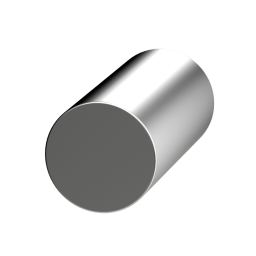
Angle
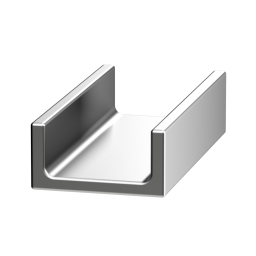
Channel
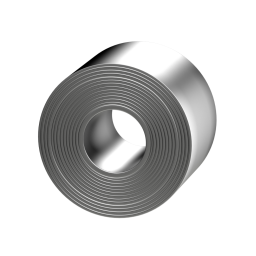
Coil
Disc
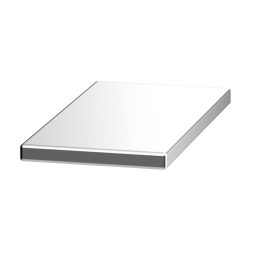
Flat Bar
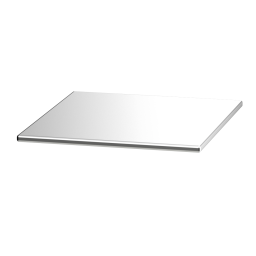
Foil
Hollow Bar
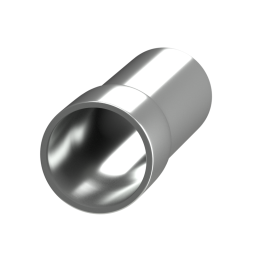
Pipe
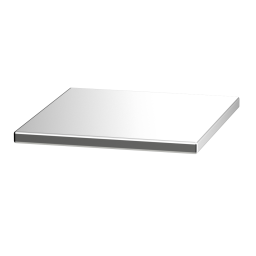
Plate

Rectangle Tube
Ring
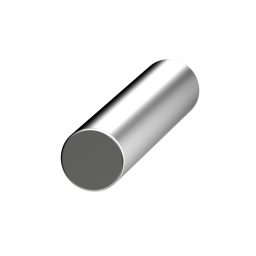
Rod
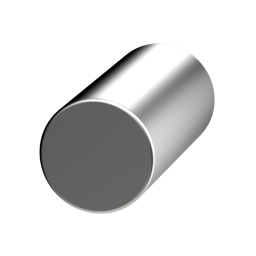
Round Bar
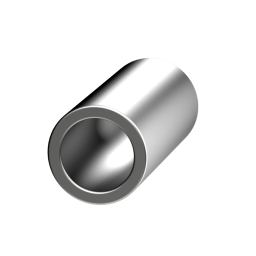
Round Tube
Sheet
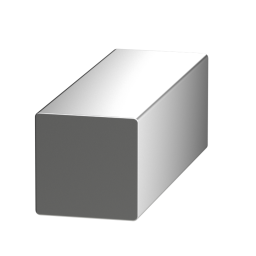
Square Bar
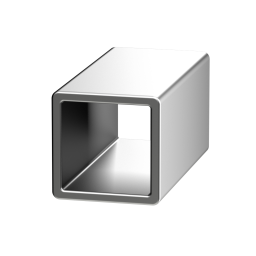
Square Tube
Strip
Tee
Additional Data
Specifications
4118,B211,B216,B316,A-225/5,A-430,J454,A92017Chemical Elements
| Aluminum | Balance |
| Chromium | 0.1 max |
| Copper | 3.5 - 4.5 |
| Iron | 0.7 max |
| Magnesium | 0.4 - 0.8 |
| Manganese | 0.4 - 1 |
| Remainder Each | 0.05 max |
| Remainder Total | 0.15 max |
| Silicon | 0.8 max |
| Titanium + Zinc | 0.2 max |
| Zinc | 0.25 max |
Physical Properties
Density: 0.101lb/in³
Melting Point: 960°F
Specific Gravity: 2.79
Mechanical Properties
Modulus of Elasticity – Tension: 10.5MSI
Modulus of Elasticity – Torsion: 4MSI
Thermal Conductivity
| Condition | Temperature | Conductivity |
|---|---|---|
| T4 | 77 °F | 93 BTU/hr·ft·°F |