Aluminum
Aluminum 2195-T8
Aging Procedure
For the T8 temper, artificial aging is performed after solution heat treatment and controlled cold work/stretching. Typical aging temperatures are in the range of 250–330°F (121–166°C) for durations of several hours depending on the required property balance. The NASA TTP (time-temperature-precipitation) study used an initial solution treatment at 950°F followed by 3% stretch and aging treatments up to 100 hours at temperatures between 200–1000°F.
Applications
2195-T8 is primarily used in aerospace structural applications requiring high strength-to-weight ratio and cryogenic performance. Key applications include cryogenic propellant tanks (e.g., NASA Space Shuttle Super Lightweight External Tank and Space Launch System cryogenic tank domes), aerospace structural panels, and other weight-critical aerospace structures. It has also been evaluated for military armor plate applications.
Corrosion Resistance
2195 aluminum has relatively poor general corrosion resistance typical of high-strength 2xxx-series alloys. Being highly alloyed with copper and lithium, it tends toward lower corrosion resistance. Protective coatings, anodizing, or cladding are recommended for service in corrosive environments. The alloy is susceptible to stress corrosion cracking (SCC) and intergranular corrosion if not properly heat treated.
Formability
Formability of 2195 in the T8 temper is limited due to its high strength. In the annealed (O) or solution heat-treated condition, formability is significantly improved. NASA has developed special anneal procedures to increase the forming range for stretch forming of large rocket dome gores. Cold working by conventional methods is possible; optimum strength is subsequently achieved through aging heat treatment.
Heat Treatability
2195 is a heat-treatable alloy. The T8 temper is achieved by solution heat treatment, quenching, controlled cold work (stretching typically 2–6%), and artificial aging. The alloy responds strongly to artificial aging due to the precipitation of T1 (Al2CuLi) and Ω phases. Pre-deformation prior to aging significantly increases the density of T1 precipitates and improves strength.
Machinability
2195 aluminum alloy sheet and plate have good machinability. Both high-speed tool steel and carbide tooling can be used. As a wrought 2xxx-series alloy in the T8 temper, it machines comparably to other high-strength 2xxx alloys such as 2024 and 2219.
Other Comments
2195 received its Aluminum Association standard designation in 1992. It is produced primarily in plate and sheet form by specialty aerospace aluminum producers (historically Alcan/Constellium). The alloy exhibits excellent cryogenic fracture toughness, with strength and elongation generally maintained or slightly improved at liquid nitrogen (−320°F) and liquid hydrogen (−423°F) temperatures, making it uniquely suited for cryogenic pressure vessel applications.
Other Physical Properties
2195-T8 has a density of approximately 0.096 lb/in³ (2.65 g/cm³), which is notably lower than most 2xxx-series alloys (typically 0.100–0.103 lb/in³) due to the lithium content. The elastic modulus is approximately 11.0 MSI, higher than standard aluminum alloys (~10.0–10.5 MSI), also attributable to the lithium addition. UNS designation is A92195; European designation is EN AW-2195.
Principle Design Features
AA 2195 is a third-generation aluminum-lithium (Al-Li) alloy of the Weldalite family, belonging to the 2000-series (Al-Cu base). The addition of lithium reduces alloy density by approximately 3% per 1 wt% Li added and increases the elastic modulus by approximately 6% per 1 wt% Li. Silver additions promote the precipitation of the Omega (Ω) phase, enhancing strength. The T8 temper (solution heat treat + cold work/stretch + artificial age) promotes fine T1 (Al2CuLi) and Ω phase precipitation, yielding very high strength with acceptable ductility. The alloy exhibits superior strength compared to 2219-T87 (approximately 30% stronger) with 5% lower density.
Weldability
2195 can be welded, with friction stir welding (FSW) being the preferred joining method and has been successfully applied in NASA Space Shuttle and SLS tank manufacturing. Variable polarity plasma arc (VPPA) welding has also been used. Conventional fusion welding methods result in significant strength reduction in the heat-affected zone and weld nugget. Post-weld heat treatment can partially restore properties.
Known Forms
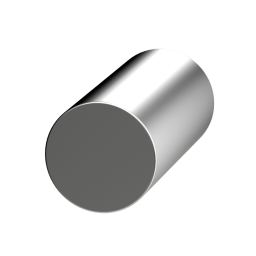
Billet
Ingot
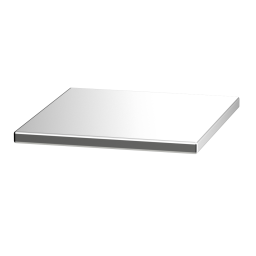
Plate
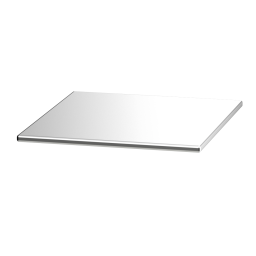
Sheet
Additional Data
Specifications
A92195,4472,4474Chemical Elements
| Aluminum | Balance |
| Copper | 3.7 - 4.3 |
| Iron | 0.15 max |
| Lithium | 0.8 - 1.2 |
| Magnesium | 0.25 - 0.8 |
| Manganese | 0.1 max |
| Silicon | 0.12 max |
| Silver | 0.25 - 0.6 |
| Titanium | 0.1 max |
| Zinc | 0.25 max |
| Zirconium | 0.04 - 0.18 |
Physical Properties
Density: 0.096lb/in³
Melting Point: 1020°F
Modulus of Elasticity: 11MSI
Specific Heat: 0.195BTU/lb·°F
Thermal Conductivity
| Condition | Temperature | Conductivity |
|---|---|---|
| T8 | 68 °F | 85 BTU/hr·ft·°F |
Thermal Expansion
| Condition | Min | Max | Expansion Coefficient |
|---|---|---|---|
| T8 | 68 °F | 212 °F | 12.9 μin/in·°F |
Mechanical Test Data
| Form | Plate |
| Condition | T8 |
| Temperature | 70°F |
| Elongation | 8% |
| Tensile Strength | 80 KSI |
| Yield Strength | 74 KSI |
| Form | Sheet |
| Condition | T8 |
| Temperature | 70°F |
| Elongation | 8% |
| Tensile Strength | 80 KSI |
| Yield Strength | 74 KSI |