Aluminum
Aluminum 2224
Applications
Alloy 2224 is primarily used in aerospace structural applications requiring high strength-to-weight ratio and good damage tolerance. It has been used to manufacture extruded structural parts for Boeing 757 and 767 aircraft. Other applications include aerospace engineering components, automotive structural parts, and defense systems where lightweight high-strength extruded sections are required.
Corrosion Resistance
Corrosion resistance is moderate for a 2xxx-series alloy. Like 2024, the high copper content makes 2224 susceptible to pitting and intergranular corrosion in aggressive environments. Protective surface treatments such as anodizing, cladding (Alclad), or chromate conversion coatings are commonly applied in aerospace use. The alloy is not recommended for sustained exposure to marine or high-chloride environments without protection. Stress corrosion cracking can occur under sustained tensile stresses in corrosive media.
Heat Treatability
Alloy 2224 is heat treatable via solution heat treatment, quenching, and artificial or natural aging. The T3511 temper involves solution heat treatment, cold working (stretching for stress relief), followed by natural aging. The alloy can develop high strength through precipitation hardening. Solution treatment is typically performed in the range of 490–500°C (915–930°F), followed by rapid water quenching.
Machinability
Alloy 2224 offers good machinability, comparable to 2024. It machines well using high-speed steel or carbide tooling with appropriate speeds and feeds. The T3511 temper is particularly suited for parts requiring precision machining, and the stress-relieved condition reduces distortion during machining operations.
Other Physical Properties
2224 shares closely similar physical properties to 2024 and 2124 due to its nearly identical base composition with only tighter impurity controls. Modulus of elasticity is approximately 10.6 MSI (73 GPa), consistent across all 2024-family derivatives regardless of temper. Density is approximately 0.102 lb/in³ (2.83 g/cm³). The alloy has a solidus of approximately 935°F (502°C) and liquidus of approximately 1180°F (638°C).
Principle Design Features
Aluminum 2224 is a heat-treatable, high-purity wrought alloy in the 2xxx (Al-Cu) series, developed as a higher-purity derivative of 2024 through tighter control of Fe and Si impurity levels. This reduction in Fe and Si minimizes the formation of brittle intermetallic particles, resulting in improved fracture toughness and fatigue crack growth resistance compared to 2024. It is primarily produced in the T3511 temper as extruded products. Its UNS designation is A92224.
Weldability
Fusion welding of 2224 is generally not recommended for structural applications due to hot-cracking susceptibility and significant loss of strength in the heat-affected zone (HAZ). When welding is required, TIG or MIG processes with compatible Al-Cu filler alloys (such as 2319) may be used with appropriate pre- and post-weld procedures. Post-weld heat treatment cannot fully restore original peak-aged properties in the welded zone.
Known Forms
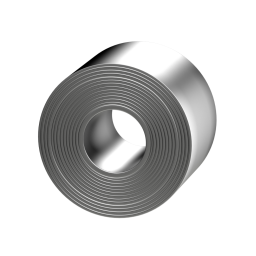
Coil
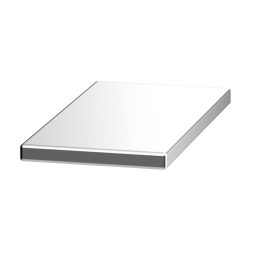
Flat Bar
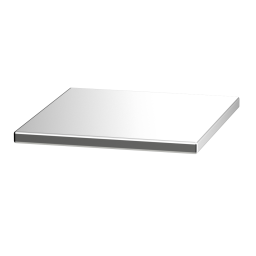
Plate
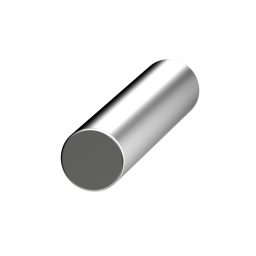
Rod
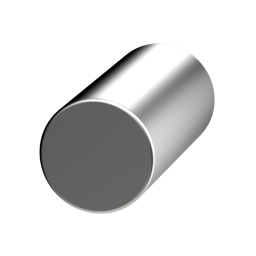
Round Bar
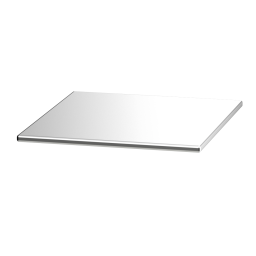
Sheet
Additional Data
Specifications
B221,A92224Chemical Elements
| Aluminum | Balance |
| Chromium | Max per Aluminum Association Teal Sheet for 2224 |
| Copper | Primary strengthening element; range per Aluminum Association Teal Sheet for 2224 |
| Iron | Max per Aluminum Association Teal Sheet for 2224; reduced vs 2024 for improved toughness |
| Magnesium | Per Aluminum Association Teal Sheet for 2224 |
| Manganese | Per Aluminum Association Teal Sheet for 2224 |
| Other Elements Each | Max each, per Aluminum Association Teal Sheet |
| Other Elements Total | Max total others, per Aluminum Association Teal Sheet |
| Silicon | Max per Aluminum Association Teal Sheet for 2224 |
| Titanium | Max per Aluminum Association Teal Sheet for 2224 |
| Zinc | Max per Aluminum Association Teal Sheet for 2224 |
Physical Properties
Density: 0.102lb/in³
Melting Point: 935°F
Modulus of Elasticity: 10.6MSI
Specific Heat: 0.215BTU/lb·°F
Thermal Conductivity
| Condition | Temperature | Conductivity |
|---|---|---|
| T3511 | 68 °F | 84 BTU/hr·ft·°F |
Thermal Expansion
| Condition | Min | Max | Expansion Coefficient |
|---|---|---|---|
| T3511 | 68 °F | 212 °F | 12.6 μin/in·°F |
Mechanical Test Data
| Form | Rod |
| Condition | T3511 |
| Temperature | 70°F |
| Elongation | 16% |
| Tensile Strength | 77 KSI |
| Yield Strength | 58 KSI |
| Form | Round Bar |
| Condition | T3511 |
| Temperature | 70°F |
| Elongation | 16% |
| Tensile Strength | 77 KSI |
| Yield Strength | 58 KSI |