Aluminum
Aluminum 2324
Applications
Alloy 2324-T39 plate is used in tension-dominated, fatigue and fracture-critical aerospace structural applications. Primary applications include lower wing skin panels and center wing box components of commercial transport aircraft. It should be considered as a replacement for 2024-T351 where higher strength, toughness, and good resistance to fatigue crack propagation are required.
Corrosion Resistance
Like other 2xxx-series Al-Cu alloys, alloy 2324 has limited general corrosion resistance due to copper-containing precipitates that promote localized corrosion initiation. The alloy is susceptible to pitting, intergranular corrosion, and stress corrosion cracking in chloride-bearing or humid environments. Protective cladding with commercially pure aluminum (alclad) or chromate conversion coatings are commonly applied in aerospace practice. The alloy is not recommended for unprotected marine service.
Formability
Formability is best in the annealed (O) temper. In the T39 temper, ductility is reduced and the material is not recommended for significant cold forming operations. Forming should be performed prior to final age hardening where possible. Minimum bend radii must be observed conservatively in aged tempers.
Heat Treatability
Alloy 2324 is a heat-treatable alloy in the 2xxx series. It develops strength through solution heat treatment, quenching, and age hardening (precipitation hardening). The T39 temper is produced by solution heat treatment, controlled cold work of approximately 9%, followed by artificial aging. This special temper simultaneously improves both strength and fracture toughness compared to conventional 2024-T351 plate.
Machinability
Alloy 2324 exhibits good machinability, consistent with other 2xxx-series Al-Cu alloys. Chips tend to be continuous and ductile. Rigid tooling setups and coolant use improve surface finish and dimensional control. Machinability is generally good for wrought plate product forms used in aerospace machining.
Other Comments
Alloy 2324-T39 was developed by Alcoa and is documented in ASM Alloy Digest filing code AL-373 (October 2000). The UNS designation is A92324. The alloy is commercially available primarily as plate. Compared to 2024-T351, 2324-T39 shows significantly higher strength and fracture toughness; however, notched fatigue strengths of both alloys are comparable, and caution is warranted when substituting 2324-T39 for 2024-T351 in all fatigue-critical areas, particularly under flight simulation loading spectra.
Principle Design Features
Alloy 2324 is a purity-controlled, higher-strength variant of alloy 2024. It features tightly restricted Fe and Si impurity levels (max 0.12% and 0.10% respectively vs. 0.50% each in 2024), which reduce the volume fraction of insoluble constituent particles and improve fracture toughness and fatigue crack propagation resistance. The T39 temper is developed through special fabricating practices involving approximately 9% cold work after solution heat treatment and quenching, significantly more than the 1–3% applied in 2024-T351 plate, resulting in improved strength and toughness simultaneously.
Weldability
Alloy 2324 is not recommended for conventional fusion welding. The high copper content creates susceptibility to solidification hot cracking and heat-affected zone softening. Friction stir welding may be used where joining is necessary. Post-weld heat treatment cannot fully restore original peak-aged properties in welded zones.
Known Forms
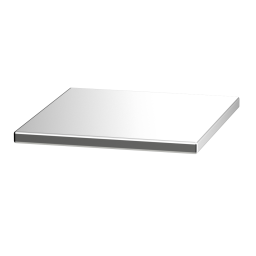
Plate
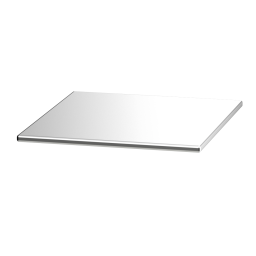
Sheet
Additional Data
Specifications
B209,A92324Chemical Elements
| Aluminum | Balance |
| Chromium | 0.1 max |
| Copper | Primary alloying element; slightly tighter range than 2024 (3.8–4.9) |
| Iron | Tightly controlled max vs. 2024 (0.50 max) to reduce insoluble constituent particles |
| Magnesium | 1.2 - 1.8 |
| Manganese | 0.3 - 0.9 |
| Other Elements Each | 0.05 max |
| Other Elements Total | 0.15 max |
| Silicon | Tightly controlled max vs. 2024 (0.50 max) to reduce insoluble constituent particles and improve fra |
| Titanium | 0.15 max |
| Zinc | 0.25 max |
Physical Properties
Density: 0.101lb/in³
Melting Point: 935°F
Modulus of Elasticity: 10.5MSI
Specific Heat: 0.209BTU/lb·°F
Mechanical Properties
Thermal Expansion: 12.9µin/in·°F
Thermal Expansion
| Condition | Min | Max | Expansion Coefficient |
|---|---|---|---|
| T3 | 68 °F | 212 °F | 12.9 μin/in·°F |
Mechanical Test Data
| Form | Plate |
| Condition | T3 |
| Temperature | 70°F |
| Elongation | 8% |
| Tensile Strength | 68.9 KSI |
| Yield Strength | 53.7 KSI |