Aluminum
Aluminum 2618
Aging Procedure
The aging heat treatment (T 61) is accomplished by first solutioning at 980 F for up to 24 hours (depending on section size) followed by quench in boiling water and then aging at 390 F for up to 20 hours (minimum of 5 hours again dependent upon section size) and air cooled.
Annealing Procedure
Annealing, which may be required as a result of cold work, may be done at 725 F for 4 hours followed by slow cooling (typically furnace cooling).
Applications
Commonly used in the manufacture of aircraft engines.
Cold Workability
The alloy has good formability and is readily cold worked in either the solution heat treated or annealed condition.
Forgeability
Hot forging is done in the range of 970 down to 700 F, starting with the material preheated to 970 F.
Formability
Formability, both hot and cold, is good.
Hardening Procedure
Hardens by cold working and aging heat treatment for T 61 condition. See "Aging".
Heat Treatability
Solution heat treatment is done at 985 F for a period of time that will permit thorough heating and solutioning. This may be as long as 24 hours for heavy sections. A water quench follows this heating. Annealing and age hardening heat treatments are also possible - see "Annealing" and "Aging".
Hot Workability
This alloy may readily be hot worked in the temperature range of 660 to 700 F.
Machinability
AL 2618 has excellent machining characteristics. The heat treated (aged) condition will allow machining to a smoother finish than is the case for annealed or water quenched conditions.
Other Mechanical Properties
Shear strength for the T 61 (aged) material is 40 ksi.
Other Physical Properties
Electrical conductivity 36% of copper.
Principle Design Features
This alloy containing copper and magnesium is age hardenable for good strength in applications that involve exposure to heat up to 575 F.
Tempering Procedure
Not applicable to this alloy.
Weldability
Resistance welding may be done satisfactorily. The amount of heat input by other welding means may be harmful to this alloy and thus conventional fusion welding methods should NOT be used.
Known Forms
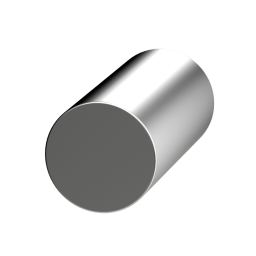
Angle
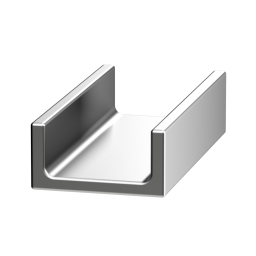
Channel
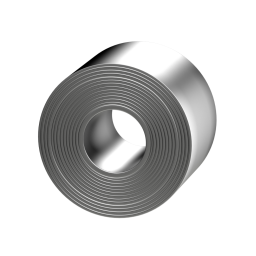
Coil
Disc
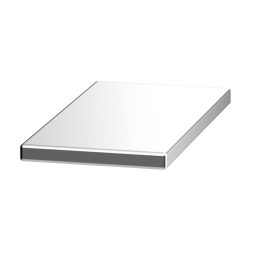
Flat Bar

Foil
Hollow Bar
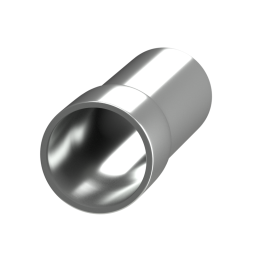
Pipe
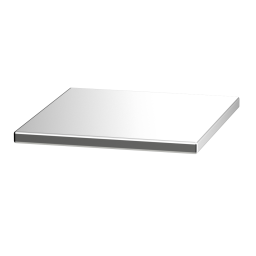
Plate

Rectangle Tube
Ring
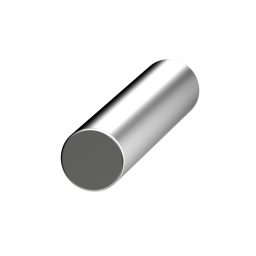
Rod
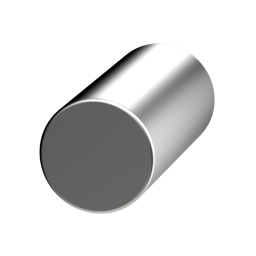
Round Bar
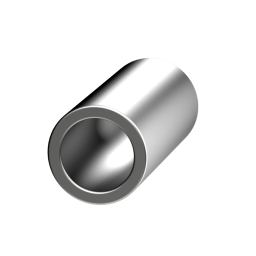
Round Tube
Sheet
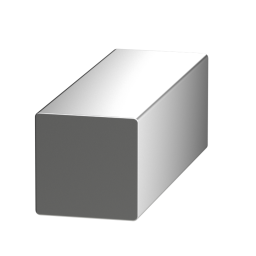
Square Bar
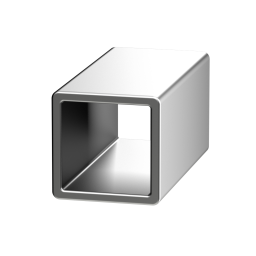
Square Tube
Strip
Tee
Additional Data
Specifications
3.1924Chemical Elements
| Aluminum | Balance |
| Copper | 1.9 - 2.7 |
| Iron | 0.9 - 1.3 |
| Magnesium | 1.3 - 1.8 |
| Nickel | 0.9 - 1.2 |
| Remainder Each | 0.05 max |
| Remainder Total | 0.15 max |
| Silicon | 0.25 max |
| Titanium | 0.04 - 0.1 |
Physical Properties
Density: 0.1lb/in³
Melting Point: 950°F
Poissons Ratio: 0.35
Specific Gravity: 2.76
Mechanical Properties
Modulus of Elasticity – Tension: 10.4MSI
Modulus of Elasticity – Torsion: 4.2MSI