Aluminum
Aluminum 5056
Annealing Procedure
To produce the fully annealed O temper, heat to approximately 650°F (343°C), hold for sufficient time for thorough soaking, then cool at any rate. This treatment relieves all cold work and returns the alloy to its softest, most ductile condition.
Applications
Aluminum 5056 is commonly used in the manufacture of cable sheathing, screen wire, zippers, and rivets for magnesium structures. Its high strength, excellent formability, and outstanding corrosion resistance make it the preferred alloy for cold-headed fasteners including solid, semi-tubular, and tubular rivets; Phillips head screws; bolts; and threaded rods. It is also used extensively for wire forms and hinge pins. Additional applications include marine hardware, offshore structural components, chemical processing equipment, and aerospace rivet stock.
Cold Workability
Cold working is the primary strengthening mechanism for 5056. The alloy is extensively used in cold heading applications to produce rivets, screws, bolts, and other fasteners. It is also drawn into wire forms and hinge pins. The H32 temper is the most common cold-heading temper. Cold reduction significantly increases tensile and yield strength while reducing elongation.
Corrosion Resistance
5056 offers excellent corrosion resistance, particularly in marine and saltwater environments, due to its high magnesium content. The alloy resists general atmospheric corrosion, chloride-induced corrosion, and performs reliably in seawater service. Stabilized tempers (e.g., H38) should be specified where susceptibility to stress corrosion cracking (SCC) or exfoliation is a concern. The alloy is not recommended for continuous elevated-temperature service above approximately 150°C (300°F) without evaluating potential sensitization effects.
Formability
Formability is rated B (good) in annealed and low-temper conditions. In the O and H111 tempers, the alloy is excellent for deep drawing, severe bending, cold heading, spinning, and stretch forming. Higher tempers (H32 and above) exhibit reduced formability. The alloy's high work-hardening rate means intermediate anneals may be required for complex multistage forming operations. Minimum bend radius in the O temper approaches 0× thickness.
Heat Treatability
5056 is a non-heat-treatable alloy. Classical solution treatment followed by artificial aging does not produce precipitation strengthening, as it does in 6xxx or 7xxx alloys. Solution treatment at approximately 530°C improves ductility and homogenizes magnesium distribution but does not significantly increase strength. Annealing (O temper) is used to restore full ductility and relieve cold work. Stabilization treatments (low-temperature thermal exposure) may be applied to improve resistance to exfoliation and SCC in strain-hardened material.
Machinability
Machinability of 5056 is rated D (poor) relative to 2011-T3. The high magnesium content promotes continuous chip formation, which can cause entanglement and surface damage. Carbide or coated tooling with moderate cutting speeds, controlled feed rates, and ample coolant is recommended. Chip breakers should be employed in sustained production operations.
Other Physical Properties
Electrical conductivity is approximately 29–34% IACS. The alloy is non-magnetic. Shear modulus is approximately 3.7 MSI (25 GPa). Latent heat of fusion is approximately 400 J/g. Maximum recommended continuous service temperature for structural use is approximately 300°F (150°C).
Principle Design Features
Aluminum 5056 is a non-heat-treatable Al-Mg alloy whose strength is derived entirely from solid-solution strengthening by magnesium and from cold work (strain hardening). It cannot be strengthened by precipitation hardening. Strength levels are controlled by temper designation (O, H32, H34, H18, H38, etc.), with higher H-temper numbers corresponding to greater cold reduction and higher strength at the expense of ductility. The alloy exhibits a high work-hardening rate relative to other 5xxx alloys, making it well suited for cold heading operations.
Weldability
5056 is well suited for fusion welding by TIG (GTAW) and MIG (GMAW) processes. Recommended filler alloys are from the Al-Mg family (e.g., 5356) to maintain corrosion resistance and minimize hot cracking risk. The heat-affected zone (HAZ) will soften if the base metal is in a strain-hardened temper. For critical weldments requiring corrosion resistance, stabilized tempers or post-weld mechanical treatment should be considered. Resistance welding capability is rated very good.
Known Forms
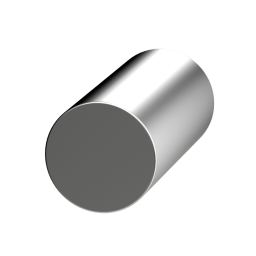
Angle
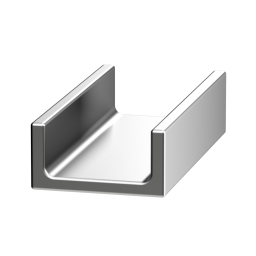
Channel
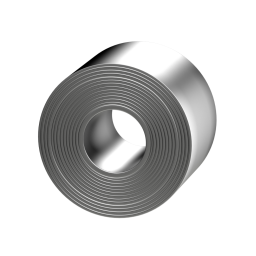
Coil
Disc
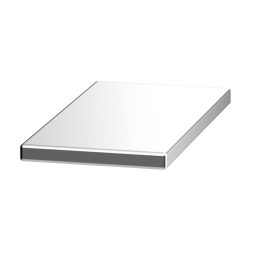
Flat Bar
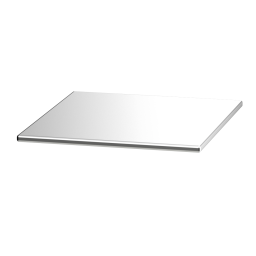
Foil
Hollow Bar
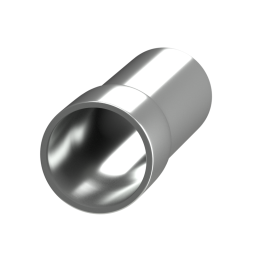
Pipe
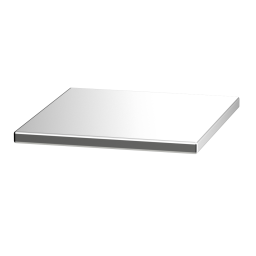
Plate
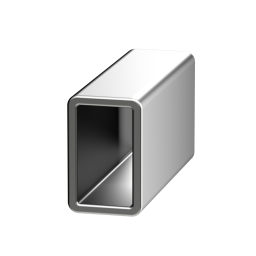
Rectangle Tube
Ring
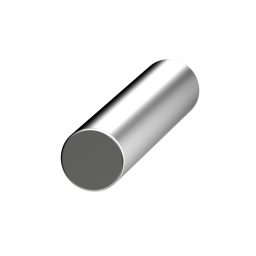
Rod
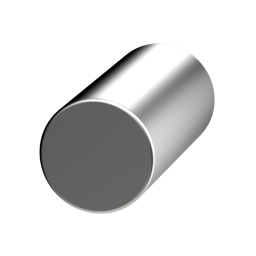
Round Bar
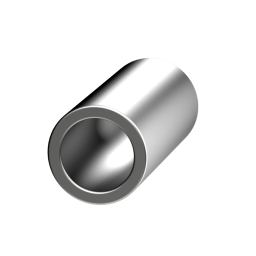
Round Tube
Sheet
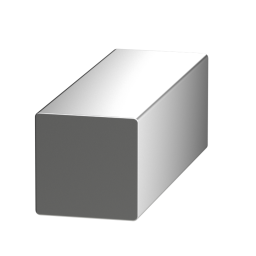
Square Bar
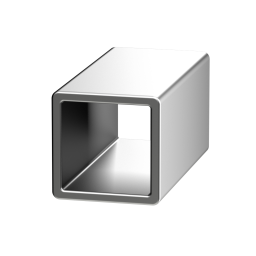
Square Tube
Strip
Tee
Wire Round
Additional Data
Specifications
4005,4176,4177,4182,4349,B211,B316,3.3555,A-81596,R-5674,R-8814,A-430,J454,A95056Chemical Elements
| Aluminum | Balance |
| Chromium | 0.05 - 0.2 |
| Copper | 0.1 max |
| Iron | 0.4 max |
| Magnesium | 4.5 - 5.6 |
| Manganese | 0.05 - 0.2 |
| Remainder Each | 0.05 max |
| Remainder Total | 0.15 max |
| Silicon | 0.3 max |
| Zinc | 0.1 max |
Physical Properties
Density: 0.095lb/in³
Electrical Resistivity: 5.5µΩ·cm
Melting Point: 1050°F
Modulus of Elasticity: 9.8MSI
Specific Gravity: 2.64
Specific Heat: 0.22BTU/lb·°F
Mechanical Properties
Poisson's Ratio: 0.33
Thermal Conductivity: 73BTU/hr·ft·°F
Thermal Expansion: 13.3µin/in·°F
Thermal Conductivity
| Condition | Temperature | Conductivity |
|---|---|---|
| O (Annealed) | 77 °F | 73 BTU/hr·ft·°F |
Thermal Expansion
| Condition | Min | Max | Expansion Coefficient |
|---|---|---|---|
| O (Annealed) | 68 °F | 212 °F | 13.3 μin/in·°F |
Mechanical Test Data
| Form | Wire Round |
| Condition | O (Annealed) |
| Temperature | 70°F |
| Brinell Hardness | 65 HB |
| Elongation | 35% |
| Tensile Strength | 42 KSI |
| Yield Strength | 22 KSI |
| Form | Wire Round |
| Condition | H18 |
| Temperature | 70°F |
| Brinell Hardness | 105 HB |
| Elongation | 10% |
| Tensile Strength | 63 KSI |
| Yield Strength | 34 KSI |
| Form | Wire Round |
| Condition | H32 |
| Temperature | 70°F |
| Elongation | 20% |
| Tensile Strength | 46 KSI |
| Yield Strength | 28 KSI |
| Form | Wire Round |
| Condition | H38 |
| Temperature | 70°F |
| Brinell Hardness | 100 HB |
| Elongation | 15% |
| Tensile Strength | 60 KSI |
| Yield Strength | 32 KSI |