Aluminum
Aluminum 5456
Aging Procedure
Not applicable to this alloy.
Annealing Procedure
Anneal at 650 F and air cool.
Applications
Commonly used in the manufacture of high strength welded structures, pressure vessels, marine applications, and in storage tanks.
Cold Workability
The alloy may be readily cold worked. However severe cold working (over 20 % reduction) should be avoided as this may make the part subject to stress corrosion cracking in application where temperatures can reach 150 F.
Forgeability
No data.
Formability
Forming of this alloy is more difficult than for other aluminum alloys. It requires generous bend radius and should not be severely cold worked. See "Cold Working".
Hardening Procedure
Hardens due to cold working only and the amount of cold work should be limited. See "Cold Working".
Heat Treatability
Not hardenable by heat treatment. See "Annealing".
Hot Workability
Hot working of this alloy may be done at 425 F. This will avoid imparting high stress into heavily cold worked shapes.
Machinability
Generally difficult to machine. Carbide tooling and oil lubricants should be used.
Other Mechanical Properties
Shear strengths for various tempers are: O temper, 28 ksi. H321, 30 ksi. H311, 28 ksi
Other Physical Properties
Electrical conductivity is 32% of copper.
Principle Design Features
This is an alloy of aluminum and magnesium with good strength. It does not respond to hardening by heat treatment. The alloy is good for structural use because of its good weldability.
Tempering Procedure
Not applicable.
Weldability
Arc welding is best for this alloy and this makes it useful for structural applications. Gas welding may be used, but results are less favorable than for arc welding.
Known Forms
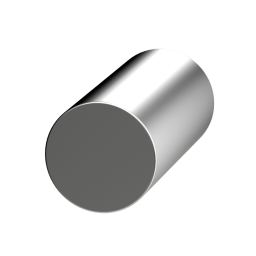
Angle
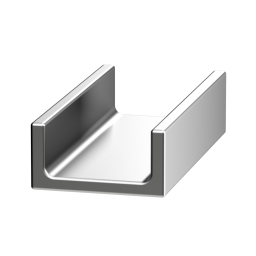
Channel
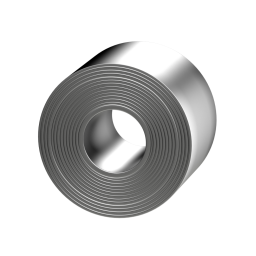
Coil
Disc
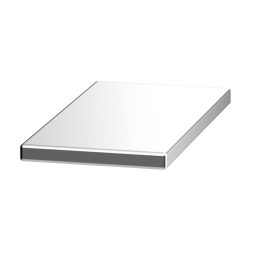
Flat Bar
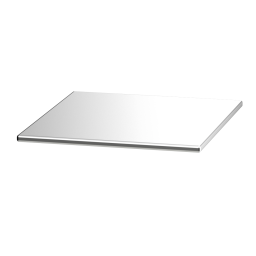
Foil
Hollow Bar
I-Beam
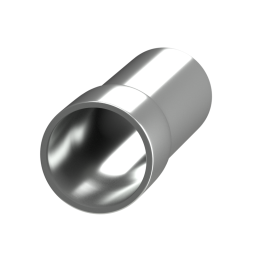
Pipe
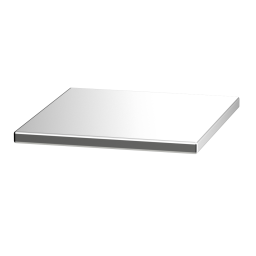
Plate

Rectangle Tube
Ring
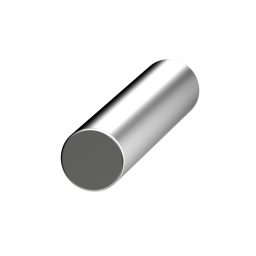
Rod
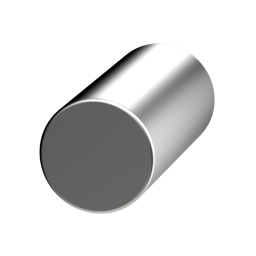
Round Bar
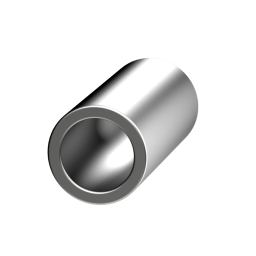
Round Tube
Sheet
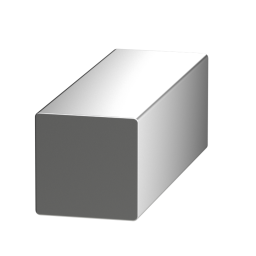
Square Bar
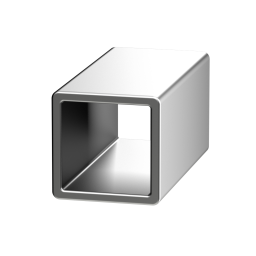
Square Tube
Strip
Tee
Additional Data
Specifications
B209,B210,B221,B241,B548,S-24149/2,A-200/7,A250/9,J454,A95456,B928Chemical Elements
| Aluminum | Balance |
| Chromium | 0.05 - 0.2 |
| Copper | 0.1 max |
| Iron | 0.4 max |
| Magnesium | 4.7 - 5.5 |
| Manganese | 0.5 - 1 |
| Remainder Each | 0.05 max |
| Remainder Total | 0.15 max |
| Silicon | 0.25 max |
| Titanium | 0.2 max |
| Zinc | 0.25 max |
Physical Properties
Density: 0.096lb/in³
Electrical Resistivity: 5.9µΩ·cm
Melting Point: 1055°F
Specific Gravity: 2.66
Specific Heat: 0.215BTU/lb·°F
Mechanical Properties
Modulus of Elasticity – Tension: 10.3MSI
Thermal Conductivity
| Condition | Temperature | Conductivity |
|---|---|---|
| O (Annealed) | 77 °F | 69.3 BTU/hr·ft·°F |
Thermal Expansion
| Condition | Min | Max | Expansion Coefficient |
|---|---|---|---|
| O (Annealed) | 68 °F | 212 °F | 13.3 μin/in·°F |
Mechanical Test Data
| Form | Plate |
| Condition | O (Annealed) |
| Temperature | 70°F |
| Brinell Hardness | 65 HB |
| Elongation | 22% |
| Tensile Strength | 45 KSI |
| Yield Strength | 23 KSI |
| Form | Plate |
| Condition | H321 |
| Temperature | 70°F |
| Brinell Hardness | 90 HB |
| Elongation | 14% |
| Tensile Strength | 51 KSI |
| Yield Strength | 37 KSI |
| Form | Sheet |
| Condition | H321 |
| Temperature | 70°F |
| Brinell Hardness | 90 HB |
| Elongation | 14% |
| Tensile Strength | 51 KSI |
| Yield Strength | 37 KSI |
| Form | Plate |
| Condition | H116 |
| Temperature | 70°F |
| Brinell Hardness | 90 HB |
| Elongation | 14% |
| Tensile Strength | 51 KSI |
| Yield Strength | 37 KSI |
| Form | Sheet |
| Condition | H116 |
| Temperature | 70°F |
| Brinell Hardness | 90 HB |
| Elongation | 14% |
| Tensile Strength | 51 KSI |
| Yield Strength | 37 KSI |
| Form | Plate |
| Condition | H111 |
| Temperature | 70°F |
| Brinell Hardness | 65 HB |
| Elongation | 20% |
| Tensile Strength | 45 KSI |
| Yield Strength | 24 KSI |