Aluminum
Aluminum 5657
Aging Procedure
Not applicable to this alloy.
Annealing Procedure
Annealing, to obtain O temper, of cold worked material is done at 775 F and air cooled. A stress-relief anneal may be done at 460 F for 3 hours followed by air cooling.
Applications
Commonly used in the manufacture of anodized auto and appliance trim.
Cold Workability
Cold working of AL 5657 is easily accomplished by standard commercial means in the soft tempers. The alloy may also be successfully cold worked in the harder tempers, but with more difficulty.
Forgeability
The alloy is hot forgeable. However there is no data as to the hot working range - consult the alloy supplier.
Formability
Forming by conventional means of this alloy may be readily accomplished. The alloy may be cold worked or hot worked with ease. However in the harder (cold worked) tempers forming becomes more difficult.
Hardening Procedure
Hardens only due to cold working.
Heat Treatability
AL 5657 is a non-heat treatable alloy. See "Annealing".
Hot Workability
Hot working of AL 5657 may be easily accomplished, if necessary, in the range of 700 to 450 F.
Machinability
This alloy is not noted for ease of machinability. It is relatively difficult to machine for an aluminum alloy and is considered only "fair" in terms of overall machinability. It tends to be "gummy" and thus needs care to produce a good machined finish. Except for very light cutting an oil base lubricant should be used during machining.
Other Mechanical Properties
Shear strength values are: H25 temper 14 ksi. H28 and 38 temper 15 ksi. Annealed O temper 11 ksi
Other Physical Properties
Electrical conductivity 54% of copper.
Principle Design Features
This is a non-heat treatable, medium strength, alloy of aluminum and magnesium.
Tempering Procedure
Not applicable.
Weldability
Alloy 5657 may be welded by conventional methods. Arc, gas torch, and resistance welding are the most commonly used processes. Filler metal, when required, should be AL 5457 or AL 5056 or 5052. The alloy may also be joined by brazing, although this requires special techniques and actual trial evaluation.
Known Forms
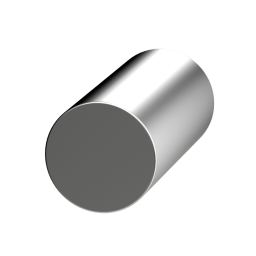
Angle
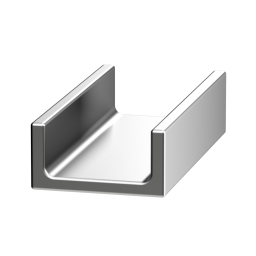
Channel
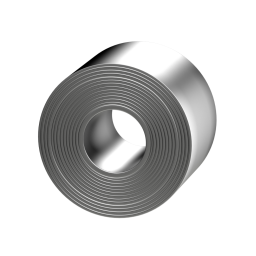
Coil
Disc
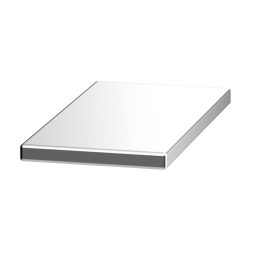
Flat Bar
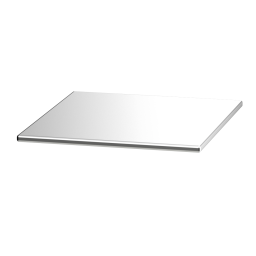
Foil
Hollow Bar
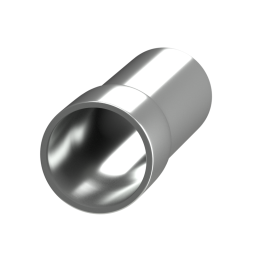
Pipe
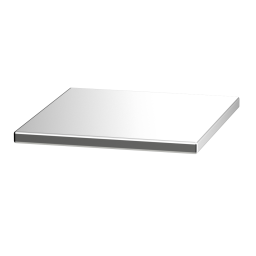
Plate
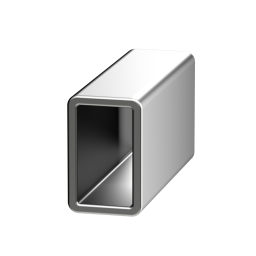
Rectangle Tube
Ring
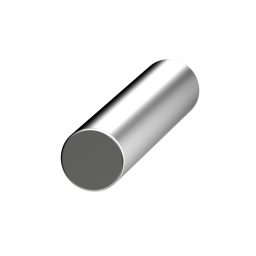
Rod
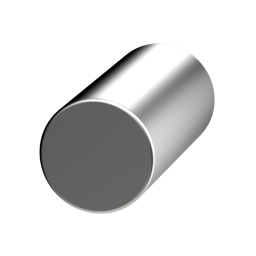
Round Bar
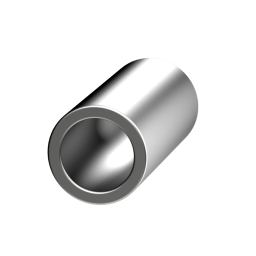
Round Tube
Sheet
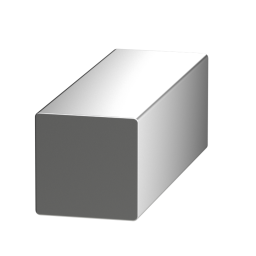
Square Bar
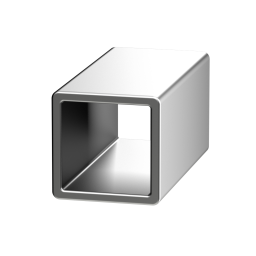
Square Tube
Strip
Tee
Additional Data
Specifications
B209,J454,A95657Chemical Elements
| Aluminum | Balance |
| Copper | 0.1 max |
| Gallium | 0.03 max |
| Iron | 0.1 max |
| Magnesium | 0.6 - 1 |
| Manganese | 0.03 max |
| Remainder Each | 0.02 max |
| Remainder Total | 0.05 max |
| Silicon | 0.08 max |
| Zinc | 0.03 max |
Physical Properties
Density: 0.097lb/in³
Melting Point: 1190°F
Specific Gravity: 2.69
Mechanical Properties
Modulus of Elasticity – Tension: 10MSI
Thermal Conductivity
| Condition | Temperature | Conductivity |
|---|---|---|
| H28 | 77 °F | 142 BTU/hr·ft·°F |
| H25 | 77 °F | 142 BTU/hr·ft·°F |
| Annealed | 77 °F | 142 BTU/hr·ft·°F |
Thermal Expansion
| Condition | Min | Max | Expansion Coefficient |
|---|---|---|---|
| H28 | 68 °F | 212 °F | 13.2 μin/in·°F |
| H25 | 68 °F | 212 °F | 13.2 μin/in·°F |
| Annealed | 68 °F | 212 °F | 13.2 μin/in·°F |