Aluminum
Aluminum 6013
Aging Procedure
Aging from the solution heat treated condition will occur naturally at room temperature for T4 temper. To obtain T6 temper the solution heat treated alloy must be aged at 375 F for 4 hours followed by air cooling.
Annealing Procedure
Annealing to relieve cold working stress is done at 775 F for 3 hours followed by controlled cooling at 50 F per hour down to 500 F. The alloy may then be air cooled from 500 F to room temperature. Note that it is necessary to re-solution heat treat aft
Applications
This alloy is used in aircraft structural parts, such as door or seating components. It is also utilized by both the aircraft and automotive industries as structural forgings.
Cold Workability
The alloy has good forming capability, but may require intermediate annealing if complex cold forming is being done. See "Annealing".
Corrosion Resistance
The AL 6013 alloy has excellent corrosion resistance and to stress-corrosion cracking. In general its corrosion resistance is better than the 2xxx or 7xxx series of aluminum alloys and the AL 6013 alloy is good for exposure to atmospheric marine or indus
Forgeability
No data available. This is a forging alloy, however so consult the alloy supplier for information.
Formability
The alloy is readily formed by conventional means.
Hardening Procedure
This alloy will cold work harden and also hardens by normal or accelerated aging. See "Aging".
Heat Treatability
Solution heat treat at 1060 F for 30 minutes at temperature followed by cold water quench to result in W temper. Aging will then occur naturally at room temperature for T4 temper, or to produce T6 temper an aging heat treatment may be used - see "Aging".
Hot Workability
No data available. Consult the alloy supplier.
Machinability
AL 6013, in the various tempers, is machinable by commercial methods. Machinability is best with the material in the cold finished tempers such as T3 or T8.
Other Physical Properties
Electrical conductivity 42% of copper.
Principle Design Features
This is an age-hardenable, high strength. alloy containing copper, silicon and magnesium as the strengthening agents. The strength characteristics make it useful for many structural applications.
Tempering Procedure
Not applicable.
Weldability
The preferred methods of welding are TIG or MIG using AL 4043 filler rod for general purposes. For higher strength weldments the filler metal should be AL 4643 and in heavy section weldments (over 1/2") post-weld solution heat treating and aging is recom
Known Forms
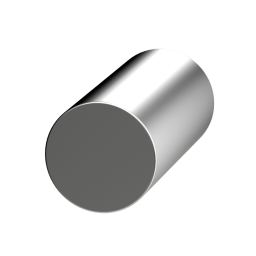
Angle
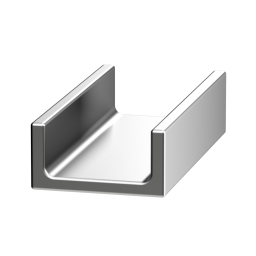
Channel
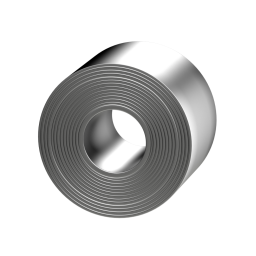
Coil
Disc
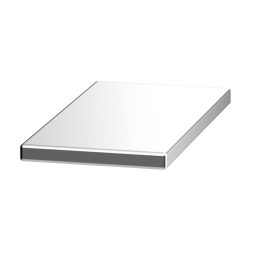
Flat Bar
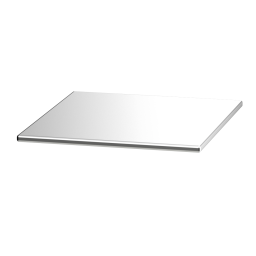
Foil
Hollow Bar
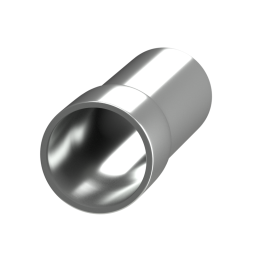
Pipe
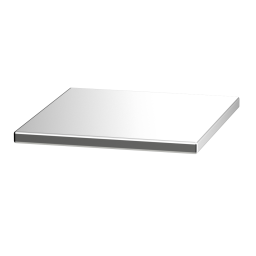
Plate

Rectangle Tube
Ring
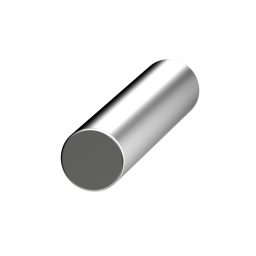
Rod
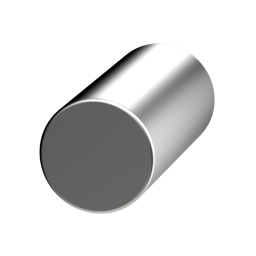
Round Bar
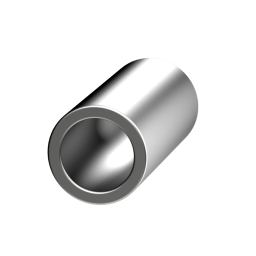
Round Tube
Sheet
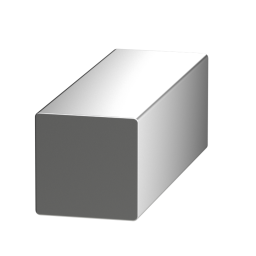
Square Bar
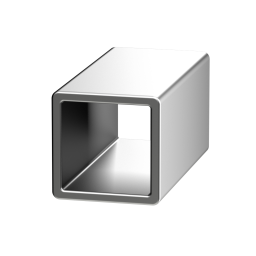
Square Tube
Strip
Tee
Additional Data
Specifications
4347,A96013Chemical Elements
| Aluminum | Balance |
Physical Properties
Density: 0.098lb/in³
Melting Point: 1075°F
Specific Gravity: 2.7
Mechanical Properties
Modulus of Elasticity – Tension: 9.9MSI
Modulus of Elasticity – Torsion: 3.8MSI
Thermal Conductivity
| Condition | Temperature | Conductivity |
|---|---|---|
| T8 | 68 °F | 9.5 BTU/hr·ft·°F |
Thermal Expansion
| Condition | Min | Max | Expansion Coefficient |
|---|---|---|---|
| T8 | 68 °F | 212 °F | 13 μin/in·°F |