Aluminum
Aluminum 6061
Aging Procedure
The aging precipitation heat treatment is done at 350 F for 8 hours followed by air cooling. This produces the T6 temper.
Annealing Procedure
Annealing should be done at 775 F for 2 to 3 hours followed by controlled cooling at 50 f per hour down to 500 F, then air cool.
Applications
Commonly used in the manufacture of heavy-duty structures requiring good corrosion resistance, truck and marine components, railroad cars, furniture, tank fittings, general structural and high pressure applications, wire products, and in pipelines.
Cold Workability
Cold working in the O temper condition is readily performed. The alloy is notably less easy to cold form in the T 4 and T 6 tempers.
Forgeability
The alloy is capable of being hot forged at temperatures in the range of 900 F to 750 F.
Formability
Easily cold worked and formed in the annealed condition. Stamping, bending, spinning, deep drawing are all readily accomplished using standard methods.
Hardening Procedure
See "Aging".
Heat Treatability
Solution heat treat at 990 F for adequate time to allow for thorough heating and then water quench. Precipitation hardening is done at 320 F for 18 hours and air cool, followed by 350 F for 8 hours and air cooling.
Hot Workability
Hot working may be done in the temperature range of 700 F to 500 F.
Machinability
Machinability in the harder T 4 and T6 tempers is good. It is notably less easy to machine in the annealed temper.
Other Mechanical Properties
Shear strength for O temper is 12 ksi and for T 6 temper it is 30, ksi
Other Physical Properties
Electrical conductivity 40% of copper.
Principle Design Features
Probably the most commonly available, heat treatable aluminum alloy.
Tempering Procedure
Not applicable.
Weldability
The alloy has very good welding characteristics and may be welded by all of the common welding techniques. Gas tungsten arc welding is generally used for thin sections (less than 0.032") and gas metal arc welding is used for heavier sections. Use alloy 4043 filler wire for best results, although a decrease in T 6 properties will result.
Known Forms
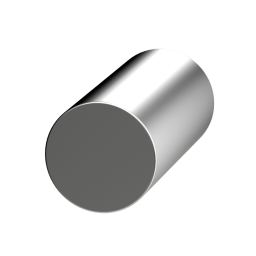
Angle
Bolt
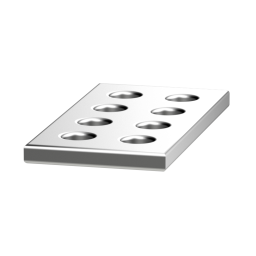
Bus Bar
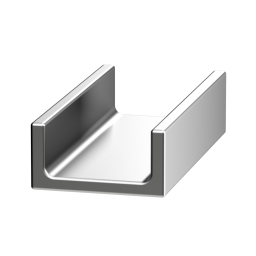
Channel
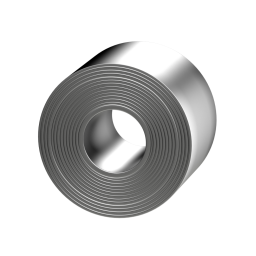
Coil
Decking
Disc
Expanded Sheet
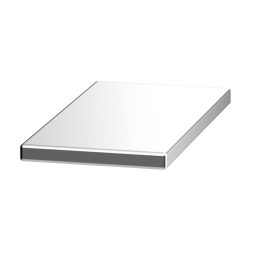
Flat Bar
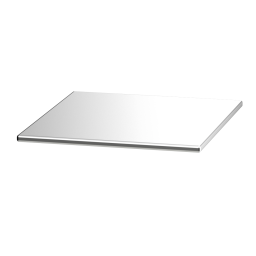
Foil
Grating
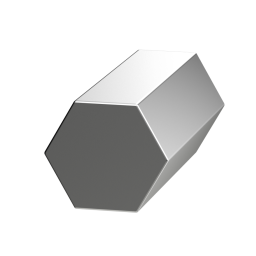
Hexagon Bar
Hollow Bar
I-Beam
Nut
Perforated Sheet
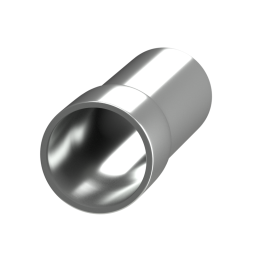
Pipe
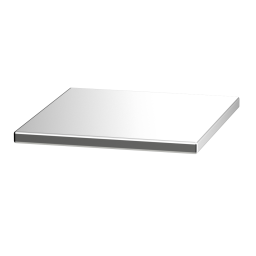
Plate
Powder
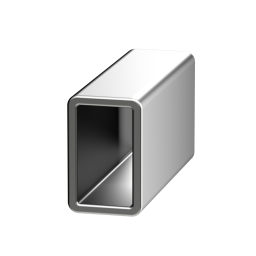
Rectangle Tube
Ring
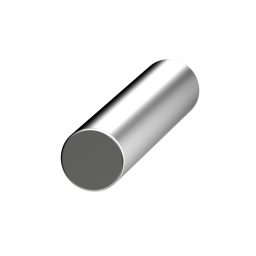
Rod
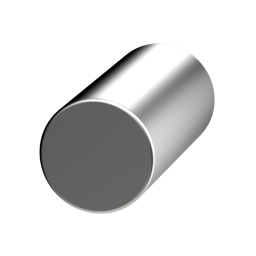
Round Bar
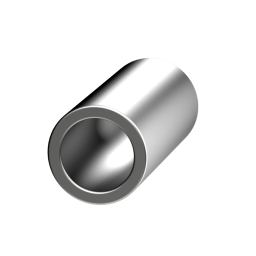
Round Tube
Screw
Sheet
Specialty Form
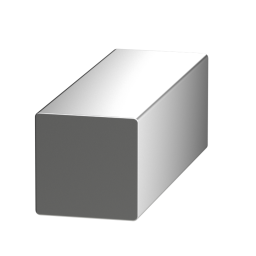
Square Bar
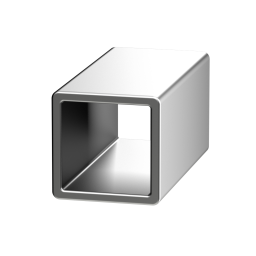
Square Tube
Strip
Tee
Threaded Rod
Washer
Wire Round
Additional Data
Specifications
4009,4025,4026,4027,4079,4080,4081,4082,4083,4113,4115,4116,4117,4127,4128,4146,4150,4160,4161,4172,4173,4248,4312,B209,B210,B211,B221,B234,B241,B247,B307,B313,B316,B345,B361,B404,B429,B483,B547,B548,B632,F467,F468,3.3211,A-12545,A-22771,F-17132A,F-18280,F-39000,F-3922,G-18014,G-18015,P-25995,T-7081,W-23351,W-85,A-200/16,A-200/8,A-225/8,A-250/11,A-367,A-430,WW-T-700/6,J454,A96061Chemical Elements
| Aluminum | Balance |
| Chromium | 0.04 - 0.35 |
| Copper | 0.15 - 0.4 |
| Iron | 0 - 0.7 |
| Magnesium | 0.8 - 1.2 |
| Manganese | 0.15 max |
| Other | 0.15 max |
| Remainder Each | 0.05 max |
| Silicon | 0.4 - 0.8 |
| Titanium | 0.15 max |
| Zinc | 0.25 max |
Physical Properties
Density: 0.098lb/in³
Melting Point: 1090°F
Specific Gravity: 2.7
Mechanical Properties
Modulus of Elasticity – Tension: 10MSI
Modulus of Elasticity – Torsion: 3.8MSI
Thermal Conductivity
| Condition | Temperature | Conductivity |
|---|---|---|
| T6 | 77 °F | 116 BTU/hr·ft·°F |
| T4 | 77 °F | 107 BTU/hr·ft·°F |