Aluminum
Aluminum 7178
Aging Procedure
AL Clad 7178 is used in the "as supplied" condition.
Annealing Procedure
Annealing should be avoided to prevent diffusion of the core and clad alloys which could disturb the corrosion resistance of the clad AL 7072 alloy.
Applications
Commonly used in the manufacture of aircraft and other structures.
Cold Workability
AL Clad 7178 cold works as does the unclad AL 7178 alloy.
Forgeability
AL Clad 7178 is used in the "as supplied" condition. Heat input for forging would disturb the corrosion resistance of the cladding because of diffusion between core and clad alloys.
Formability
Forming characteristics are the same as for unclad AL 7178 alloy.
Hardening Procedure
Hardens due to cold work.
Heat Treatability
AL Clad 7178 should be used in the "as supplied" condition. Heat treatment could result in diffusion between the core and clad alloys thus disturbing the corrosion characteristics of the cladding.
Hot Workability
AL Clad 7178 should be used in the "as supplied" condition. Heat input for hot working could result in diffusion between the core and clad alloys thus disturbing the corrosion characteristics of the clad AL 7072 alloy.
Machinability
Machinability is that of unclad AL 7178 alloy.
Other Comments
AL Clad 7178 has a cladding of AL 7072 upon a core of AL 7178 alloy. The cladding is normally on both sides and clad thickness ( on each side) varies from 1.5% to 4% of the total composite thickness.
Other Mechanical Properties
Mechanical properties are those of the core material AL 7178 alloy.
Other Physical Properties
Physical properties are basically controlled by the core alloy. In this case the properties of AL 7178 apply.
Principle Design Features
AL Clad 7178 consists of AL 7072 alloy cladding on both sides to a core of AL 7178 alloy. The cladding provides anodic corrosion protection to the core alloy of AL 7178.
Tempering Procedure
Not applicable.
Weldability
Welding may be done to AL Clad 7178. However the resultant weld and HAZ may have different corrosion properties because of diffusion between the core and clad alloy from the heat of welding.
Known Forms
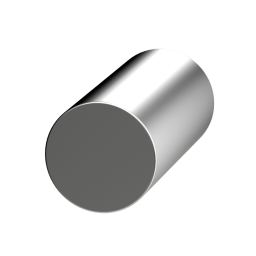
Angle
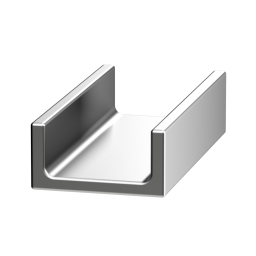
Channel
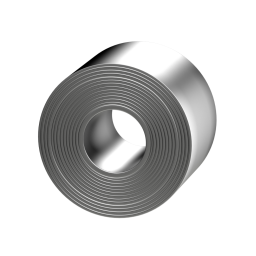
Coil
Disc
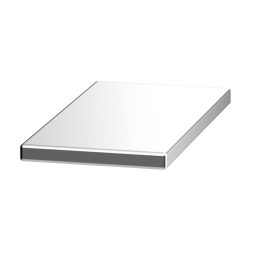
Flat Bar
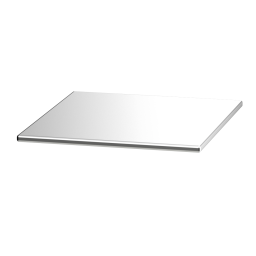
Foil
Hollow Bar
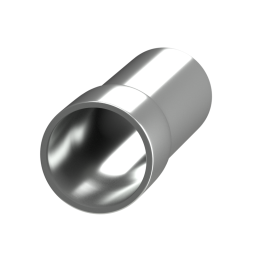
Pipe
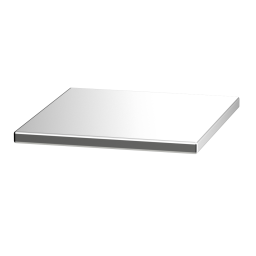
Plate
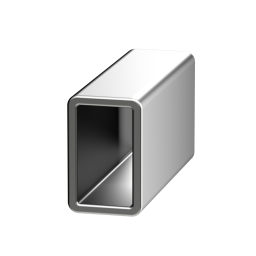
Rectangle Tube
Ring
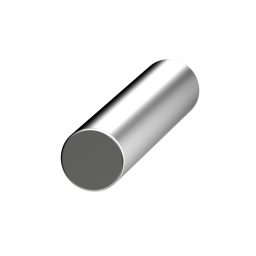
Rod
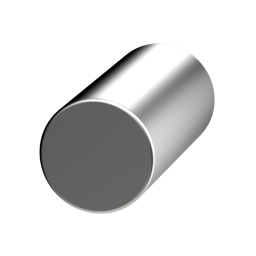
Round Bar
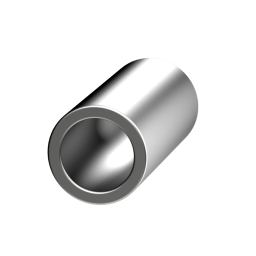
Round Tube
Sheet
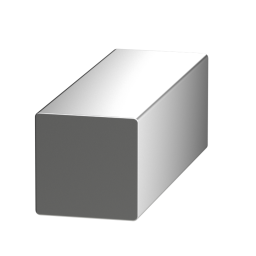
Square Bar
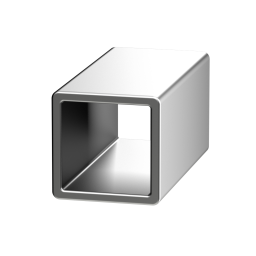
Square Tube
Strip
Tee
Additional Data
Specifications
B209,B221,B241,B316,A-200/13,A-200/14,A-250/14,A-250/21,A-250/28,A-430,J454,A97178Chemical Elements
| Aluminum | Balance |
| Chromium | 0.18 - 0.35 |
| Copper | 1.6 - 2.4 |
| Iron | 0.5 max |
| Magnesium | 2.4 - 3.1 |
| Manganese | 0.3 max |
| Remainder Each | 0.05 max |
| Remainder Total | 0.15 max |
| Silicon | 0.4 max |
| Titanium | 0.2 max |
| Zinc | 6.3 - 7.3 |
Physical Properties
Density: 0.102lb/in³
Melting Point: 900°F
Specific Gravity: 2.83
Mechanical Properties
Modulus of Elasticity – Tension: 10.4MSI
Thermal Conductivity
| Condition | Temperature | Conductivity |
|---|---|---|
| T6 | 68 °F | 9.8 BTU/hr·ft·°F |