Aluminum
Aluminum 8111-0
Annealing Procedure
Annealing is performed to fully soften cold-worked material and restore maximum ductility for further rolling or as a final temper. Typical annealing temperatures for 8xxx AlFeSi foil alloys are in the range of 300–400°C (570–750°F), held for sufficient time to achieve full recrystallization, then air or furnace cooled. Specific time and temperature depend on gauge, prior cold work, and furnace type.
Applications
Aluminum 8111 is used almost exclusively in foil form. Primary applications include packaging of food products, pharmaceuticals, medical devices, and cosmetics. Also used as roll foil for thermal, acoustic, and moisture insulation. Specific uses include bottle neck films (e.g., beer bottle closures), fresh food packaging covers, and laminated flexible barrier materials. At thinner gauges it can serve as capacitor foil and electronic shielding material.
Cold Workability
Outstanding cold workability. The alloy is specifically designed for multi-pass cold rolling to extremely thin gauges. The combination of iron and silicon controls grain growth and microstructure during cold rolling and intermediate anneals, enabling consistent, defect-free foil production. Available in tempers ranging from O (annealed/fully soft) to H18 (fully cold-worked).
Corrosion Resistance
Like all 8xxx-series aluminum alloys, 8111 forms a thin, protective natural oxide layer on its surface providing good corrosion resistance in normal atmospheric, food-contact, and moderately humid environments. It is considered suitable for direct food and pharmaceutical contact. The alloy resists oxidation effectively, making it appropriate for outdoor packaging applications involving exposure to moisture.
Formability
Excellent formability, particularly in the annealed (O) temper. The high elongation in the annealed condition (typically 15–25%) allows the alloy to be cold-rolled to very thin foil gauges without intermediate cracking. It can be formed, drawn, and wrapped around irregular shapes. Cold working to H-tempers (e.g., H18) increases strength but reduces elongation to 1–3%, as is typical and desired for finished foil products.
Heat Treatability
8111 is a non-heat-treatable aluminum alloy. Strengthening is achieved exclusively through cold working (strain hardening). Annealing is used to restore ductility between cold-rolling passes and to produce the final O-temper condition.
Hot Workability
Good hot workability. The alloy is typically cast into ingots and hot-rolled into slabs as the first stage of foil production. The relatively narrow solidus-to-liquidus range for the AlFeSi composition provides controlled castability and good hot rolling behavior.
Machinability
Not typically evaluated for machinability as the alloy is principally produced and used in thin foil form. In heavier gauges, machinability would be considered fair to good, consistent with other 8xxx AlFeSi alloys.
Other Comments
8111 is closely related to EN-AW 8011 (AlFeSi(A)) and can sometimes be used as a substitute. It is one of the standard alloys listed in ASTM B479 for annealed foil. Reynolds Wrap household aluminum foil is notably made from 8111-series aluminum. The alloy designation 8111-0 denotes the alloy in its O (annealed) temper, which is the most common commercial temper for this grade. The '0' suffix in the grade code corresponds to the annealed condition.
Other Physical Properties
Density approximately 2.71 g/cm³ (0.0975 lb/in³). Melting range approximately 635–655°C (1175–1211°F) solidus to liquidus; the presence of Fe and Si slightly lowers the solidus below that of pure aluminum. Modulus of elasticity approximately 69 GPa (10 MSI). Electrical resistivity approximately 3.45 µΩ·cm in the annealed condition. Specific heat approximately 900 J/kg·K (0.215 BTU/lb·°F). Thermal conductivity approximately 200 W/m·K (116 BTU/hr·ft·°F) in the annealed condition.
Principle Design Features
8111 is an 8xxx-series wrought aluminum alloy primarily alloyed with iron (Fe) and silicon (Si), giving it the European designation AlFeSi(B) (EN-AW 8111). It is a non-heat-treatable alloy strengthened by cold working. The alloy is registered with the Aluminum Association (AA) under UNS A98111. Its balanced Fe-Si composition provides excellent rollability, allowing production of foil gauges as thin as 6 µm without cracking. The alloy is closely related to 8011 (AlFeSi(A)) but differs slightly in its Si and Fe ratio ranges.
Weldability
Aluminum 8111 is generally weldable, though it is not typically used in structural welded applications. Its primary use in foil gauges means that lamination and bonding processes are far more common than fusion welding. For foil-to-foil or foil-to-film laminates, heat-sealing, adhesive bonding, and coextrusion are standard joining methods.
Known Forms
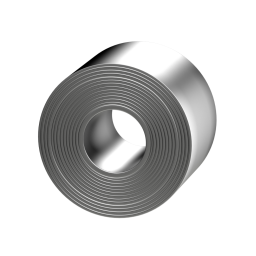
Coil
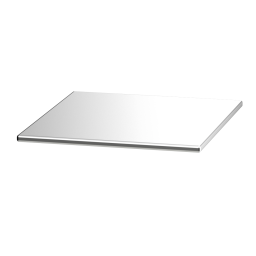
Foil
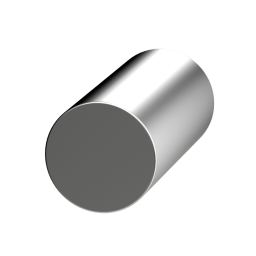
Strip
Additional Data
Specifications
B479,A98111Chemical Elements
| Aluminum | Balance |
| Chromium | Maximum per EN 573-3 |
| Copper | Maximum per EN 573-3 |
| Iron | Per EN 573-3 / AA Teal Sheets for 8111 |
| Magnesium | Maximum per EN 573-3 |
| Manganese | Maximum per EN 573-3 |
| Other (Each) | Each other element max per EN 573-3 |
| Other (Total) | Total other elements max per EN 573-3 |
| Silicon | Per EN 573-3 / AA Teal Sheets for 8111 |
| Titanium | Maximum per EN 573-3 |
| Zinc | Maximum per EN 573-3 |
Physical Properties
Density: 0.0975lb/in³
Electrical Resistivity: 3.45µΩ·cm
Melting Point: 1175°F
Modulus of Elasticity: 10MSI
Specific Heat: 0.215BTU/lb·°F
Mechanical Properties
Thermal Conductivity: 116BTU/hr·ft·°F
Thermal Expansion: 13µin/in·°F
Thermal Conductivity
| Condition | Temperature | Conductivity |
|---|---|---|
| O (Annealed) | 77 °F | 116 BTU/hr·ft·°F |
Thermal Expansion
| Condition | Min | Max | Expansion Coefficient |
|---|---|---|---|
| O (Annealed) | 68 °F | 212 °F | 13 μin/in·°F |
Mechanical Test Data
| Form | Foil |
| Condition | O (Annealed) |
| Temperature | 70°F |
| Brinell Hardness | 25 HB |
| Elongation | 20% |
| Tensile Strength | 16 KSI |