Brass
Brass 360
Annealing Procedure
Annealing of C36000 can be performed at temperatures ranging from 800°F to 1100°F (427–594°C). Annealing is used to soften the alloy after cold working and to relieve residual stress.
Applications
Brass 360 is primarily used in high-speed automatic screw machine products. Typical applications include plumbing fixtures and fittings, valve bodies and valve stems, adapters, couplings, pump shafts, gears, pinions, fasteners (nuts, bolts, connectors), faucet components, hardware, electronic and electrical connectors, and precision machined components across industrial, automotive, and consumer goods markets.
Cold Workability
C36000 has poor cold working capacity. The alloy can be strengthened by cold work — the most common commercial temper is half-hard (H02) — but extensive cold forming operations are not well-suited to this grade due to its lead content and duplex structure, which limit ductility.
Corrosion Resistance
Brass 360 offers good corrosion resistance in atmospheric, industrial, and automotive environments. The alloy forms a protective patina that resists rust unlike steel or iron. However, its lead content precludes its use in contact with potable water in many jurisdictions. It may also be susceptible to stress corrosion cracking in ammonia-bearing environments and may corrode in highly acidic or saline conditions.
Forgeability
C36000 can be hot forged at temperatures of 1300°F to 1450°F (705–788°C). The alloy has average hot forming capacity and is used in hot forging for valve bodies and similar components.
Formability
Brass 360 has limited formability compared to non-leaded brass grades. Cold forming operations such as deep drawing and bending should be minimized. It is best suited for machining operations rather than forming. Knurling and roll threading are compatible processes.
Hot Workability
C36000 has average hot forming capacity. Hot forging is performed at temperatures ranging from 1300°F to 1450°F (705–788°C).
Machinability
C36000 has a machinability rating of 100 — the highest of all copper alloys and the industry standard benchmark. Its lead content acts as a built-in lubricant and chip-breaker, producing small, free chips that clear easily from the work area, minimizing tool wear, reducing downtime, and enabling full utilization of screw machine speed and feed capabilities. It is also well-suited for knurling and roll threading.
Other Comments
C36000 is also designated as CDA 360, ISO CuZn36Pb3, EN CW603N, and British Standard CZ124. Lead content may be restricted to a maximum of 3.0% by environmental regulations in some jurisdictions. The alloy is not suitable for potable water contact applications due to lead content. It is RoHS non-compliant and should not be used in electronics applications where lead-free requirements apply.
Other Physical Properties
Electrical conductivity is 26% IACS at 68°F. Specific gravity is 8.50. Melting point liquidus is approximately 1650°F (900°C); solidus is 1630°F (890°C). The alloy is non-magnetic.
Principle Design Features
Brass 360 (UNS C36000) is a copper-zinc-lead alloy known as Free-Cutting Brass. Its approximately 3% lead content creates short, broken machining chips that minimize tool wear and allow continuous high-speed machining. It holds the machinability index rating of 100, the standard against which all other copper alloys are compared. The alloy has a two-phase alpha-beta (duplex) microstructure that combines moderately high strength with good corrosion resistance.
Weldability
C36000 can be joined by soldering and brazing. Butt welding is also feasible. Gas shielded arc welding, oxyacetylene welding, seam welding, coated metal arc welding, and spot welding are not recommended for this alloy due to its lead content and the associated risk of porosity and fume generation.
Known Forms
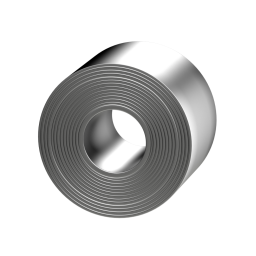
Coil
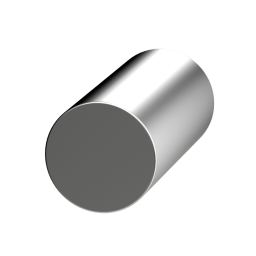
Disc
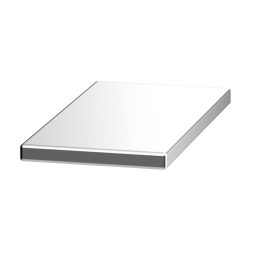
Flat Bar
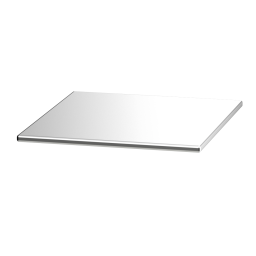
Foil
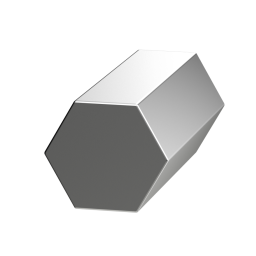
Hexagon Bar
Hollow Bar
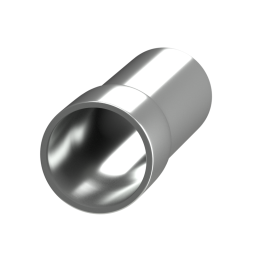
Pipe
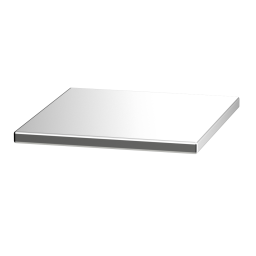
Plate
Ring
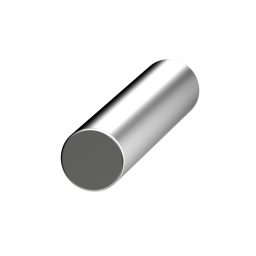
Rod
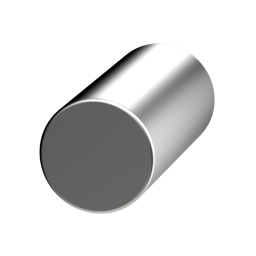
Round Bar
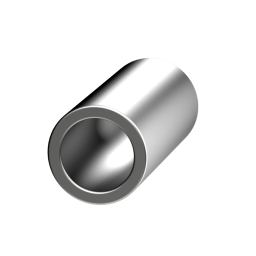
Round Tube
Sheet
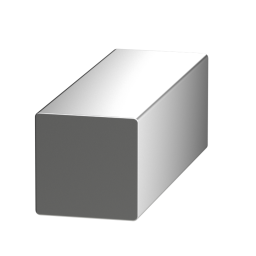
Square Bar
Strip
Additional Data
Specifications
B16,J463,C36000,4610Chemical Elements
| Copper | Primary alloying element |
| Iron | 0.35 max |
| Lead | 2.5 - 3 |
| Zinc | Balance |
Physical Properties
Density: 0.307lb/in³
Electrical Resistivity: 6.62µΩ·cm
Melting Point: 1630°F
Modulus of Elasticity: 14MSI
Specific Heat: 0.09BTU/lb·°F
Mechanical Properties
Thermal Conductivity: 67BTU/hr·ft·°F
Thermal Expansion: 11.4µin/in·°F
Thermal Conductivity
| Condition | Temperature | Conductivity |
|---|---|---|
| Annealed | 68 °F | 67 BTU/hr·ft·°F |
Thermal Expansion
| Condition | Min | Max | Expansion Coefficient |
|---|---|---|---|
| Annealed | 68 °F | 572 °F | 11.4 μin/in·°F |
Mechanical Test Data
| Form | Rod |
| Condition | O (Annealed) |
| Temperature | 70°F |
| Elongation | 53% |
| Rockwell Hardness | B55 |
| Tensile Strength | 47 KSI |
| Yield Strength | 18 KSI |
| Form | Rod |
| Condition | Half Hard |
| Temperature | 70°F |
| Elongation | 25% |
| Reduction of Area | 50% |
| Rockwell Hardness | B78 |
| Tensile Strength | 58 KSI |
| Yield Strength | 45 KSI |
| Form | Rod |
| Condition | Full Hard |
| Temperature | 70°F |
| Elongation | 7% |
| Rockwell Hardness | B87 |
| Tensile Strength | 78 KSI |
| Yield Strength | 60 KSI |