Cobalt
Cobalt Hiperco 50
Annealing Procedure
For the standard magnetic anneal: anneal parts at 1300–1600°F (704–871°C) for 2 to 4 hours in dry hydrogen or vacuum and cool at 250–400°F (139–222°C) per hour until 600°F (316°C) is reached, after which any cooling rate may be employed. Increasing the anneal temperature within 1300–1600°F improves magnetic properties while decreasing yield and tensile strengths. The temperature must never exceed 1600°F (871°C) as soft magnetic characteristics will degrade due to austenitic phase formation. A non-oxidizing, non-carburizing atmosphere (dry hydrogen, argon, or vacuum) is required.
Applications
Hiperco 50 is used primarily for rotor and stator laminations stamped from cold-rolled strip for motors and generators in aircraft power generation. It achieves maximum torque density and minimum losses in high-performance electric motors. Additional applications include actuators in consumer electronics, magnetic cores in transformers and electrical equipment, transducers, poles and cores, head laminations, and emergency power systems (e.g., Ram Air Turbine and Auxiliary Power Units in aerospace). It is also used in medical imaging equipment (MRI), cryogenic adiabatic demagnetization refrigerators, and high-efficiency energy sector transformers.
Cold Workability
Hiperco 50 is produced in cold-rolled strip form. The alloy has a high work-hardening rate. Rotor and stator laminations are stamped from cold-rolled strip prior to final anneal.
Corrosion Resistance
Hiperco 50 has moderate corrosion resistance. It is susceptible to oxidation at elevated temperatures; a protective (non-oxidizing) atmosphere is required during annealing to prevent contamination. Surface oxide layers can be intentionally grown at 600–900°F (316–480°C) to provide electrical insulation between laminations for AC applications.
Formability
Hiperco 50 is very difficult to form due to its high cobalt content. It can easily crack during forging. The alloy is produced in cold-rolled strip form and must be final annealed in a protective atmosphere or vacuum environment after stamping to achieve the required combination of mechanical and magnetic properties.
Hot Workability
Hiperco 50 can be easily cracked while forging and is not readily hot-worked. Processing is primarily performed as cold-rolling of strip.
Machinability
Hiperco 50 has a high work-hardening rate and is not produced in machinable forms. When machining is required, carbide tools are recommended. Surface speeds can be increased 2–3 times compared to high-speed steel suggestions, and feeds can be increased by 50–100%. Careful control of speeds and feeds is essential for optimal results.
Other Comments
Note on material family classification: Hiperco 50 is categorized in this system under the Nickel (NI) family; however, it is fundamentally an iron-cobalt-vanadium alloy (Fe-Co-V) with nickel present only as a trace impurity (max 0.25%). The primary alloying elements are cobalt (~48.5%) and iron (balance), with vanadium (~2%) and a small niobium addition. It would more accurately be classified as a Cobalt or Iron-based soft magnetic alloy. Hiperco® is a registered trademark of CRS Holdings LLC, a subsidiary of Carpenter Technology Corporation.
Other Physical Properties
Curie Temperature: 1720°F (938–940°C) — the phase transition from magnetic to non-magnetic. Specific Gravity: 8.12 at 68°F (20°C). The alloy is also known by equivalent trade names: AFK 502, Vacoflux 50, Permendur 49, and Rotelloy 3.
Principle Design Features
Hiperco 50 is an iron-cobalt-vanadium soft magnetic alloy exhibiting the highest magnetic saturation (24 kilogauss / 2.4 Tesla) of all commercially available soft magnetic alloys while maintaining low core loss compared to electrical steel. It has high DC maximum permeability and low DC coercive force. The alloy contains a small niobium addition for grain refinement during mill processing and final heat treatment, which allows varying levels of mechanical strength and magnetic properties to be achieved depending on the anneal temperature used (1300–1600°F range). It has the same nominal composition as Vanadium Permendur and Permendur V.
Known Forms
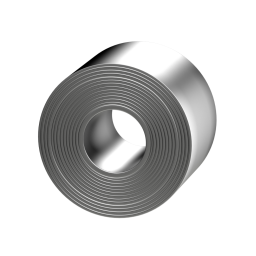
Coil
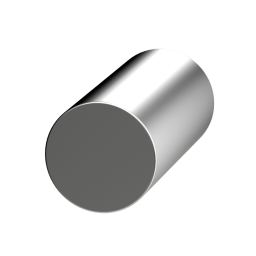
Strip
Additional Data
Specifications
A801 Alloy Type 1,R30005,A-47182,S-1907,S-1949A,A-47182Chemical Elements
| Carbon | 0.025 max |
| Chromium | 0.15 max |
| Cobalt | Primary alloying element |
| Iron | Balance |
| Manganese | 0.15 max |
| Nickel | 0.25 max |
| Niobium | 0.1 max |
| Phosphorus | 0.015 max |
| Silicon | 0.15 max |
| Sulfur | 0.01 max |
| Vanadium | 1.75 - 2.1 |
Physical Properties
Density: 0.293lb/in³
Electrical Resistivity: 40.1µΩ·cm
Melting Point: 2601°F
Modulus of Elasticity: 30MSI
Specific Heat: 0.1BTU/lb·°F
Mechanical Properties
Thermal Conductivity: 17.2BTU/hr·ft·°F
Thermal Conductivity
| Condition | Temperature | Conductivity |
|---|---|---|
| Annealed | 70 °F | 17.2 BTU/hr·ft·°F |
Thermal Expansion
| Condition | Min | Max | Expansion Coefficient |
|---|---|---|---|
| Annealed | 77 °F | 392 °F | 5.3 μin/in·°F |
| Annealed | 77 °F | 752 °F | 5.6 μin/in·°F |
| Annealed | 77 °F | 1112 °F | 5.8 μin/in·°F |
| Annealed | 77 °F | 1472 °F | 6.3 μin/in·°F |
Mechanical Test Data
| Form | Strip |
| Condition | Cold Rolled |
| Temperature | 70°F |
| Elongation | 2% |
| Rockwell Hardness | C36 |
| Tensile Strength | 190 KSI |
| Yield Strength | 175 KSI |
| Form | Strip |
| Condition | Annealed |
| Temperature | 70°F |
| Elongation | 5% |
| Tensile Strength | 85 KSI |
| Yield Strength | 32 KSI |
| Form | Strip |
| Condition | Heat Treated |
| Temperature | 70°F |
| Elongation | 5% |
| Tensile Strength | 135 KSI |
| Yield Strength | 60 KSI |