Copper
Copper C11000
Annealing Procedure
The annealing temperature for this alloy is between 700 and 1200 F.
Applications
C11000 ETP Copper is the most widely used grade of copper, primarily selected for its combination of very high electrical and thermal conductivity, good corrosion resistance, excellent formability, and aesthetic appeal. Primary electrical applications include busbars, wire conductors (magnet wire, stranded conductors, overhead line conductors), switches, terminals, contacts, commutators, welding fixtures, ground straps, and radio parts. Architectural and construction applications include roofing, flashing, gutters, downspouts, building fronts, and skylight frames. Industrial applications include heat exchangers, auto radiators, kettles, printing rolls, anodes, and heat sinks. Builders hardware applications include ball floats, rivets, nails, cotter pins, and nuts and bolts. Due to its EPA-registered antimicrobial properties, it is also used in touch surfaces in healthcare and public environments.
Cold Workability
The capacity for cold working this alloy is rated as "excellent".
Corrosion Resistance
C11000 has excellent corrosion resistance to atmospheric weathering, and very good resistance to many chemicals. It is suitable for use with most fresh and salt waters and can be used underground due to its resistance to soil corrosion. It also resists non-oxidizing mineral and organic acids, caustic solutions, and saline solutions. When exposed to outdoor conditions, it develops a protective oxide layer (patina) that progressively changes from copper-red to dark brown to the characteristic green verdigris, further enhancing long-term durability. However, C11000 is susceptible to hydrogen embrittlement when exposed to temperatures above 370°C (700°F) in reducing or hydrogen-rich atmospheres; this is due to its trace oxygen content reacting with hydrogen to form water vapor, which causes internal micro-cracking.
Forgeability
The hot forgeability rating of this alloy is 65. (Forging brass = 100). The recommended hot working temperature for this alloy is between 1400 and 1600 F.
Formability
C11000 has an excellent rating for both cold and hot forming. Its face-centered cubic (FCC) crystal structure provides high ductility, enabling deep drawing, spinning, bending, coining, and stamping without cracking. Cold work reduction of 70–90% can be achieved before intermediate annealing is required. Minimum bend radius is approximately 1 to 1.5 times material thickness in the annealed condition, and approximately 2.5 times thickness in the half-hard condition. Hot forming is performed in the range of 1400–1600°F (760–871°C); temperatures should not exceed approximately 1560°F (850°C) to avoid excessive grain growth.
Hot Workability
This alloy's capacity for being hot formed is rated as "excellent".
Machinability
The machinability rating of this alloy is 20. (Where Alloy 360 FC Brass is 100).
Principle Design Features
C11000, Electrolytic Tough Pitch (ETP) Copper, is the most commercially prevalent copper grade. It is produced by direct electrolytic refining of selected cathodes under carefully controlled conditions, resulting in a minimum copper (including silver) content of 99.90%. It contains trace oxygen (typically 0.02–0.04%) present as cuprous oxide (Cu2O), which maximizes electrical conductivity by tying up trace solute elements as oxides rather than leaving them in solid solution where they would raise resistivity. As a result, C11000 achieves a minimum electrical conductivity of 100% IACS in the annealed condition. It is highly ductile, easily annealed, and can be strengthened by cold working. It is not heat-treatable for strength (no allotropic transformation). Its high thermal conductivity (226 BTU/hr·ft·°F) makes it equally valuable for thermal management applications. The trade-off for the trace oxygen content is susceptibility to hydrogen embrittlement in high-temperature reducing atmospheres.
Weldability
Soldering is rated as "excellent", brazing is rated as "good", oxyacetylene welding is "not recommended", gas shielded arc welding is rated as "fair", coated metal arc welding is "not recommended", spot welding is "not recommended", seam welding is "not recommended" and butt welding is rated as "good".
Known Forms
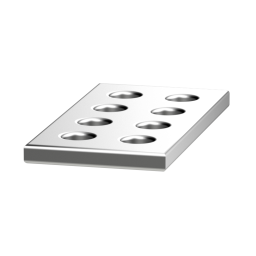
Bus Bar
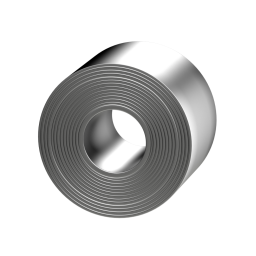
Coil
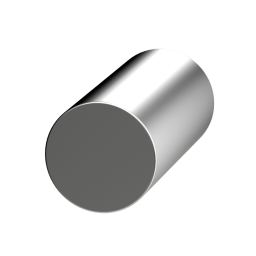
Disc
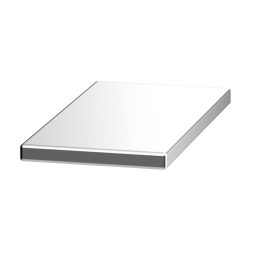
Flat Bar
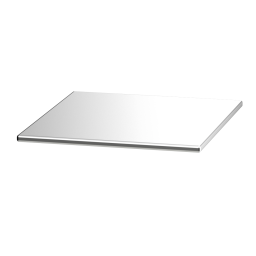
Foil
Hollow Bar
Perforated Sheet
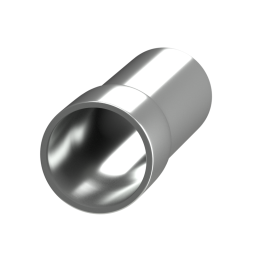
Pipe
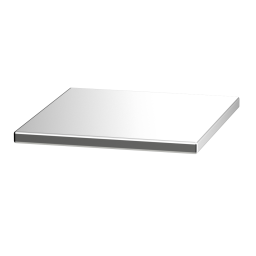
Plate
Powder
Ring
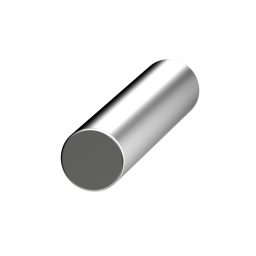
Rod
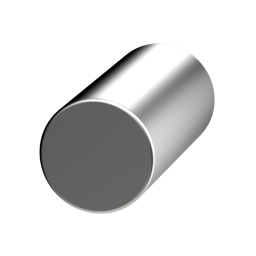
Round Bar
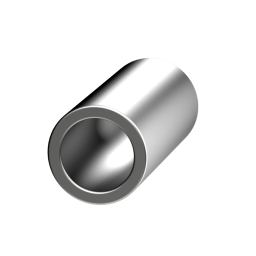
Round Tube
Sheet
Specialty Form
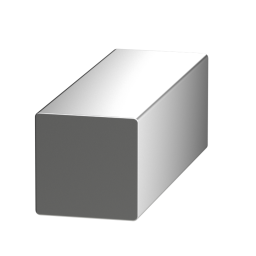
Square Bar
Strip
Wire Flat
Wire Round
Wire Square
Additional Data
Specifications
SB133,B1,B101,B116,B124,B133,B152,B172,B173,B174,B187,B188,B189,B2,B224,B226,B228,B229,B246,B272,B283,B286,B298,B3,B33,B355,B370,B447,B451,B47,B470,B48,B49,B496,B506,B556,B638,B694,B738,B8,F467,F468,B-20292,C-12168,W-6712,B575,J461,J463,C11000Chemical Elements
| Copper | Balance |
| Oxygen | 0.04 max |
Physical Properties
Density: 0.323lb/in³
Electrical Resistivity: 1.71µΩ·cm
Melting Point: 1981°F
Specific Heat: 0.092BTU/lb·°F
Mechanical Properties
Modulus of Elasticity – Tension: 17MSI
Thermal Conductivity: 226BTU/hr·ft·°F
Thermal Expansion: 9.8µin/in·°F
Thermal Conductivity
| Condition | Temperature | Conductivity |
|---|---|---|
| Annealed | 68 °F | 226 BTU/hr·ft·°F |
Thermal Expansion
| Condition | Min | Max | Expansion Coefficient |
|---|---|---|---|
| Annealed | 68 °F | 572 °F | 9.8 μin/in·°F |
Mechanical Test Data
| Form | Round Bar |
| Condition | Annealed |
| Temperature | 70°F |
| Elongation | 35% |
| Tensile Strength | 32 KSI |
| Yield Strength | 10 KSI |
| Form | Sheet |
| Condition | Annealed |
| Temperature | 70°F |
| Elongation | 35% |
| Tensile Strength | 32 KSI |
| Yield Strength | 10 KSI |
| Form | Strip |
| Condition | Annealed |
| Temperature | 70°F |
| Elongation | 35% |
| Tensile Strength | 32 KSI |
| Yield Strength | 10 KSI |
| Form | Round Bar |
| Condition | Half Hard |
| Temperature | 70°F |
| Elongation | 14% |
| Rockwell Hardness | F83 |
| Tensile Strength | 41 KSI |
| Yield Strength | 38 KSI |
| Form | Sheet |
| Condition | Half Hard |
| Temperature | 70°F |
| Elongation | 14% |
| Rockwell Hardness | F83 |
| Tensile Strength | 41 KSI |
| Yield Strength | 38 KSI |
| Form | Strip |
| Condition | Half Hard |
| Temperature | 70°F |
| Elongation | 14% |
| Rockwell Hardness | F83 |
| Tensile Strength | 41 KSI |
| Yield Strength | 38 KSI |
| Form | Round Bar |
| Condition | Full Hard |
| Temperature | 70°F |
| Elongation | 8% |
| Tensile Strength | 50 KSI |
| Yield Strength | 45 KSI |
| Form | Sheet |
| Condition | Full Hard |
| Temperature | 70°F |
| Elongation | 8% |
| Tensile Strength | 50 KSI |
| Yield Strength | 45 KSI |
| Form | Strip |
| Condition | Full Hard |
| Temperature | 70°F |
| Elongation | 8% |
| Tensile Strength | 50 KSI |
| Yield Strength | 45 KSI |