Nickel
Nickel A-286
Aging Procedure
Aging of this alloy for high strength can be accomplished at 1325 F for 16 hours followed by an air cool. Aging is done after first giving the alloy a solution heat treatment at 1800 F.
Annealing Procedure
See "Heat Treatment".
Applications
Used for reasonably low cost when moderate strength and oxidation resistance are required at temperatures greater than suitable for stainless steels. This alloy finds application in gas turbine forgings. It is suited for use up to a temperature of about 1300 F in corrosive environment (such as gas turbines) and to 1500 F for continuous service in oxidizing environments.
Cold Workability
This alloy is readily cold worked in a manner similar to that of the austenitic (300 series) stainless steels. Severe cold forming will result in work hardening which will necessitate a solution anneal heat treatment to soften the alloy.
Forgeability
Light forging can be done in the temperature range of 1600-1850 F. Heavy forging is done at temperatures in the range of 1850-2200F.
Formability
This alloy can be readily cold or hot formed using conventional procedures. Generally minimum diameter for bending is 1 times the thickness of the sheet or strip and 2 times thickness for plate. Forming behavior is similar to that for Type 310 stainless steel.
Hardening Procedure
As with austenitic stainless steels hardening of this alloy is accomplished by cold working. However the alloy, as is common with many of the iron-nickel alloys containing titanium, may be age hardened. Refer to "Aging" listing.
Heat Treatability
The alloy is solution annealed at 1800 F and oil quenched, followed by holding at 1325 F for 16 hours and air cool. This treatment develops high strength for the alloy.
Hot Workability
See "Forging".
Machinability
Readily machined by standard methods. Similar in behavior to the machining of the austenitic (300 series) stainless steels. Cemented carbide tools are best for high cutting rates as in turning operations. Turning: Surface speed of 300-325 fpm using carbide tooling at feed rate of 0.008 inches per revolution. Use water base coolant or lubricant. Drilling: High speed steel drills with a positive rake work well. Feed rates are 0.001" to 0.006" per revolution, with the smaller feed rate the smaller the hole diameter being drilled. Surface speed range 25-35 feet per minute. Milling: Rigid machines and fixtures are essential for a good milled finish. Cutting speeds of 30-40 surface feet per minute with a feed rate of 0.003" to 0.005" per mill cutter tooth should be used. Grinding behavior is very similar to that of steel. Wet grinding is best using aluminum oxide grinding wheels.
Principle Design Features
An iron based high temperature, high strength alloy.
Weldability
As with all nickel containing alloy cleanliness of the area to be welded is of paramount importance. Welding procedures and processes are the same as used for stainless steel. Preheating or post welding heat treatment is not required. Welds should always have a raised (convex) weld bead and matching filler metal should be used. The alloy should be in the solution annealed condition for optimum welding results. It is susceptible to hot cracking and that tendency is aggravated in the aged condition.
Known Forms
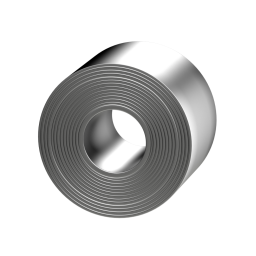
Coil
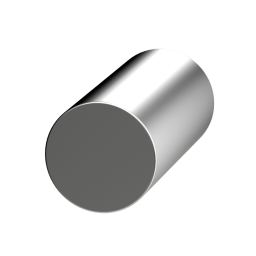
Disc
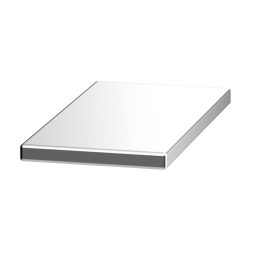
Flat Bar
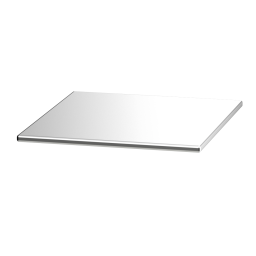
Foil
Hollow Bar
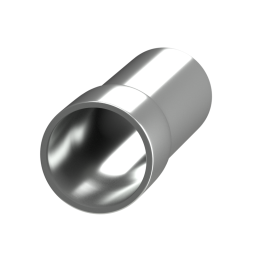
Pipe
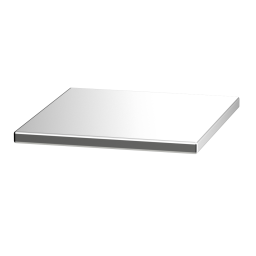
Plate
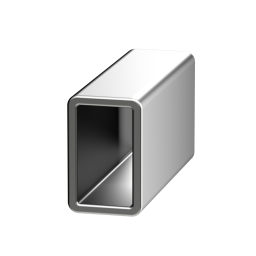
Rectangle Tube
Ring
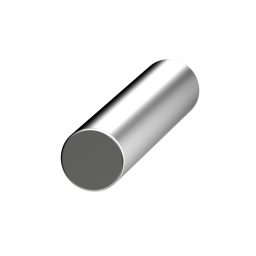
Rod
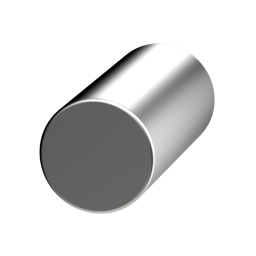
Round Bar
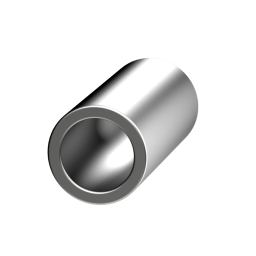
Round Tube
Sheet
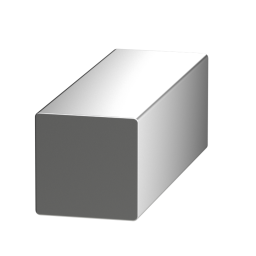
Square Bar
Strip
Additional Data
Specifications
660,662,5525,5726,5731,5732,5734,5737,5804,5805,5853,5858,5895,A453 Grade 660,A638 Grade 660,1.4943,1.4944,B50T1181,B50T12,B50T81,M250,S66286Chemical Elements
| Aluminum | 0.1 - 0.3 |
| Boron | 0.02 max |
| Carbon | 0.08 max |
| Chromium | 14 - 16 |
| Iron | Balance |
| Manganese | 1 - 1.5 |
| Molybdenum | 1 - 1.6 |
| Nickel | 24.5 - 27 |
| Titanium | 1.5 - 2.5 |
Physical Properties
Density: 0.286lb/in³
Melting Point: 2550°F
Poissons Ratio: 0.3
Specific Gravity: 7.9
Specific Heat: 0.1BTU/lb·°F
Mechanical Properties
Modulus of Elasticity – Tension: 29.1MSI
Relative Magnetic Permeability: 1.01μᵣ
Thermal Expansion: 9.17µin/in·°F
Thermal Conductivity
| Condition | Temperature | Conductivity |
|---|---|---|
| Annealed | 70 °F | 8.8 BTU/hr·ft·°F |