Nickel
Nickel Alloy 155 - (Multimet tm)
Aging Procedure
Not applicable as a strengthening process. Long term use at temperatures in the 1200 F to 1600 F range results in a reduction of impact strength.
Annealing Procedure
See "Heat Treatment".
Applications
Industrial furnace structural parts and fixtures. High temperature bolts and gas turbine combustion chambers, exhaust manifolds, and turbine blades.
Cold Workability
The alloy cold works readily and can be drawn, formed by bending or spinning as it has good ductility. Work hardening occurs and it may be necessary to give the piece a solution heat treatment before finishing all cold working. In finished condition the part should be solution heat treated to restore optimum mechanical properties of the alloy.
Forgeability
Hot forging is done by heating the billet to 2150 F, allowing adequate time for through heating. Forging should stop before the temperature drops below 1700 F. Re-heat for additional forging if necessary.
Formability
Forming by cold working is preferred and the alloy has good ductility. It does work harden and may require a solution heat treatment to restore ductility during cold forming.
Hardening Procedure
The alloy can be hardened only by cold working.
Heat Treatability
Solution heat treat at 2150 F followed by water quench or rapid air cool.
Hot Workability
See the comments under "Forging".
Machinability
Similar to the austenitic (300 series) stainless steels in machining characteristics the alloy can be machined by conventional means. Both carbide and high speed tool steels may be used for turning or boring. However high speed steels work best for drilling and milling operations.
Other Physical Properties
Impact strength in Charpy tests. Charpy Keyhole Notch Impact Strength. Bar stock, aged at 1200 F, 2 hrs. 57 ft. lbs. at 70 F " " " " " 63 ft. lbs. at 1200 F Charpy V-Notch Impact Strength. Plate, solution annealed 56 ft. lbs. at minus 321 F " " " 86 ft. lbs. at minus 108 F " " " 113 ft. lbs. at 70 F
Principle Design Features
This iron based alloy has a long history, back to 1950, of high strength at temperatures up to 1500 F and is capable of sustaining moderate loading at temperatures of 2000 F. It has good oxidation resistance at high temperature and also possesses good corrosion resistance to sulfuric acid (at room temperature) and to nitric acid. High temperature strength derives directly from the chemical composition of the alloy and is not dependent upon age hardening.
Weldability
Multimet is readily weldable by resistance, MIG and TIG process. As is true of the high temperature alloys in general submerged-arc welding should not be used because the high heat input of that process may cause cracking in the weld area. Matching composition filler metal should be used and for multi-pass welds each bead should be allowed to cool to touch before the next bead is started. Pre or post-heating is not required.
Known Forms
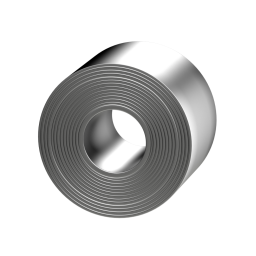
Coil
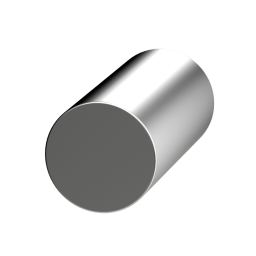
Disc
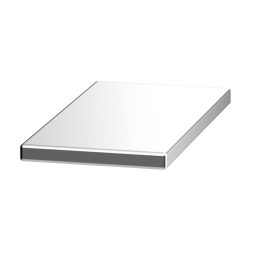
Flat Bar

Foil
Hollow Bar
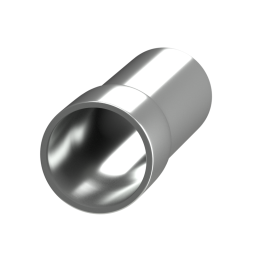
Pipe
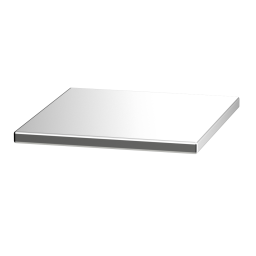
Plate

Rectangle Tube
Ring
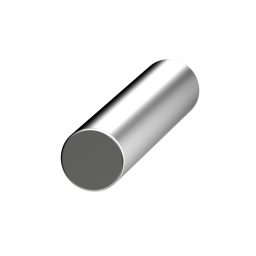
Rod
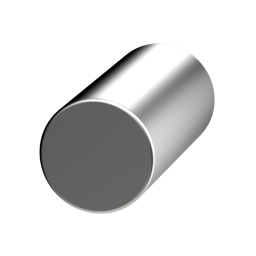
Round Bar
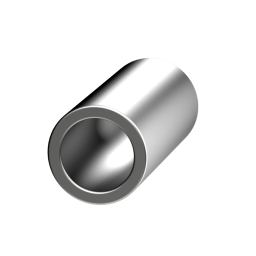
Round Tube
Sheet
Square Bar
Strip
Additional Data
Specifications
661,5532,5585,5768,5769,5794,B639,2.4964,B50A484,R30155Chemical Elements
| Carbon | 0.08 - 0.16 |
| Chromium | 20 - 22.5 |
| Cobalt | 18.5 - 21 |
| Iron | Balance |
| Manganese | 1 - 2 |
| Molybdenum | 2.5 - 3.5 |
| Nickel | 19 - 21 |
| Niobium+Tantalum | 0.75 - 1.25 |
| Nitrogen | 0.1 - 0.2 |
| Phosphorus | 0.04 max |
| Silicon | 1 max |
| Sulphur | 0.03 max |
| Tungsten | 2 - 3 |
Physical Properties
Density: 0.296lb/in³
Electrical Resistivity: 558µΩ·cm
Melting Point: 2450°F
Poissons Ratio: 0.298
Specific Gravity: 8.2
Specific Heat: 0.104BTU/lb·°F
Mechanical Properties
Thermal Conductivity: 8.4167BTU/hr·ft·°F
Thermal Expansion: 8.5µin/in·°F
Thermal Conductivity
| Condition | Temperature | Conductivity |
|---|---|---|
| Annealed | 70 °F | 10.1 BTU/hr·ft·°F |