Nickel
Nickel alloy 49
Annealing Procedure
To achieve maximum magnetic softness and optimum magnetic and electrical properties, Alloy 49 should be annealed in a dry hydrogen atmosphere at 2150°F (1177°C) for 2–4 hours, followed by furnace cooling at a rate of 100–200°F per hour down to 800°F, then at any rate thereafter. A low-temperature hydrogen anneal at 1300–1400°F (704–760°C) can also be used to develop constant permeability characteristics (initial permeability ~500 gauss). Process annealing at 1600°F (871°C) is also referenced for intermediate conditions.
Applications
Alloy 49 is used primarily in laminated cores for instrument transformers, magnetic shielding components, and cores for electronic and communications devices where extremely high permeability at low magnetizing forces is required. Additional applications include solenoid cores for sensitive light-duty relays, magnetic amplifiers, power supply chokes, inductors, transformer cores, and telecommunications equipment. It is also used for glass-to-metal sealing of fiber optic connections due to its low and consistent thermal expansion characteristics. The alloy is sought after in aerospace, defense, automotive, and commercial electronics industries.
Corrosion Resistance
Alloy 49 has moderate corrosion resistance. It resists weather and moisture corrosion to a moderate extent but is not suitable for highly corrosive environments without protective coatings. Protective surface treatments may be required in harsh or aggressive chemical environments.
Formability
Alloy 49 is a ductile alloy that can be stamped and deep drawn into parts on a mass production scale. It is typically used in the annealed condition for forming operations. Deep drawing requires a combination of small grain size, excellent ductility, and non-directional mechanical properties. The alloy can be cold processed in the annealed condition.
Machinability
The standard grade of Alloy 49 machines somewhat like austenitic stainless steels. It develops gummy chips but does not work-harden as rapidly as stainless steels. Work-hardened bar stock offers the best machining characteristics. Animal lard oil (not sulfur-bearing cutting compounds) should be used for drilling and machining operations performed at low speeds, as sulfur-bearing compounds are highly detrimental to final magnetic properties. For high-volume machining from bar stock, the free-machining grade (High Permeability 49-FM) is recommended. Parts should be degreased and cleaned as soon as possible after machining.
Other Comments
Alloy 49 is known by several trade names including High Permeability 49® (Carpenter Technology / Carpenter Electrification), High Perm 49®, Alloy 4750, and Low Expansion 49. The alloy is covered under ASTM A753 as Alloy Type 2 (UNS K94840). The free-machining variant is designated High Permeability 49-FM and is not covered by ASTM A753 (which excludes alloys modified with sulfur or selenium for machinability). The modulus of elasticity varies by condition: 22.0 × 10³ ksi (process annealed bar, tension), 22.5 × 10³ ksi (hydrogen annealed bar, tension), and 24.0 × 10³ ksi (cold drawn bar or cold rolled strip, tension).
Other Physical Properties
Curie temperature: 840–930°F (449–499°C). Specific gravity: 8.18. Electrical resistivity: 49 µΩ·cm (290 ohm·cir-mil/ft). Temperature coefficient of electrical resistance: 20.0 × 10⁻⁴ Ohm/Ohm/°F. Saturation flux density: approximately 15,000–16,000 gauss (1.5–1.6 Tesla) after hydrogen annealing. Magnetic permeability can exceed 100,000 after proper heat treatment.
Principle Design Features
Alloy 49 (also known as High Permeability 49, Alloy 4750, and Low Expansion 49) is a 48% nickel-iron binary alloy (UNS K94840) that possesses the highest saturation flux density (~16,000 gauss / 1.6 Tesla) of any nickel-iron alloy. It combines high initial and maximum magnetic permeability with low core loss and low coercive force after appropriate hydrogen annealing. The alloy also exhibits a consistently low rate of thermal expansion, making it suitable for glass-to-metal sealing applications. It is available in three grades (standard, rotor grade, and transformer grade) depending on intended end application.
Weldability
Alloy 49 can be welded. Standard welding practices applicable to austenitic nickel-iron alloys are generally appropriate. Post-weld hydrogen annealing is recommended to restore optimum magnetic properties after welding operations.
Known Forms
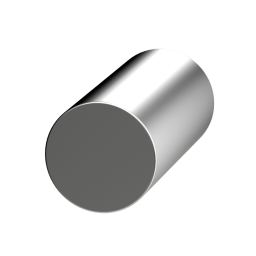
Billet
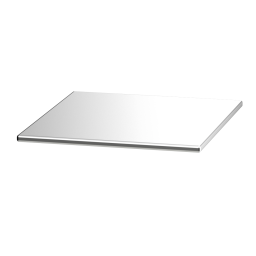
Foil
Ring
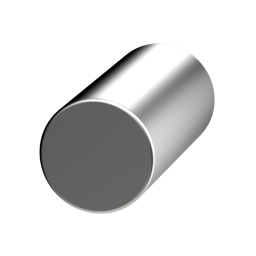
Round Bar
Sheet
Strip
Wire Round
Additional Data
Specifications
K94840,A753,7718,N-14411Chemical Elements
| Carbon | 0.05 max |
| Iron | Balance |
| Manganese | 0.8 max |
| Nickel | Primary alloying element |
| Phosphorus | 0.03 max |
| Silicon | 0.5 max |
| Sulfur | 0.025 max |
Physical Properties
Density: 0.295lb/in³
Electrical Resistivity: 49µΩ·cm
Melting Point: 2600°F
Modulus of Elasticity: 22MSI
Specific Heat: 0.12BTU/lb·°F
Thermal Conductivity
| Condition | Temperature | Conductivity |
|---|---|---|
| Annealed | 70 °F | 7.52 BTU/hr·ft·°F |
Thermal Expansion
| Condition | Min | Max | Expansion Coefficient |
|---|---|---|---|
| Annealed | 75 °F | 842 °F | 5 μin/in·°F |
Mechanical Test Data
| Form | Round Bar |
| Condition | Annealed |
| Temperature | 70°F |
| Elongation | 30% |
| Rockwell Hardness | B80 |
| Tensile Strength | 79 KSI |
| Yield Strength | 36 KSI |