Nickel
Nickel Duranickel (tm)
Aging Procedure
See "Heat Treat".
Annealing Procedure
Anneal art 1700 F for 5 minutes at temperature and rapid cool.
Applications
Applications include electrical conductivity parts, such as springs, parts that need good thermal conductivity and good fatigue strength.
Cold Workability
Cold working is readily accomplished by conventional means. The alloy does work harden and, depending upon the amount of cold work, it may be necessary to give the part an intermediate anneal to complete working.
Forgeability
The alloy may be forged in the range of 2250 F to 1900 F.
Formability
Formability by conventional means is good. Cold working does strengthen (harden) the alloy.
Hardening Procedure
Hardens by cold working or aging - see "Heat Treat".
Heat Treatability
Anneal at 1700 F for approximately 5 minutes at temperature and rapid cool or water quench. Age-hardening is accomplished at 1090 F for 16 hours and furnace cool to 900 F at a slow, furnace cooled, rate of less than 15 degrees per hour. Cooling rate after 900 F is not critical -- furnace cooling or rapid cooling may be used.
Hot Workability
Hot work in the temperature range of 2150 F to 1600 F.
Machinability
The alloy may be readily machined by conventional methods. It is not as "gummy" as Nickel 200, but because of the aluminum content it tends to be abrasive to cutting tools. Machining this alloy in the cold worked or age-hardened condition is easier than in the soft annealed condition. High-speed-steel cutting tools with a high positive rake angle should be used.
Principle Design Features
This is an age-hardenable alloy, similar to Nickel 200 but with greater strength and hardness.
Weldability
If welding of this alloy is required it may be done with the ordinary welding techniques. It should be welded while in the annealed condition and then stress-relieved at 1550 F for 1/2 hour. Heating to the 1550 F temperature must be done rapidly to avoid cracking.
Known Forms
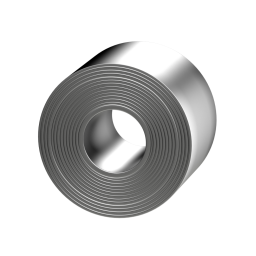
Coil
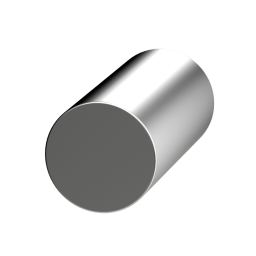
Disc
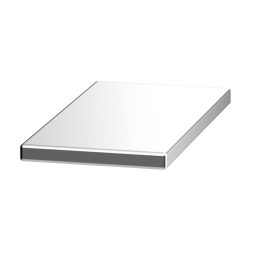
Flat Bar
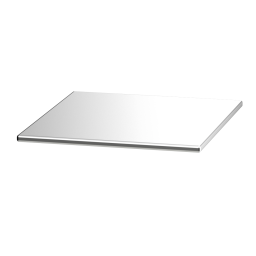
Foil
Hollow Bar
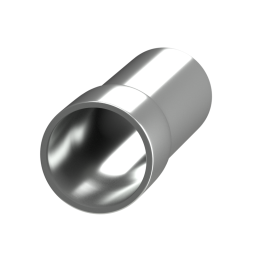
Pipe
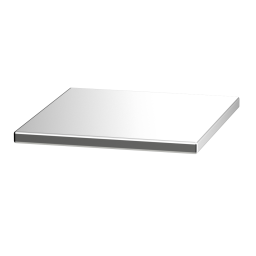
Plate

Rectangle Tube
Ring
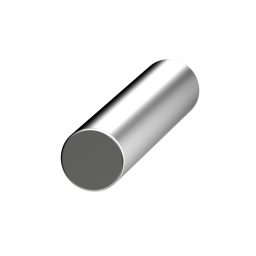
Rod
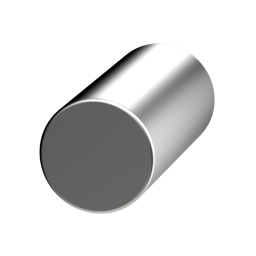
Round Bar
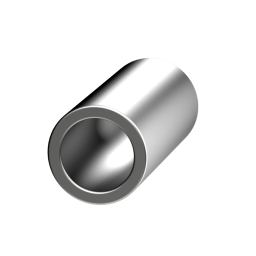
Round Tube
Sheet
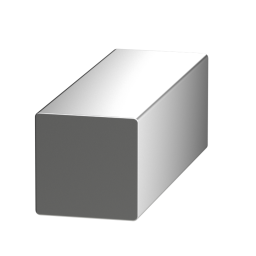
Square Bar
Strip
Additional Data
Chemical Elements
| Aluminum | 4 - 4.75 |
| Carbon | 0.3 max |
| Copper | 0.25 max |
| Iron | 0.6 max |
| Manganese | 0.5 max |
| Nickel | Balance |
| Silicon | 1 max |
| Sulphur | 0.01 max |
| Titanium | 0.25 - 1 |
Physical Properties
Density: 0.296lb/in³
Electrical Resistivity: 255µΩ·cm
Melting Point: 2600°F
Poissons Ratio: 0.3
Specific Gravity: 8.26
Specific Heat: 0.104BTU/lb·°F
Mechanical Properties
Modulus of Elasticity – Tension: 30MSI
Thermal Conductivity: 23.3333BTU/hr·ft·°F
Thermal Expansion: 7.2µin/in·°F
Thermal Conductivity
| Condition | Temperature | Conductivity |
|---|---|---|
| Solution Annealed & Aged | 70 °F | 16.5 BTU/hr·ft·°F |
| Solution Annealed & Aged | 400 °F | 19.7 BTU/hr·ft·°F |
| Solution Annealed & Aged | 1000 °F | 26.6 BTU/hr·ft·°F |
| Solution Annealed & Aged | 1400 °F | 30.4 BTU/hr·ft·°F |
| Solution Annealed & Aged | 2000 °F | 36 BTU/hr·ft·°F |
Thermal Expansion
| Condition | Min | Max | Expansion Coefficient |
|---|---|---|---|
| Solution Annealed & Aged | 70 °F | 212 °F | 7.2 μin/in·°F |
| Solution Annealed & Aged | 70 °F | 392 °F | 7.5 μin/in·°F |
| Solution Annealed & Aged | 70 °F | 932 °F | 8.1 μin/in·°F |
| Solution Annealed & Aged | 70 °F | 1600 °F | 9.1 μin/in·°F |