Nickel
Nickel hymu 80
Annealing Procedure
For maximum softness and optimum magnetic and electrical properties, HyMu 80 should be annealed in an oxygen-free, dry hydrogen atmosphere with a dew point below -40°F (-40°C) at 2050–2150°F (1121–1177°C) for 2 to 4 hours. Furnace cool to 1100°F (593°C), then from 1100 to 700°F (593 to 371°C) cool at a rate of 350–600°F (194–334°C) per hour. For in-process annealing between cold working operations, anneal at 1450–1850°F (788–1010°C) for not more than 1 hour. Annealing should be conducted in dissociated ammonia, hydrogen, vacuum, or inert gas atmospheres, as the high-nickel alloy readily absorbs carbon, sulfur, oxygen, and other contaminants from combustion furnace gases. Oil, grease, lacquer, and all other contaminants must be removed prior to annealing.
Applications
HyMu 80 has been used primarily in transformer cores, tape wound toroids, and laminations where compactness and weight factors are important. It is also widely used for magnetic shielding to protect electrical and electronic components from stray or low-frequency magnetic fields. Additional applications include relays, inductors, power transformers, and high-quality motor laminations.
Corrosion Resistance
HyMu 80 is only moderately resistant to moisture and atmospheric corrosion. It is not intended for use in severely corrosive environments without protective coatings or enclosures.
Formability
Annealed, deep-draw quality strip can be fabricated into shields by bending, drawing, and spinning. For best forming characteristics, strip should be ordered in the cold rolled and annealed condition. For best blanking characteristics, strip should be ordered in the cold rolled condition (Rockwell B 90 minimum). For best drawing characteristics, strip should be specified as annealed, deep draw quality.
Machinability
HyMu 80 machines somewhat like the austenitic stainless alloys but does not work harden as rapidly. Gummy chips develop in most machining operations. Work-hardened bars (Rockwell B 90 minimum) offer the best machining characteristics. Lard oil should be used for drilling and machining operations, which must be done at slow speeds. If sulfur-bearing or water-soluble cutting compounds are used, parts should be thoroughly cleaned within 48 hours and then heat treated. High-speed steel or carbide tools are recommended.
Other Comments
HyMu 80 is also known as Permalloy 80, Moly-Permalloy, MuMetal (generic), Magnifer 7904 (VDM), and Moly Permalloy 80 (ATI). To develop best shielding characteristics, shields must be annealed at 1900°F (1040°C) or higher after all fabricating operations are completed; in general, higher annealing temperatures yield higher permeability and better shielding characteristics. The alloy should not be used at cryogenic temperatures without special consideration, as maximum permeability degrades significantly at low temperatures.
Other Physical Properties
Curie Temperature: 830°F (410°C). Specific Gravity: 8.74. The alloy exhibits a minimum DC permeability of 80,000 at 40 gauss (annealed and tested per ASTM A596). Electrical resistivity is 349 ohm-cir-mil/ft (55 µΩ·cm) at 70°F in the annealed condition.
Principle Design Features
HyMu 80 is an unoriented, 80% nickel-iron-molybdenum soft magnetic alloy offering extremely high initial permeability and maximum permeability with minimum hysteresis loss. It has a minimum DC permeability of 80,000 at a flux density of 40 gauss when heat treated per recommended procedure and tested per ASTM A596. The alloy is also known by trade names Permalloy 80 and Moly-Permalloy, and is equivalent to VDM Magnifer 7904 and ATI Moly Permalloy.
Weldability
HyMu 80 is readily welded by following the usual practices for ferrous alloys. Spot welding or tungsten inert-gas (TIG) welding can be used, with or without a base metal filler rod. If a filler metal is required, use the same alloy analysis. Finished annealed parts can be soft or hard soldered. Do not braze or solder prior to final heat treatment, as welded or formed components must be annealed after fabrication to develop optimum magnetic properties.
Known Forms
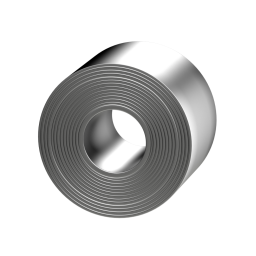
Coil
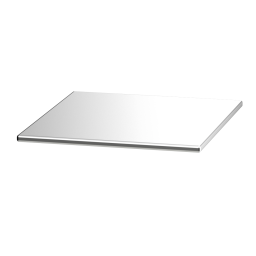
Foil
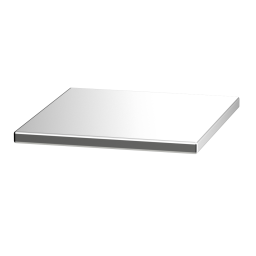
Plate
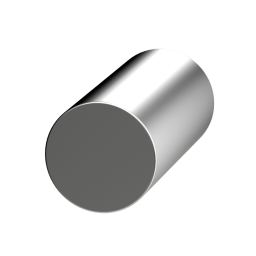
Ribbon
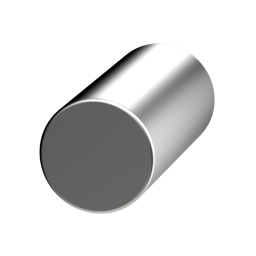
Round Bar
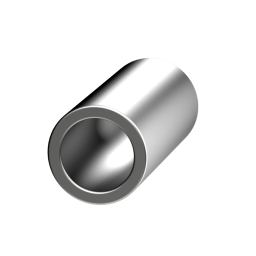
Round Tube
Sheet
Strip
Wire Round
Additional Data
Specifications
A753,N14080,N-14411CChemical Elements
| Carbon | 0.02 max |
| Iron | Balance |
| Manganese | 0.35 max |
| Molybdenum | 4.2 max |
| Nickel | Primary alloying element |
| Silicon | 0.35 max |
Physical Properties
Density: 0.316lb/in³
Electrical Resistivity: 55µΩ·cm
Modulus of Elasticity: 31.4MSI
Specific Heat: 0.118BTU/lb·°F
Thermal Conductivity
| Condition | Temperature | Conductivity |
|---|---|---|
| Annealed | 70 °F | 11.2 BTU/hr·ft·°F |
Thermal Expansion
| Condition | Min | Max | Expansion Coefficient |
|---|---|---|---|
| Annealed | 70 °F | 400 °F | 7.2 μin/in·°F |
Mechanical Test Data
| Form | Round Bar |
| Condition | Annealed |
| Temperature | 70°F |
| Elongation | 50% |
| Rockwell Hardness | B83 |
| Tensile Strength | 75 KSI |
| Yield Strength | 27 KSI |
| Form | Strip |
| Condition | Annealed |
| Temperature | 70°F |
| Elongation | 50% |
| Rockwell Hardness | B83 |
| Tensile Strength | 75 KSI |
| Yield Strength | 27 KSI |