Nickel
Nickel Inconel 625
Annealing Procedure
For hot- or cold-formed parts, anneal at 1700°–1900°F (927°–1038°C) for times commensurate with section thickness, followed by air or rapid quenching. Higher temperatures within this range or up to 2000°F may be used to soften material for additional cold work. These temperatures are metal temperatures for batch operations and may not apply to continuous annealing. The rate of cooling after annealing has no significant effect on properties. When heated, Inconel 625 forms a tightly adherent oxide scale unless bright-annealed in very dry hydrogen or vacuum; treatment in a fused-salt bath prior to pickling is recommended to remove scale from furnace-heated material.
Applications
Inconel 625 (UNS N06625) is used across a broad range of demanding industries. Aerospace applications include jet engine exhaust systems, combustion liners, afterburner hardware, thrust-reverser systems, aircraft ducting, bellows, turbine shroud rings, and heat-exchanger tubing in environmental control systems. Marine applications include mooring cables, propeller blades, submarine auxiliary propulsion motors, submarine quick-disconnect fittings, exhaust ducts for Navy utility boats, sheathing for submarine communication cables, and steam-line bellows. Oil and gas applications include subsea umbilical tubes, flexible riser armor and pressure sheaths, chemical injection lines, and offshore pipe systems. Chemical processing applications include reaction vessels, heat exchangers, distillation columns, transfer piping, valves, and equipment handling both oxidizing and reducing acids including hydrochloric, nitric, phosphoric, and sulfuric acids. Nuclear applications include reactor-core and control-rod components in pressurized water reactors and heat exchanger tubes in ammonia cracker plants for heavy water production. Additional uses include pollution-control equipment (chimney liners, flue gas desulfurization components), springs, seals, electrical cable connectors, fasteners, flexure devices, and oceanographic instrument components.
Cold Workability
Inconel 625 responds well to standard cold-forming methods. However, the alloy work-hardens more rapidly than conventional austenitic stainless steels, generating higher forming forces. Intermediate annealing at 1700°–1900°F is recommended when multiple cold-forming passes are required. Increased tensile properties can be achieved by cold work for moderate-temperature applications; tensile strengths exceeding 300,000 psi with good ductility have been developed in wire after 75–90% cold reduction. The effect of cold work on plate properties is well characterized in the Special Metals technical bulletin.
Corrosion Resistance
Inconel 625 exhibits outstanding corrosion resistance in a wide range of severely corrosive media. In mild environments such as the atmosphere, fresh water, sea water, neutral salts, and alkaline media, there is virtually no attack. The combination of nickel and chromium provides resistance to oxidizing chemicals, while the high nickel and molybdenum contents supply resistance to non-oxidizing environments. The high molybdenum content makes the alloy highly resistant to pitting and crevice corrosion. Niobium stabilizes the alloy against sensitization during welding, preventing subsequent intergranular cracking. The high nickel content provides near-immunity to chloride ion stress-corrosion cracking. The alloy resists attack by mineral acids such as hydrochloric, nitric, phosphoric, and sulfuric acids, as well as alkalis and organic acids in both oxidizing and reducing conditions. It is also resistant to impingement corrosion and intergranular attack.
Formability
Inconel 625 can be cold-formed by all standard processes including deep drawing, spinning, press forming, and roll forming. The alloy work-hardens more rapidly than austenitic stainless steels; therefore, intermediate annealing may be required for severe cold-forming operations. The alloy has excellent ductility in the annealed condition, with elongations typically ranging from 30 to 65% depending on product form and condition. Cold-worked material can achieve tensile strengths exceeding 300,000 psi in wire after 75–90% cold reduction. Hot-formed or cold-formed parts are generally annealed at 1700°–1900°F to restore properties.
Heat Treatability
Inconel 625 does not require precipitation-hardening heat treatments to achieve its characteristic properties; strength is derived from solid-solution hardening by molybdenum and niobium. Three heat treatment options are available: (1) Annealing at 1600°–1900°F (927°–1038°C) with air or rapid quenching – produces optimal tensile and yield strength with fine grain size, preferred for applications up to approximately 1500°F; (2) Solution annealing at 2000°–2200°F (1093°–1204°C) with air or rapid quenching – produces maximum creep and rupture resistance with coarser grain size, preferred for elevated-temperature service above 1500°F; (3) Stress relieving at 1100°–1600°F (593°–871°C) – reduces residual stresses in cold-drawn or cold-worked material. No post-weld heat treatment is required after welding.
Hot Workability
Inconel 625 is readily hot-worked, but because it was designed to retain high strength at elevated temperatures, it resists deformation at hot-working temperatures and requires adequate power. Hot working should be performed at temperatures up to but not above 2150°F (1177°C). The work should be brought as close to 2150°F as conditions permit. Heavy forging can be carried out from 2150°F down to 1850°F (1010°C), and lighter reductions can be taken down to 1700°F (927°C). To guard against duplex grain structure, the work should be given uniform reductions, with final minimum reductions of at least 15%.
Machinability
Inconel 625 is classified as moderate to difficult to machine due to its rapid work-hardening rate, high heat generation during cutting, tendency to weld to cutting tool surfaces, and high resistance to metal removal owing to its high shear strength. However, the alloy can be machined using conventional production methods at satisfactory rates with proper technique. Key guidelines: use rigid, overpowered machines; keep the work piece and tool held rigidly with minimal tool overhang; maintain sharp tooling at all times, replacing at regular intervals rather than waiting for tool failure (a 0.015-inch wear land is considered dull); use heavy, constant feeds to maintain positive cutting action and prevent work-hardening the surface; use appropriate cutting fluids. Recommended speeds are approximately 35 sfm with high-speed steel cutters and 110 sfm with carbide tooling.
Other Comments
Inconel 625 was developed in the 1960s by Special Metals Corporation (originally Huntington Alloy Products) initially for steam-line piping for supercritical steam plants. The alloy is also known commercially as Haynes 625, Nickelvac 625, Nicrofer 6020, Altemp 625, and Chronin 625. The designation '625' reflects the alloy's ability to achieve yield strengths of approximately 60,000 psi (414 MPa) in the annealed condition without precipitation hardening. INCONEL is a registered trademark of Special Metals Corporation.
Other Physical Properties
Inconel 625 is non-magnetic in the annealed condition and remains so throughout its service temperature range. The alloy is austenitic (face-centered cubic crystal structure). It is double-melted in commercial production, typically using Electric Furnace/Argon Oxygen Decarburization (EF-AOD) or Vacuum Induction Melting (VIM) as the primary melt, followed by Vacuum Arc Remelt (VAR) or Electroslag Remelting (ESR) as the secondary melt to ensure homogeneity and cleanliness. A low-cycle fatigue variant (625 LCF, UNS N06626) is produced by VIM with fine grain size for improved thermal stability and fatigue resistance in cyclic applications such as bellows.
Principle Design Features
Inconel 625 is an austenitic nickel-chromium-molybdenum-niobium superalloy (UNS N06625, Werkstoff Nr. 2.4856) that derives its high strength from solid-solution strengthening of the nickel-chromium matrix by molybdenum and niobium, eliminating the need for precipitation-hardening heat treatments. It is non-magnetic in the annealed condition. The alloy maintains exceptional strength and toughness across an extremely wide temperature range, from cryogenic service to approximately 1800°F (982°C). It offers outstanding fabricability including excellent weldability, formability, and cold and hot workability. The combination of nickel, chromium, molybdenum, and niobium also imparts outstanding resistance to a wide range of severely corrosive environments. Service temperatures range from cryogenic to 1800°F (982°C) in oxidizing environments.
Weldability
Inconel 625 is readily joined by all conventional welding processes including gas tungsten arc welding (GTAW/TIG), gas metal arc welding (GMAW/MIG), shielded metal arc welding (SMAW), and electron-beam welding. Recommended filler metals are INCONEL Filler Metal 625 (AWS ERNiCrMo-3, AMS 5837) for gas-shielded processes and INCONEL Welding Electrode 112 (AWS ENiCrMo-3) for shielded metal arc welding. No post-weld heat treatment is required to maintain high strength and ductility. Niobium in the alloy acts as a stabilizer during welding to prevent sensitization and subsequent intergranular cracking. The alloy tolerates a high degree of dilution when welding to dissimilar metals. Weld metals from both INCONEL filler products have high strength and toughness from cryogenic temperatures to 1800°F.
Known Forms
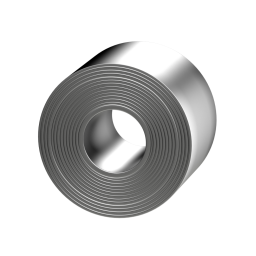
Coil
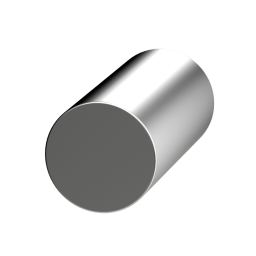
Disc
Fitting
Flange
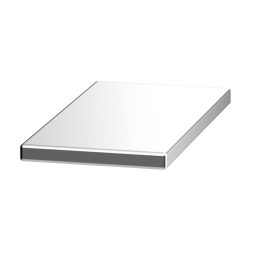
Flat Bar
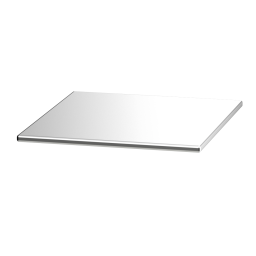
Foil
Hollow Bar
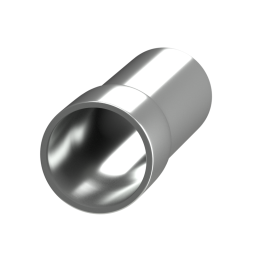
Pipe
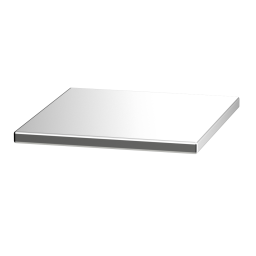
Plate
Powder
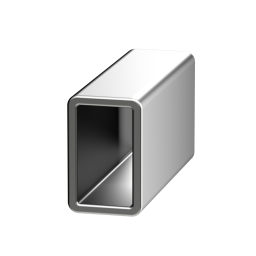
Rectangle Tube
Ring
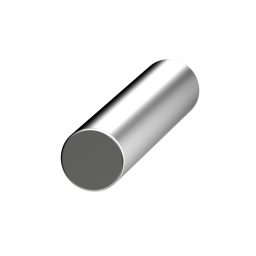
Rod
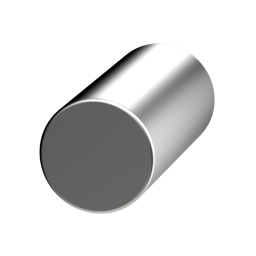
Round Bar
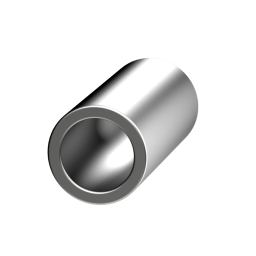
Round Tube
Sheet
Specialty Form
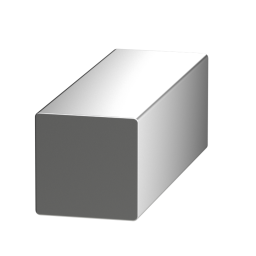
Square Bar
Strip
Valve
Wire Flat
Wire Round
Wire Square
Additional Data
Specifications
5581,5599,5666,5837,B366,B443,B444,B446,B564,B704,B705,2.4856,N06625,B751,SB-443,SB-444,SB-446,SB-564,ERNiCrMo-3Chemical Elements
| Aluminum | 0.4 max |
| Carbon | 0.1 max |
| Chromium | 20 - 23 |
| Cobalt | 1 max |
| Iron | 5 max |
| Manganese | 0.5 max |
| Molybdenum | 8 - 10 |
| Nickel | Balance |
| Niobium | 3.15 - 4.15 |
| Phosphorus | 0.015 max |
| Silicon | 0.5 max |
| Sulfur | 0.015 max |
| Titanium | 0.4 max |
Physical Properties
Density: 0.305lb/in³
Electrical Resistivity: 127µΩ·cm
Melting Point: 2354°F
Modulus of Elasticity: 30.1MSI
Specific Heat: 0.098BTU/lb·°F
Mechanical Properties
Thermal Conductivity: 5.5BTU/hr·ft·°F
Thermal Conductivity
| Condition | Temperature | Conductivity |
|---|---|---|
| Annealed | 70 °F | 5.5 BTU/hr·ft·°F |
Thermal Expansion
| Condition | Min | Max | Expansion Coefficient |
|---|---|---|---|
| Annealed | 70 °F | 200 °F | 7.1 μin/in·°F |
| Annealed | 70 °F | 400 °F | 7.3 μin/in·°F |
| Annealed | 70 °F | 600 °F | 7.5 μin/in·°F |
| Annealed | 70 °F | 800 °F | 7.7 μin/in·°F |
Mechanical Test Data
| Form | Round Bar |
| Condition | Annealed |
| Temperature | 70°F |
| Brinell Hardness | 145 HB |
| Elongation | 60% |
| Reduction of Area | 60% |
| Tensile Strength | 120 KSI |
| Yield Strength | 60 KSI |
| Form | Plate |
| Condition | Annealed |
| Temperature | 70°F |
| Brinell Hardness | 145 HB |
| Elongation | 60% |
| Reduction of Area | 60% |
| Tensile Strength | 120 KSI |
| Yield Strength | 60 KSI |
| Form | Sheet |
| Condition | Annealed |
| Temperature | 70°F |
| Brinell Hardness | 145 HB |
| Elongation | 55% |
| Tensile Strength | 120 KSI |
| Yield Strength | 60 KSI |
| Form | Strip |
| Condition | Annealed |
| Temperature | 70°F |
| Brinell Hardness | 145 HB |
| Elongation | 55% |
| Tensile Strength | 120 KSI |
| Yield Strength | 60 KSI |
| Form | Pipe |
| Condition | Annealed |
| Temperature | 70°F |
| Elongation | 55% |
| Tensile Strength | 120 KSI |
| Yield Strength | 60 KSI |
| Form | Round Tube |
| Condition | Annealed |
| Temperature | 70°F |
| Elongation | 55% |
| Tensile Strength | 120 KSI |
| Yield Strength | 60 KSI |
| Form | Round Bar |
| Condition | Solution Annealed |
| Temperature | 70°F |
| Brinell Hardness | 116 HB |
| Elongation | 65% |
| Reduction of Area | 90% |
| Tensile Strength | 105 KSI |
| Yield Strength | 42 KSI |
| Form | Plate |
| Condition | Solution Annealed |
| Temperature | 70°F |
| Brinell Hardness | 116 HB |
| Elongation | 65% |
| Reduction of Area | 90% |
| Tensile Strength | 105 KSI |
| Yield Strength | 42 KSI |
| Form | Pipe |
| Condition | Solution Annealed |
| Temperature | 70°F |
| Elongation | 60% |
| Tensile Strength | 100 KSI |
| Yield Strength | 40 KSI |
| Form | Round Tube |
| Condition | Solution Annealed |
| Temperature | 70°F |
| Elongation | 60% |
| Tensile Strength | 100 KSI |
| Yield Strength | 40 KSI |