Nickel
Nickel Inconel 718
Aging Procedure
Standard aerospace aging (AMS 5663): Heat to 1325°F (718°C) for 8 hours, furnace cool at 100°F/hr to 1150°F (621°C), hold at 1150°F for a total aging cycle of 18 hours, then air cool. API/NACE sour-service aging (per NACE MR0175/ISO 15156-3): Solution anneal at approximately 1800°F (982°C), followed by aging at approximately 1328°F (720°C) for 8 hours, furnace cool to 1148°F (620°C), hold until total aging cycle equals 16–18 hours, then air cool. The NACE aging cycle is tailored to achieve ≤40 HRC hardness and a minimum yield strength of 120 KSI for sour-service compliance. Alloy 718 will show a dimensional contraction of approximately 0.0008 in/in after precipitation hardening.
Annealing Procedure
Solution anneal at 1700–1850°F (927–1010°C), followed by rapid cooling (air cool or faster, typically water quench). This dissolves strengthening precipitates and prepares the alloy for subsequent aging. For the API/NACE oil & gas variant, solution annealing is typically performed at approximately 1800°F (982°C) per NACE MR0175/ISO 15156-3 and API 6ACRA requirements. Continuous annealing hold time is approximately 1 hour; batch annealing may require up to 3 hours.
Applications
Inconel 718 API (UNS N07718) in the API 6ACRA/NACE condition is primarily used in oil and gas drilling and production equipment requiring sour-service resistance, including wellhead components, Christmas tree assemblies, downhole tubulars, subsea valves, pressure control valves, pumps, and completion tools. Aerospace applications include jet engine components, turbine disks, rocket motor components, fasteners, springs, and cryogenic tankage. Additional uses include industrial gas turbines, nuclear reactor components, and chemical processing equipment operating in aggressive environments.
Cold Workability
Inconel 718 can be cold worked and is available in various cold-reduced tempers. Cold working increases strength and hardness; the alloy can be strengthened further by subsequent aging. Multiple melting (VIM/VAR or VIM/ESR) is required for high-integrity cold-worked products. Intermediate anneals are required for significant deformation levels to restore ductility.
Corrosion Resistance
Inconel 718 offers excellent corrosion resistance derived from its high nickel and chromium content, which forms a stable, self-healing passive oxide layer. It resists oxidation up to 1800°F (980°C), chloride-induced pitting and crevice corrosion, and stress corrosion cracking in marine and chemical environments. The API/NACE variant meets NACE MR0175/ISO 15156-3 requirements for resistance to sulfide stress cracking (SSC) and stress corrosion cracking in H2S-containing sour gas environments. It also shows good resistance to seawater, CO2, elemental sulfur, organic acids, alkalies, and high-temperature oxidation, carburization, and nitridation.
Formability
Inconel 718 can be formed using conventional methods including cold rolling, drawing, bending, and deep drawing. The alloy work-hardens significantly during cold working, which may require intermediate anneals for severe deformation operations. Tooling must be designed to accommodate the alloy's high strength and springback characteristics. The annealed condition offers the best formability for complex shapes prior to final heat treatment.
Heat Treatability
Inconel 718 is strengthened by a two-step process: solution annealing followed by precipitation (aging) heat treatment. The exact cycle differs between aerospace (AMS) and oil & gas (API 6ACRA/NACE) variants. Both steps must be carefully controlled in terms of temperature, time, and cooling rate to achieve the desired balance of strength, hardness, and ductility. The API/NACE variant requires a specific aging cycle to keep hardness ≤40 HRC for sour-service compliance.
Hot Workability
Inconel 718 can be hot worked (forged, rolled, extruded) over the temperature range of approximately 1750–2050°F (955–1120°C). Precise temperature control during hot working is critical; working below the delta (δ) solvus (~1800°F/982°C) promotes grain refinement via δ-phase pinning. Furnace atmospheres must be slightly reducing with very low sulfur content. The alloy must be clean and free of oils, grease, and scale before heating to prevent surface contamination.
Machinability
Inconel 718 is considered moderately difficult to machine due to its high strength, strong work-hardening tendency, high heat generation during cutting, and tendency to weld to cutting tool surfaces. Machining is best performed in the solution annealed condition prior to final aging to take advantage of lower hardness. Rigid, overpowered machines are required. Sharp, properly cooled tooling with reduced cutting speeds, heavy feeds, and flood coolant is recommended. Carbide or ceramic tooling is preferred for most operations.
Other Comments
Inconel 718 API refers specifically to material processed and heat-treated to meet API 6ACRA (supplement to API 6A – Specification for Wellhead and Christmas Tree Equipment) and NACE MR0175/ISO 15156-3 requirements for sour-service (H2S-containing) oilfield environments. The API/NACE variant has tighter compositional controls and a lower-temperature aging cycle compared to AMS aerospace variants, resulting in lower minimum yield (120 KSI vs. 150 KSI for AMS 5663) and a hardness cap of 40 HRC to minimize susceptibility to sulfide stress cracking and hydrogen embrittlement. The alloy is designated UNS N07718 and also known as DIN/Werkstoff Nr. 2.4668. It is produced by multiple-melt practice (VIM+VAR or VIM+ESR) to ensure compositional homogeneity and cleanliness required for critical pressure-containing applications.
Other Mechanical Properties
Excellent fatigue resistance under cyclic loading. Superior creep-rupture strength at temperatures up to 1300°F (704°C). Outstanding cryogenic toughness down to −423°F (−253°C / liquid hydrogen temperature). The alloy maintains approximately 25 MSI modulus of elasticity at 600°F and approximately 22 MSI at 1400°F. Hardness in the solution annealed condition is typically 20–28 HRC; in the aged condition (AMS 5663) approximately 36–43 HRC; in the NACE condition ≤40 HRC maximum.
Other Physical Properties
Melting range: 2300–2440°F (1260–1336°C). Density: 0.296 lb/in³ (8.19 g/cm³). Specific heat at 70°F: 0.104 BTU/lb·°F. Modulus of elasticity (dynamic, tension): 29.0 MSI at 70°F, decreasing to approximately 22 MSI at 1400°F. Magnetic permeability (annealed): ~1.013; (annealed and aged): ~1.011 – essentially non-magnetic. Electrical resistivity at room temperature: ~125 µΩ·cm. Alloy 718 will contract approximately 0.0008 in/in after precipitation hardening.
Principle Design Features
Inconel 718 is a gamma double-prime (γ″) precipitation-hardened nickel-chromium-iron superalloy. Its principal strengthening phase is Ni3Nb (γ″), supplemented by Ni3(Al,Ti) (γ′). The sluggish precipitation kinetics of γ″ at moderate temperatures permit welding without rapid hardening or cracking – a unique advantage over aluminum/titanium-hardened nickel alloys. The API variant is produced with tighter compositional controls and a specific solution anneal plus duplex aging cycle per API 6ACRA/NACE MR0175/ISO 15156-3, yielding a hardness ≤40 HRC for sour-service compatibility. The alloy retains excellent strength from cryogenic temperatures (−423°F) up to approximately 1300°F for continuous service.
Weldability
Inconel 718 has outstanding weldability compared to other precipitation-hardenable nickel superalloys. It can be welded in either the annealed or fully aged condition with resistance to post-weld age cracking. Preferred welding methods include Gas Tungsten Arc Welding (GTAW/TIG) and Plasma Arc Welding (PAW). Matching filler metal (AWS A5.14 ERNiFeCr-2 / AMS 5832) is recommended. Heat input should be kept low using stringer beads. Post-weld heat treatment (solution anneal followed by aging) is required to restore full mechanical properties. For the API/NACE condition, post-weld heat treatment must comply with API 6ACRA and NACE MR0175/ISO 15156-3 requirements.
Known Forms
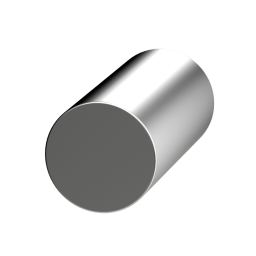
Billet
Disc
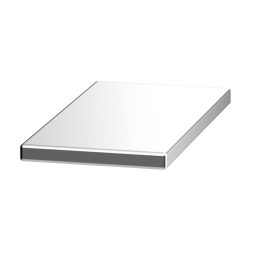
Flat Bar
Hollow Bar
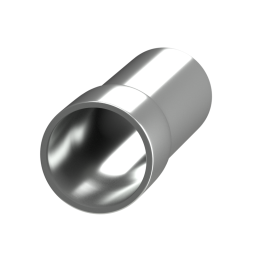
Pipe
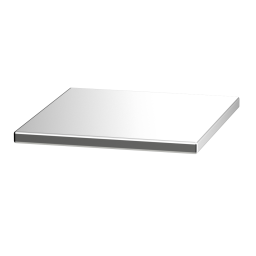
Plate
Ring
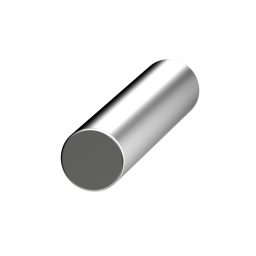
Rod
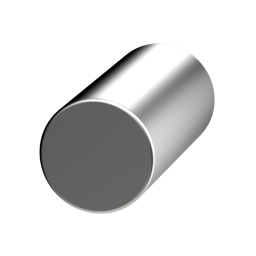
Round Bar
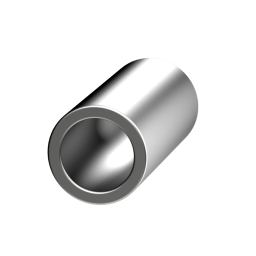
Round Tube
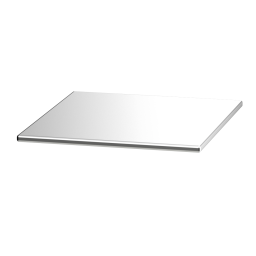
Sheet
Strip
Wire Round
Additional Data
Specifications
5589,5590,5596,5597,5662,5663,5664,5832,B637,B670,N07718,SB-637,6A718,15156-3Chemical Elements
| Aluminum | 0.2 - 0.8 |
| Boron | 0.006 max |
| Carbon | 0.08 max |
| Chromium | 17 - 21 |
| Cobalt | 1 max |
| Copper | 0.3 max |
| Iron | Balance |
| Manganese | 0.35 max |
| Molybdenum | 2.8 - 3.3 |
| Nickel | Primary alloying element |
| Niobium | 4.75 - 5.5 |
| Phosphorus | 0.015 max |
| Silicon | 0.35 max |
| Sulfur | 0.015 max |
| Titanium | 0.65 - 1.15 |
Physical Properties
Density: 0.296lb/in³
Electrical Resistivity: 125µΩ·cm
Melting Point: 2300°F
Modulus of Elasticity: 29MSI
Specific Heat: 0.104BTU/lb·°F
Thermal Conductivity
| Condition | Temperature | Conductivity |
|---|---|---|
| Annealed | 70 °F | 6.4 BTU/hr·ft·°F |
| Annealed | 200 °F | 7.2 BTU/hr·ft·°F |
| Annealed | 400 °F | 8.2 BTU/hr·ft·°F |
| Annealed | 600 °F | 9.3 BTU/hr·ft·°F |
| Annealed | 1000 °F | 11.3 BTU/hr·ft·°F |
| Annealed | 1200 °F | 12.3 BTU/hr·ft·°F |
| Annealed | 1400 °F | 13.3 BTU/hr·ft·°F |
Thermal Expansion
| Condition | Min | Max | Expansion Coefficient |
|---|---|---|---|
| Annealed | 70 °F | 200 °F | 7.3 μin/in·°F |
| Annealed | 70 °F | 400 °F | 7.5 μin/in·°F |
| Annealed | 70 °F | 600 °F | 7.7 μin/in·°F |
| Annealed | 70 °F | 1000 °F | 8.1 μin/in·°F |
| Annealed | 70 °F | 1200 °F | 8.4 μin/in·°F |
| Annealed | 70 °F | 1400 °F | 8.9 μin/in·°F |
Mechanical Test Data
| Form | Round Bar |
| Condition | Solution Annealed |
| Temperature | 70°F |
| Elongation | 30% |
| Rockwell Hardness | C28 |
| Tensile Strength | 120 KSI |
| Yield Strength | 60 KSI |
| Form | Plate |
| Condition | Solution Annealed |
| Temperature | 70°F |
| Elongation | 30% |
| Rockwell Hardness | C28 |
| Tensile Strength | 120 KSI |
| Yield Strength | 60 KSI |
| Form | Sheet |
| Condition | Solution Annealed |
| Temperature | 70°F |
| Elongation | 30% |
| Rockwell Hardness | C28 |
| Tensile Strength | 120 KSI |
| Yield Strength | 60 KSI |
| Form | Round Bar |
| Condition | Solution Treated & Aged |
| Temperature | 70°F |
| Elongation | 12% |
| Reduction of Area | 15% |
| Rockwell Hardness | C40 |
| Tensile Strength | 180 KSI |
| Yield Strength | 150 KSI |
| Form | Plate |
| Condition | Solution Treated & Aged |
| Temperature | 70°F |
| Elongation | 12% |
| Reduction of Area | 15% |
| Rockwell Hardness | C40 |
| Tensile Strength | 180 KSI |
| Yield Strength | 150 KSI |
| Form | Sheet |
| Condition | Solution Treated & Aged |
| Temperature | 70°F |
| Elongation | 12% |
| Rockwell Hardness | C40 |
| Tensile Strength | 180 KSI |
| Yield Strength | 150 KSI |
| Form | Round Bar |
| Condition | Solution Annealed & Aged |
| Temperature | 70°F |
| Elongation | 15% |
| Rockwell Hardness | C40 |
| Tensile Strength | 140 KSI |
| Yield Strength | 120 KSI |