Nickel
Nickel Invar 36
Annealing Procedure
The alloy softens progressively when heated in the range of 1000–2300°F (538–1260°C). Pronounced grain growth does not occur until 1900°F (1038°C) is exceeded. Two common methods: Method 1 — Heat parts to 1525°F ±25°F (829°C ±14°C) and hold at temperature for one-half hour per inch of thickness, then furnace cool at a rate not to exceed 200°F/hr to 600°F (316°C), then air cool. Method 2 — Heat to 1450°F (790°C) and hold 30 minutes per inch of thickness, then air cool. Material can also be air cooled or water quenched from the annealing temperature. Heating above 1000°F (538°C) relieves cold work stresses; the higher the temperature, the lower the annealed hardness achieved.
Applications
Invar 36 is used wherever high dimensional stability is required, including: aerospace composite tooling and carbon fiber layup molds; optical and laser systems and benches; cryogenic transport and storage equipment; liquefied natural gas (LNG) tankers and transfer lines; precision scientific instruments, gauges, and standards of length; thermostat and thermostat rods; clock pendulums and watch balance wheels; seismic creep gauges; shadow-mask frames for color television tubes; telecommunications and electronics components; and semiconductor manufacturing equipment.
Cold Workability
Invar 36 can be cold worked and does not work harden as rapidly as austenitic stainless steels. Cold working is effective in lowering the thermal expansivity of the alloy, though subsequent annealing will restore the annealed expansion coefficient. Material to be used in high-precision applications that has been subjected to cold working or machining may require a stress-relieving heat treatment for dimensional stabilization.
Corrosion Resistance
Invar 36 possesses a useful degree of corrosion resistance similar to other nickel-iron alloys. It performs adequately in normal atmospheric environments. As with all alloys, corrosion performance depends on factors including temperature, concentration, pH, impurities, aeration, velocity, crevices, surface finish, and dissimilar metal contact. Corrosion testing is recommended for specific service environments. The alloy can be chromium, cadmium, or nickel plated, or zinc coated using conventional methods for ferrous alloys.
Forgeability
Invar 36 can be hot forged. A forging temperature of 2000–2150°F (1100–1180°C) is preferred. The principal precaution is to heat quickly and avoid soaking in the furnace, as long soaking may result in a checked surface due to sulfur absorption from the furnace atmosphere and/or oxide penetration.
Formability
Invar 36 presents no unusual problems in blanking and forming. For cleanest blanking properties, a Rockwell hardness of B90 is suggested, which allows mild bending and forming operations. For deep drawing operations, a finish-annealed strip with a Rockwell hardness of about B75 is usually desirable. The alloy may also be swaged and cold upset. Invar 36 can be chemically etched.
Heat Treatability
Invar 36 cannot be hardened by any thermal treatment. Mechanical properties can only be improved through cold working. The expansion coefficient of the alloy is sensitive to heat treatment method: rapid cooling (quenching) decreases the expansion rate, while slow cooling increases it. Cold working is even more effective than quenching in lowering expansivity. The alloy is never used above its thermal inflection point.
Hot Workability
Invar 36 can be hot worked using standard equipment. A working temperature range of 2000–2150°F (1100–1180°C) is preferred. The alloy should be heated quickly to avoid excessive furnace soak time, which can lead to surface defects.
Machinability
Invar 36 is somewhat difficult to machine due to its high ductility and toughness. Its machinability characteristics are quite similar to austenitic stainless steels. High-speed steel or sintered carbide cutting tools should be used with edges kept sharp. Chips formed during machining tend to be stringy and tough, causing rapid wear on cutting edges. In general, slow speeds and light feeds are recommended to avoid excessive heat that could adversely affect thermal expansion characteristics. Soluble oil cutting compounds are recommended for all machining operations. A free-machining grade (with selenium addition, UNS K93050) is available for higher productivity applications.
Other Mechanical Properties
Invar 36 has a modulus of elasticity of approximately 20.5 MSI (141 GPa), which is approximately 79% that of carbon steel. The alloy exhibits good toughness and retains useful strength and ductility at cryogenic temperatures. It does have a propensity to creep, which should be considered in precision long-term structural applications. Stabilization treatment (water quench from 1500°F followed by aging 1 hour at 600°F, air cool) is recommended before use in high-precision dimensional applications.
Other Physical Properties
Invar 36 is a ferromagnetic material below its Curie temperature and non-magnetic above it. Since its low-expansion behavior occurs below the Curie point, the alloy is always magnetic in the temperature range where it exhibits its characteristic low CTE. The CTE of standard Invar 36 between 68°F and 212°F is approximately 0.44 µin/in·°F (0.8 µin/in·°C), rising to higher values above approximately 500°F. The alloy has relatively poor thermal conductivity (approximately 6.7 BTU/hr·ft·°F) compared to common structural metals.
Principle Design Features
Invar 36 is a nickel-iron, low-expansion alloy containing 36% nickel. It maintains nearly constant dimensions over the range of normal atmospheric temperatures, with a coefficient of thermal expansion approximately one-tenth that of carbon steel. This characteristic low CTE persists from cryogenic temperatures up to approximately 400–500°F (204–260°C). The alloy is strong, tough, ductile, and magnetic below its Curie point. It cannot be hardened by thermal treatment but can be strengthened moderately by cold work.
Weldability
Invar 36 can be welded by conventional methods including GTAW (TIG) and GMAW (MIG). Caution must be taken not to overheat the molten metal, as overheating causes spattering and pits in the weld area. When filler rod is required, Invarod (same composition filler) is recommended; otherwise mild steel or 18-8 stainless steel rods may be employed if matching properties are not required. For brazing, silver- and zinc-free alloys are recommended, and the material should be annealed prior to brazing. Joints should be designed to avoid placing Invar 36 in tension during brazing.
Known Forms
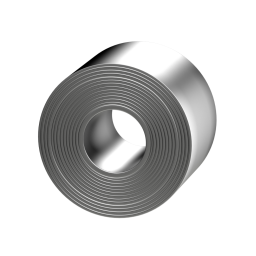
Coil
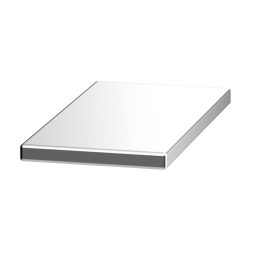
Flat Bar
Foil
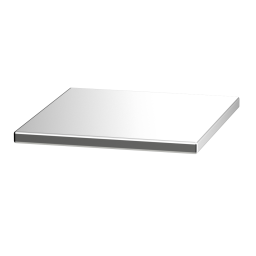
Plate
Rod
Round Bar
Sheet
Strip
Wire Round
Additional Data
Specifications
1.3912,K93600,F1684,K93603,B753,A658,MIL-I-23011 CL 7,MIL-S-16598Chemical Elements
| Carbon | 0.1 max |
| Chromium | 0.5 max |
| Copper | 0.5 max |
| Iron | Balance |
| Manganese | 0.6 max |
| Molybdenum | 0.5 max |
| Nickel | Primary alloying element |
| Phosphorus | 0.025 max |
| Silicon | 0.35 max |
| Sulfur | 0.025 max |
Physical Properties
Density: 0.293lb/in³
Electrical Resistivity: 80µΩ·cm
Melting Point: 2601°F
Modulus of Elasticity: 20.5MSI
Specific Heat: 0.123BTU/lb·°F
Mechanical Properties
Thermal Conductivity: 6.7BTU/hr·ft·°F
Thermal Conductivity
| Condition | Temperature | Conductivity |
|---|---|---|
| Annealed | 70 °F | 6.7 BTU/hr·ft·°F |
Thermal Expansion
| Condition | Min | Max | Expansion Coefficient |
|---|---|---|---|
| Annealed | -328 °F | 68 °F | 0.18 μin/in·°F |
| Annealed | -148 °F | 68 °F | 0.44 μin/in·°F |
| Annealed | 68 °F | 212 °F | 0.44 μin/in·°F |
| Annealed | 68 °F | 302 °F | 0.72 μin/in·°F |
| Annealed | 68 °F | 392 °F | 0.78 μin/in·°F |
| Annealed | 68 °F | 482 °F | 0.83 μin/in·°F |
Mechanical Test Data
| Form | Round Bar |
| Condition | Annealed |
| Temperature | 70°F |
| Elongation | 35% |
| Reduction of Area | 65% |
| Rockwell Hardness | B70 |
| Tensile Strength | 65 KSI |
| Yield Strength | 40 KSI |
| Form | Strip |
| Condition | Annealed |
| Temperature | 70°F |
| Elongation | 35% |
| Reduction of Area | 65% |
| Rockwell Hardness | B70 |
| Tensile Strength | 65 KSI |
| Yield Strength | 40 KSI |
| Form | Plate |
| Condition | Annealed |
| Temperature | 70°F |
| Elongation | 42% |
| Tensile Strength | 71 KSI |
| Yield Strength | 35 KSI |
| Form | Round Bar |
| Condition | Cold Drawn |
| Temperature | 70°F |
| Elongation | 20% |
| Reduction of Area | 60% |
| Rockwell Hardness | B90 |
| Tensile Strength | 90 KSI |
| Yield Strength | 70 KSI |
| Form | Strip |
| Condition | Cold Rolled |
| Temperature | 70°F |
| Elongation | 5.5% |
| Rockwell Hardness | B98 |
| Tensile Strength | 104 KSI |
| Yield Strength | 98.5 KSI |