Nickel
Nickel Maraging 200
Aging Procedure
After solution annealing and machining or forming to final dimensions, the material is aged (precipitation hardened) at 900°F to 950°F (480°C to 510°C) for 3 to 6 hours, followed by air cooling. Large cross-sections should be aged for longer periods. No protective atmosphere is required. This treatment raises hardness to approximately Rc 43–46 for the 200 grade and develops the full ultra-high-strength properties. For die casting tooling applications, a modified aging cycle of 980–1000°F for 6 hours after rough machining and re-annealing is recommended.
Annealing Procedure
Solution annealing is performed at approximately 1500–1510°F (815–820°C) for 15–30 minutes for thin sections, or 1 hour per inch of thickness for heavier sections, followed by air cooling to room temperature. This produces a soft, fully martensitic structure with a hardness of approximately Rc 28–35. A protective atmosphere is not required since the alloy is essentially carbon-free.
Applications
Maraging 200 is used in aerospace and defense applications requiring ultra-high strength combined with toughness. Typical applications include bearings, Belleville springs, bolts, cannon recoil springs, rocket motor and missile cases, couplings, load cells, flexures for guidance mechanisms of missiles, helicopter drive shafts, transmission shafts, fan shafts in commercial jet engines, aircraft wing components and forgings, aluminum die casting dies, cold forming dies, plastic molding dies, cores, pins, punches, and trim knees.
Corrosion Resistance
Non-stainless varieties of maraging steel such as Maraging 200 are moderately corrosion-resistant and exhibit good resistance to stress corrosion cracking and hydrogen embrittlement. Protective coatings or platings are generally recommended for extended service in corrosive environments. The material may be nitrided to increase surface hardness and improve wear resistance.
Formability
In the solution annealed condition, Maraging 200 is relatively soft (Rc 30/35) and is readily formed and machined. The alloy may be cold rolled to as much as 90% reduction prior to aging without cracking. It is typically machined or formed to final dimensions before the aging heat treatment is applied, since dimensional change during aging is extremely small and predictable (approximately 0.001 in/in uniform shrinkage).
Hot Workability
Maraging 200 can be hot worked and is processed by standard hot-working practices used for high-alloy steels. It is available in hot-worked product forms including billet, bar, rod, plate, and sheet. Detailed hot-working procedures should follow mill recommendations.
Machinability
In the annealed condition, Maraging 200 is very tough and relatively soft (Rc 30/35 max), and its machinability is comparable to steels such as 4340 at the same hardness level. After aging (precipitation hardening), the hardness increases significantly and the choice of cutting tools and machining conditions becomes important. Rigid equipment, very sharp tools, and an abundance of coolant are essential when machining in the aged condition.
Other Comments
Maraging 200 is the lowest-strength grade in the standard 18Ni maraging steel family alongside Maraging 250, 300, and 350. It offers the best combination of toughness and ductility among these grades. The steel is exceptionally stable during both annealing and aging, exhibiting predictable, uniform shrinkage (approximately 0.001 in/in) with virtually no distortion — a significant advantage over many other high-strength steels. It can also be surface-hardened by nitriding. MIL-S-46850D, which historically covered all maraging grades including 200 ksi, was cancelled by the U.S. Military as of July 1, 2024, and has been superseded by individual SAE AMS specifications.
Principle Design Features
Maraging 200 is an 18% nickel, cobalt-strengthened, ultra-low-carbon maraging steel (C-type) that achieves ultra-high strength through martensitic precipitation aging rather than through carbon. It is produced by double vacuum melting — VIM (Vacuum Induction Melt) followed by VAR (Vacuum Arc Remelt) — to ensure a low impurity level. The alloy designation number (200) reflects the nominal yield/tensile strength in ksi after aging. In the aged condition, the steel attains over 200 ksi tensile strength with a nominal 12% elongation. The steel retains strength up to approximately 840°F (450°C) and maintains good notch impact toughness down to -58°F (-50°C) and below.
Weldability
Maraging 200 can be welded without preheat in both the annealed and aged condition due to its essentially carbon-free composition. After welding, an aging heat treatment (precipitation hardening) is required to restore the full mechanical properties in the weld heat-affected zone. The low carbon content eliminates concerns about carburization and decarburization, and a protective atmosphere is not required.
Known Forms
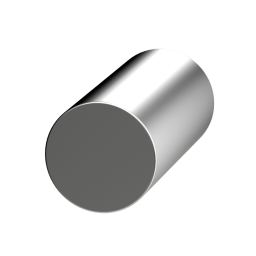
Billet
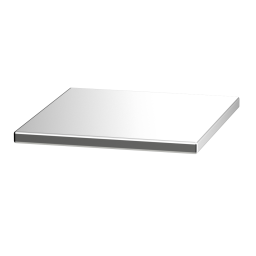
Plate
Ring
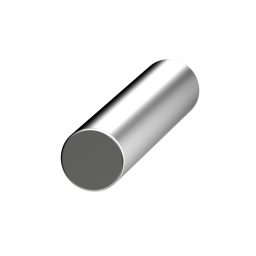
Rod
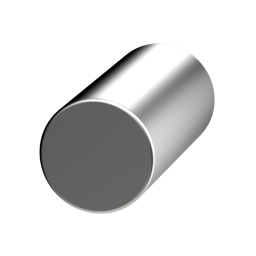
Round Bar
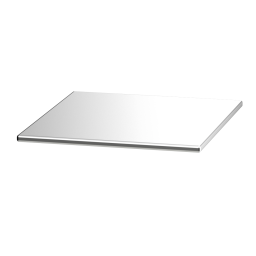
Sheet
Specialty Form
Strip
Additional Data
Specifications
A579,K92810,A538,S-46850Chemical Elements
| Aluminum | 0.05 - 0.15 |
| Boron | 0.003 max |
| Calcium | 0.05 max |
| Carbon | 0.03 max |
| Cobalt | 7 - 8.5 |
| Iron | Balance |
| Manganese | 0.1 max |
| Molybdenum | 3 - 3.5 |
| Nickel | Primary alloying element |
| Phosphorus | 0.01 max |
| Silicon | 0.1 max |
| Sulfur | 0.01 max |
| Titanium | 0.1 - 0.25 |
| Zirconium | 0.02 max |
Physical Properties
Density: 0.289lb/in³
Melting Point: 2580°F
Modulus of Elasticity: 27MSI
Specific Heat: 0.11BTU/lb·°F
Mechanical Properties
Thermal Conductivity: 8.2BTU/hr·ft·°F
Thermal Expansion: 5.6µin/in·°F
Thermal Conductivity
| Condition | Temperature | Conductivity |
|---|---|---|
| Annealed | 70 °F | 8.2 BTU/hr·ft·°F |
Thermal Expansion
| Condition | Min | Max | Expansion Coefficient |
|---|---|---|---|
| Annealed | 70 °F | 212 °F | 5.6 μin/in·°F |
Mechanical Test Data
| Form | Round Bar |
| Condition | Annealed |
| Temperature | 70°F |
| Elongation | 18% |
| Rockwell Hardness | C29 |
| Tensile Strength | 140 KSI |
| Yield Strength | 100 KSI |
| Form | Plate |
| Condition | Annealed |
| Temperature | 70°F |
| Elongation | 18% |
| Rockwell Hardness | C29 |
| Tensile Strength | 140 KSI |
| Yield Strength | 100 KSI |
| Form | Round Bar |
| Condition | Solution Treated & Aged |
| Temperature | 70°F |
| Elongation | 12% |
| Tensile Strength | 200 KSI |
| Yield Strength | 200 KSI |
| Form | Plate |
| Condition | Solution Treated & Aged |
| Temperature | 70°F |
| Elongation | 12% |
| Tensile Strength | 200 KSI |
| Yield Strength | 200 KSI |