Nickel
Nickel Nickel 200
Annealing Procedure
Annealing at 1500 F as a typical temperature. Annealing may be done within the range of 1700 F to 1300 F depending upon the degree of cold working and time at temperature.
Applications
Electronic parts, resistance to corrosion applications such as handling alkaline solutions and foods.
Cold Workability
Cold working may be accomplished using standard tooling as for plain carbon steels. More power is required as the nickel material has a higher elastic limit than steel and thus resists deformation.
Forgeability
Forging may be done at 2250 F to 1700 F.
Formability
Nickel is readily formed by all of the conventional means. It behaves in a similar fashion to plain carbon steel, except that more power is required to form nickel.
Hardening Procedure
Hardens due to cold working only.
Heat Treatability
Anneal at 1500 F to 1300 F and air cool.
Hot Workability
Hot working may be done in the range of 2200 F to 1200 F.
Machinability
Commercially pure nickel is soft and "gummy" to machine. However it can be machined with standard tooling. High-speed-steel tools work better than carbide tooling and it is important to maintain a high positive rake angle on cutting tools.
Principle Design Features
Commercially pure (99%) wrought nickel, basically unalloyed but containing minor amounts of other elements usually totaling less than 1%.
Weldability
All of the conventional welding and joining methods work with nickel. In particular the shielded metal-arc, gas tungsten-arc and gas metal-arc welding methods are recommended. Use nickel filler wire or electrodes.
Known Forms
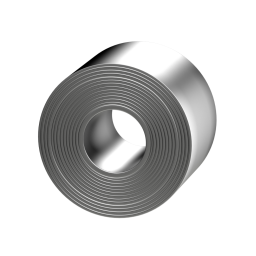
Coil
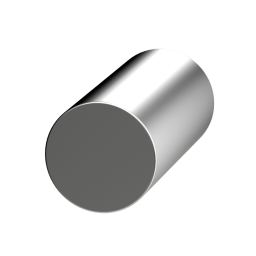
Disc
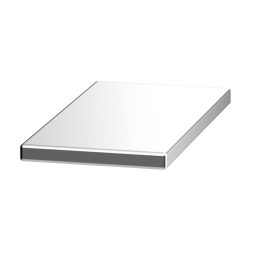
Flat Bar
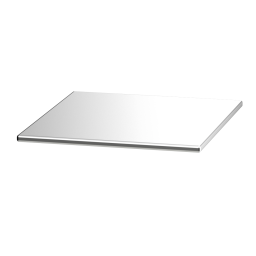
Foil
Hollow Bar
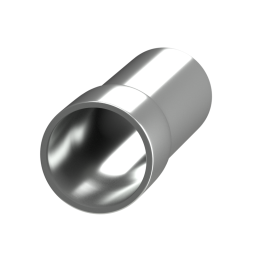
Pipe
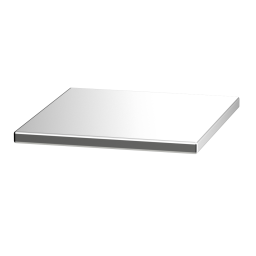
Plate

Rectangle Tube
Ring
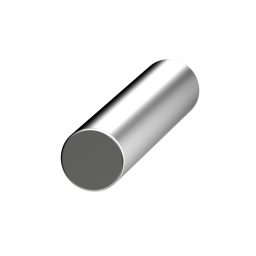
Rod
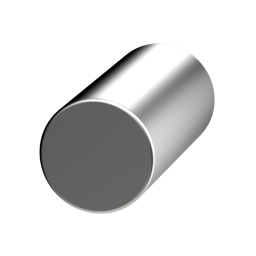
Round Bar
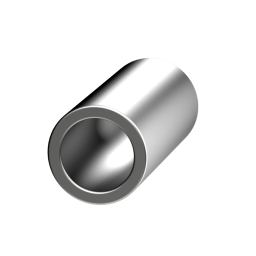
Round Tube
Sheet
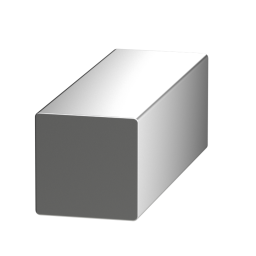
Square Bar
Strip
Wire Flat
Wire Round
Additional Data
Specifications
B160,B161,B162,B163,B366,B725,B730,2.4060,2.4066,N02200Chemical Elements
| Carbon | 0.15 max |
| Copper | 0.25 max |
| Iron | 0.4 max |
| Manganese | 0.35 max |
| Nickel | Balance |
| Silicon | 0.35 max |
| Sulphur | 0.01 max |
Physical Properties
Density: 0.321lb/in³
Electrical Resistivity: 76µΩ·cm
Melting Point: 2625°F
Poissons Ratio: 0.29
Specific Gravity: 8.89
Specific Heat: 0.109BTU/lb·°F
Mechanical Properties
Modulus of Elasticity – Tension: 29.7MSI
Thermal Conductivity: 38.5833BTU/hr·ft·°F
Thermal Expansion: 7.4µin/in·°F
Thermal Conductivity
| Condition | Temperature | Conductivity |
|---|---|---|
| Annealed | 70 °F | 48.6 BTU/hr·ft·°F |
Thermal Expansion
| Condition | Min | Max | Expansion Coefficient |
|---|---|---|---|
| Annealed | 70 °F | 200 °F | 7.4 μin/in·°F |
| Annealed | 70 °F | 400 °F | 7.7 μin/in·°F |
| Annealed | 70 °F | 800 °F | 8.3 μin/in·°F |
| Annealed | 70 °F | 1000 °F | 8.5 μin/in·°F |
Mechanical Test Data
| Form | Strip |
| Condition | Annealed |
| Temperature | 70°F |
| Elongation | 47% |
| Tensile Strength | 65 KSI |
| Yield Strength | 22 KSI |
| Form | Plate |
| Condition | Hot Rolled |
| Temperature | 70°F |
| Elongation | 45% |
| Rockwell Hardness | B67 |
| Tensile Strength | 77 KSI |
| Yield Strength | 50 KSI |
| Form | Strip |
| Condition | Spring Temper |
| Temperature | 70°F |
| Elongation | 8% |
| Tensile Strength | 110 KSI |
| Yield Strength | 93 KSI |