Nickel
Nickel Permanickel 300 (tm)
Aging Procedure
See "Heat Treat".
Annealing Procedure
Anneal at 2000 F and water quench.
Applications
Typically used for electrical contact applications such as springs.
Cold Workability
The alloy readily cold works by conventional means.
Forgeability
Forging may be done at 2200 F to 1700 F. Note that after forging a solution anneal must be done -- see "Annealing".
Formability
Easily formed by conventional means.
Hardening Procedure
Hardens due to cold working and aging - see "Heat Treat". A combination of cold working and aging will produce the greatest tensile strength.
Heat Treatability
Solution anneal at 2000 F and water quench. This is followed by the aging treatment at 910 F for 16 hours and furnace cool.
Hot Workability
Hot working may be done in the range of 2200 F to 1200 F. Note that after hot work a solution anneal must be done -- see "Annealing".
Machinability
May be readily machined by conventional means, although machining is best when the alloy is in the age-hardened condition.
Other Mechanical Properties
In the age-hardened heat treat condition the tensile properties are approximately 50% greater and the elongation is reduced by about 50% in comparison to the annealed values shown.
Principle Design Features
This is an age-hardenable, high nickel content alloy, with very good thermal and electrical conductivity.
Weldability
Fusion welding is not recommended due to the composition of the alloy. Electric resistance welding may be used.
Known Forms
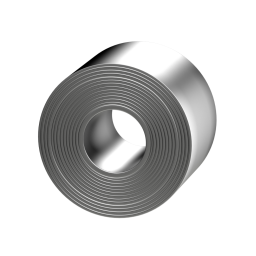
Coil
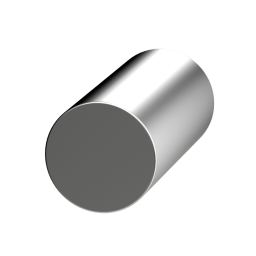
Disc
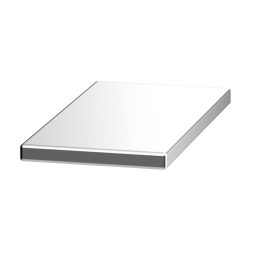
Flat Bar
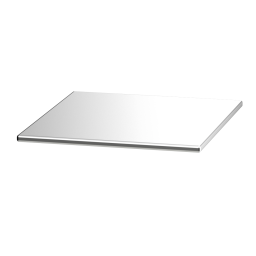
Foil
Hollow Bar
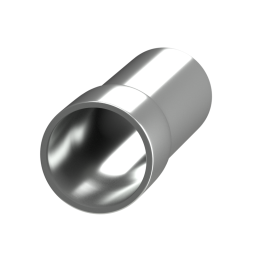
Pipe
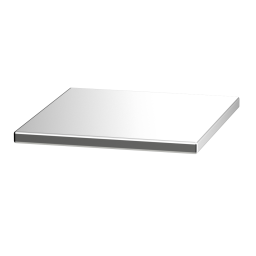
Plate

Rectangle Tube
Ring
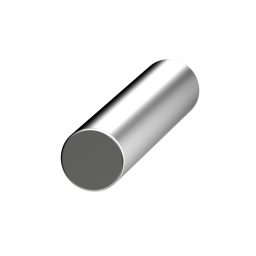
Rod
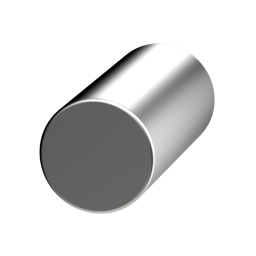
Round Bar
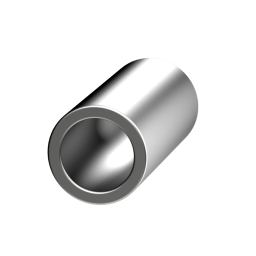
Round Tube
Sheet
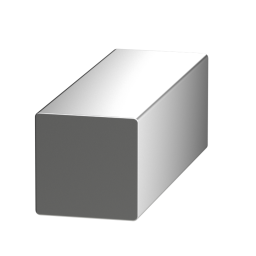
Square Bar
Strip
Additional Data
Specifications
F290,N03300Chemical Elements
| Carbon | 0.4 max |
| Copper | 0.25 max |
| Iron | 0.6 max |
| Magnesium | 0.5 - 0.2 |
| Manganese | 0.5 max |
| Nickel | Balance |
| Silicon | 0.35 max |
| Sulphur | 0.01 max |
| Titanium | 0.2 - 0.6 |
Physical Properties
Density: 0.316lb/in³
Electrical Resistivity: 100µΩ·cm
Melting Point: 2600°F
Specific Gravity: 8.74
Specific Heat: 0.106BTU/lb·°F
Mechanical Properties
Modulus of Elasticity – Tension: 30MSI
Thermal Conductivity: 33.3333BTU/hr·ft·°F
Thermal Expansion: 6.8µin/in·°F
Thermal Conductivity
| Condition | Temperature | Conductivity |
|---|---|---|
| Annealed | 70 °F | 40 BTU/hr·ft·°F |
Mechanical Test Data
| Form | Strip |
| Condition | Annealed |
| Temperature | 70°F |
| Elongation | 37% |
| Rockwell Hardness | B90 |
| Tensile Strength | 105 KSI |
| Form | Strip |
| Condition | Annealed & Aged |
| Temperature | 70°F |
| Elongation | 15% |
| Rockwell Hardness | C35 |
| Tensile Strength | 172 KSI |
| Form | Strip |
| Condition | Extra Full Hard |
| Temperature | 70°F |
| Elongation | 6% |
| Rockwell Hardness | C35 |
| Tensile Strength | 170 KSI |
| Form | Strip |
| Condition | Half Hard |
| Temperature | 70°F |
| Elongation | 9% |
| Rockwell Hardness | C30 |
| Tensile Strength | 142 KSI |