Nickel
Nickel Rene 41 (tm)
Aging Procedure
Aging is done, after solution heat treating, at 1400 F for 16 hours followed by air cooling. This develops maximum strength levels at the higher end application temperatures. Aging may also be done at higher temperatures such as 1600 F with an increase in high temperature ductility but a decrease in strength.
Annealing Procedure
Solution anneal at 1950 - 1975 F for 4 hours at temperature followed by an air cool.
Applications
Gas turbine, aircraft and land/marine, applications. Also can be used in high strength, high temperature environments where oxidation resistance is of prime importance.
Cold Workability
Cold forming may be done using standard tooling although plain carbon tool steels are not recommended for forming as they tend to produce galling. Soft die materials (bronze, zinc alloys, etc.) minimize galling and produce good finishes, but die life is somewhat short. For long production runs the alloy tool steels ( D-2, D-3) and high-speed steels (T-1, M-2, M-10) give good results especially if hard chromium plated to reduce galling. Tooling should be such as to allow for liberal clearances and radii. Heavy duty lubricants should be used to minimize galling in all forming operations. Bending of sheet or plate through 180 degrees is generally limited to a bend radius of 1 T for material up to 1/8" thick and 2 T for material thicker than 1/8".
Forgeability
Forging can be accomplished with the alloy in the solution annealed condition. It is ductile and behaves much the same as the 300 series stainless steels. However it is stronger than stainless steel even at forging temperatures and thus requires more force in forming.
Formability
This alloy has good ductility and may be readily formed by all conventional methods. Because the alloy is stronger than regular steel it requires more powerful equipment to accomplish forming. Heavy-duty lubricants should be used during cold forming. It is essential to thoroughly clean the part of all traces of lubricant after forming as embrittlement of the alloy may occur at high temperatures if lubricant is left on.
Hardening Procedure
The alloy hardens by cold working, but should then be solution annealed. Aging does harden and strengthen the alloy.
Heat Treatability
Heat treating consists of a solution anneal at 1975 F for 4 hours then air cooling and a subsequent aging heat treatment at 1400 F for 16 hours followed by air cooling.
Hot Workability
See comments under "Forging".
Machinability
Conventional machining techniques used for iron based alloys may be used. This alloy does work-harden during machining and has higher strength and "gumminess" not typical of steels. Heavy duty machining equipment and tooling should be used to minimize chatter or work-hardening of the alloy ahead of the cutting. Most any commercial coolant may be used in the machining operations. Water-base coolants are preferred for high speed operations such as turning, grinding, or milling. Heavy lubricants work best for drilling, tapping, broaching or boring. Turning: Carbide tools are recommended for turning with a continuous cut. High-speed steel tooling should be used for interrupted cuts and for smooth finishing to close tolerance. Tools should have a positive rake angle. Cutting speeds and feeds are in the following ranges: For High-Speed Steel Tools For Carbide Tooling Depth Surface Feed Depth Surface Feed of cut speed in inches of cut speed in inches inches feet/min. per rev. inches feet/min. per rev. 0.250" 25-35 0.030 0.250" 150-200 0.020 0.050" 50-60 0.010 0.050" 325-375 0.008 Drilling: Steady feed rates must be used to avoid work hardening due to dwelling of the drill on the metal. Rigid set-ups are essential with as short a stub drill as feasible. Heavy-duty, high-speed steel drills with a heavy web are recommended. Feeds vary from 0.0007 inch per rev. for holes of less than 1/16" diameter, 0.003 inch per rev. for 1/4" dia., to 0.010 inch per rev. for holes of 7/8"diameter. Milling: To obtain good accuracy and a smooth finish it is essential to have rigid machines and fixtures and sharp cutting tools. High-speed steel cutters such as M-2 or M-10 work best with cutting speeds of 30-40 feet per minute and feed of 0.004"-0.006" per cutting tooth. Grinding: The alloy should be wet ground and aluminum oxide wheels or belts are preferred.
Other Mechanical Properties
Form-Condition Temp. Yield Str. Tensile Str. Elong. in 2% Deg.F 0.2% offset Bar 1950 F 70 154 ksi 206 ksi 14 % soln. anneal 1000 147 203 17 & 1400 F aged, 1400 136 160 11 air cool. 1800 38 42 36 Sheet - same 70 148 ksi 185 ksi 15 % condition as 1000 136 174 17 bar above. 1400 121 140 10 1800 25 40 20 100 hr. 0.2% 100 hr.Rupture 1000 hr.Rupture Creep Str. Strength Strength Sheet - same 1200 ----- 92 ksi 82 ksi as above. 1400 60 ksi 55 40 1600 16 26 17 1800 ----- 9 -----
Principle Design Features
A wrought nickel base high temperature, high strength alloy. Good oxidation resistance at high temperatures in the range of 1200 to 1800 F. The alloy is strengthened by solution heat treating and double aging at lower temperatures.
Weldability
The commonly used welding methods work well with this alloy. Matching alloy filler metal should be used. If matching alloy is not available then the nearest alloy richer in the essential chemistry (Ni, Co, Cr, Mo) should be used. All weld beads should be slightly convex. It is not necessary to use preheating. Surfaces to be welded must be clean and free from oil, paint or crayon marking. The cleaned area should extend at least 2" beyond either side of a welded joint. Gas-Tungsten Arc Welding: DC straight polarity (electrode negative) is recommended. Keep as short an arc length as possible and use care to keep the hot end of filler metal always within the protective atmosphere. Shielded Metal-Arc Welding: Electrodes should be kept in dry storage and if moisture has been picked up the electrodes should be baked at 600 F for one hour to insure dryness. Current settings vary from 60 amps for thin material (0.062" thick) up to 140 amps for material of 1/2" and thicker. It is best to weave the electrode slightly as this alloy weld metal does not tend to spread. Cleaning of slag is done with a wire brush (hand or powered). Complete removal of all slag is very important before successive weld passes and also after final welding. Gas Metal-Arc Welding: Reverse-polarity DC should be used and best results are obtained with the welding gun at 90 degrees to the joint. For Short-Circuiting-Transfer GMAW a typical voltage is 20- 23 with a current of 110-130 amps and a wire feed of 250-275 inches per minute. For Spray-Transfer GMAW voltage of 26 to 33 and current in the range of 175-300 amps with wire feed rate of 200-350 inches per minute are typical. Submerged-Arc Welding: Matching filler metal, the same as for GMAW, should be used. DC current with either reverse or straight polarity may be used. Convex weld beads are preferred.
Known Forms
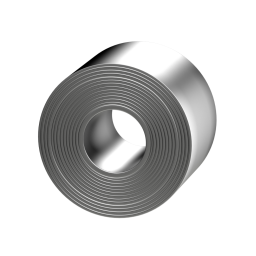
Coil
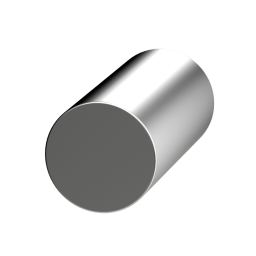
Disc
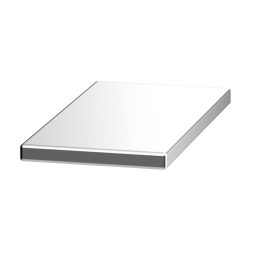
Flat Bar
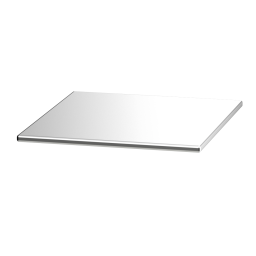
Foil
Hollow Bar
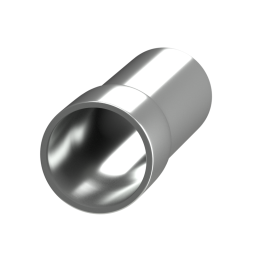
Pipe
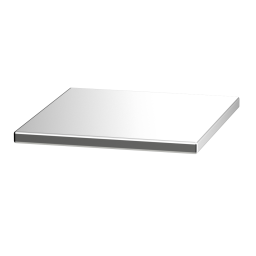
Plate

Rectangle Tube
Ring
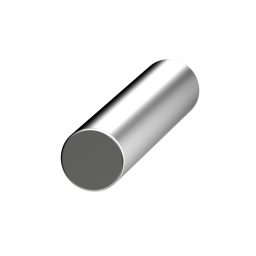
Rod
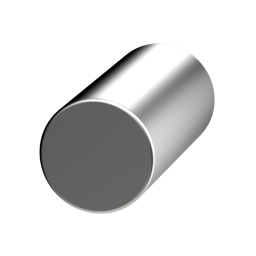
Round Bar
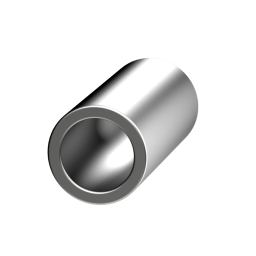
Round Tube
Sheet
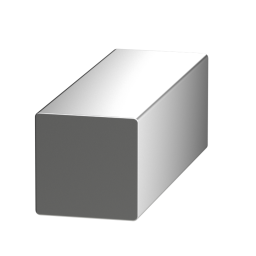
Square Bar
Strip
Additional Data
Specifications
683,5545,5712,5713,5800,2.4973,B50T44,B50T59,B50T94,B50TF109,B50TF11,B50TF110,B50TF210,B50TF59,B50TF75,B50TF76,N07041Chemical Elements
| Aluminum | 1.4 - 1.8 |
| Boron | 0.003 - 0.01 |
| Carbon | 0.04 - 0.12 |
| Chromium | 17.5 - 20 |
| Cobalt | 10 - 12 |
| Iron | 5 max |
| Manganese | 0.1 max |
| Molybdenum | 9 - 10.5 |
| Nickel | Balance |
| Silicon | 0.5 max |
| Sulphur | 0.015 max |
| Titanium | 3 - 3.3 |
Physical Properties
Density: 0.298lb/in³
Melting Point: 2430°F
Poissons Ratio: 0.31
Specific Gravity: 8.25
Specific Heat: 0.11BTU/lb·°F
Mechanical Properties
Modulus of Elasticity – Tension: 31.6MSI
Relative Magnetic Permeability: 1.002μᵣ
Thermal Conductivity: 6.6667BTU/hr·ft·°F
Thermal Expansion: 7.5µin/in·°F
Thermal Conductivity
| Condition | Temperature | Conductivity |
|---|---|---|
| Annealed | 70 °F | 8 BTU/hr·ft·°F |
Rupture Test Data
| Condition | Form | Temperature | Time | Rupture Strength |
|---|---|---|---|---|
| Solution Annealed & Aged | Sheet | 1600 °F | 1000 hrs | 17 KSI |
| Solution Annealed & Aged | Sheet | 1400 °F | 1000 hrs | 40 KSI |
| Solution Annealed & Aged | Sheet | 1200 °F | 1000 hrs | 82 KSI |
Creep Test Data
| Condition | Form | Temperature | Time | Applied Stress | Creep Strain |
|---|---|---|---|---|---|
| Solution Annealed & Aged | Sheet | 1600 °F | 100 hrs | 0.2 % | 16 mil/in |
| Solution Annealed & Aged | Sheet | 1400 °F | 100 hrs | 0.2 % | 60 mil/in |
Mechanical Test Data
| Form | Sheet |
| Condition | Solution Annealed & Aged |
| Temperature | 70°F |
| Elongation | 15% |
| Tensile Strength | 185 KSI |
| Yield Strength | 148 KSI |
| Form | Sheet |
| Condition | Solution Annealed & Aged |
| Temperature | 1000°F |
| Elongation | 17% |
| Tensile Strength | 174 KSI |
| Yield Strength | 136 KSI |
| Form | Sheet |
| Condition | Solution Annealed & Aged |
| Temperature | 1200°F |
| Elongation | 14% |
| Tensile Strength | 164 KSI |
| Yield Strength | 130 KSI |
| Form | Sheet |
| Condition | Solution Annealed & Aged |
| Temperature | 1400°F |
| Elongation | 10% |
| Tensile Strength | 140 KSI |
| Yield Strength | 121 KSI |
| Form | Sheet |
| Condition | Solution Annealed & Aged |
| Temperature | 1600°F |
| Elongation | 14% |
| Tensile Strength | 88 KSI |
| Yield Strength | 74 KSI |