Nickel
Nickel Super Invar 32-5
Annealing Procedure
Two annealing procedures are referenced in literature for Super Invar 32-5. The Carpenter/AZoM procedure anneals at 1550°F (844°C) followed by a water quench. An alternative procedure heats to 1450°F and holds for 30 minutes per inch of thickness, then air cools. Temperatures above 1000°F relieve cold work stresses; the higher the annealing temperature, the lower the resulting annealed hardness. Parts should be heat treated at or near finish size to minimize distortion and CTE variation.
Applications
Super Invar 32-5 is used primarily in structural components for supports and substrates in optical and laser systems requiring precision measurements. Applications include semiconductor components, waveguide tubes, systems requiring metals in conjunction with low expansion glass/quartz assemblies, interferometers, telescope mounts, mirror systems, aerospace instruments, metrology equipment, calibration standards, and precision measuring devices. The alloy is also used in optical benches, precision bases, and any application demanding the highest dimensional stability under temperature fluctuation.
Cold Workability
Super Invar 32-5 can be cold worked using conventional techniques. The alloy has high ductility which facilitates cold working operations. Cold working will increase the hardness (up to approximately HRB 90 from the annealed HRB 75).
Corrosion Resistance
Super Invar 32-5 has certain corrosion resistance in atmospheric environments, fresh water, and seawater. It has limited resistance to strong acids and alkalis.
Formability
Super Invar 32-5 presents no unusual problems in blanking and forming and can be formed using all conventional methods. For best blanking, a hardness of HRB 90 is suggested, which will allow mild bending and forming operations. When deep drawing operations are involved, a mill annealed strip of HRB 75 is usually desirable. The alloy can be cold worked using conventional techniques due to its high ductility.
Hot Workability
The suggested forging temperature range for Super Invar 32-5 is 2000–2150°F (1093–1177°C). Heat rapidly and avoid long soaking times, as extended soaking may cause a checked surface due to contamination.
Machinability
Super Invar 32-5 machines similarly to, but not as well as, Type 316 austenitic stainless steel. The alloy is somewhat difficult to machine because the chips are gummy and stringy. Slow speeds and positive feeds are preferred. Tool geometries normally used for austenitic stainless steels are suitable. All tools should be kept sharp with a fine finish, be as large as possible, and be rigidly supported. Recommended cutting fluids include a 1:1 blend of a sulfachlorinated petroleum oil (8–10% fatty oil) with a paraffin blending oil, or a water-emulsifiable cutting fluid with polar and extreme pressure additives. Parts should be heat treated at or as close to finish size as possible, since machining, forming, and deep drawing introduce stresses that can cause variation in thermal expansion.
Other Comments
Super Invar 32-5 is also known as Alloy 32-5 and carries the Chinese designation 4J32. The alloy's very low CTE is most effective over the temperature range of approximately -67°F to 203°F (-55°C to 95°C). Outside this range, and especially below -22°F (-30°C), the alloy may undergo martensite transformation, degrading dimensional stability. For grinding operations, a soft silicon carbide wheel is recommended; for finishing grinding, start with 80 grit. The alloy ages dimensionally even at constant temperature, expanding slowly over time — part drawings for precision applications should specify a detailed heat treatment procedure to optimize CTE and temporal stability.
Other Physical Properties
Specific gravity: 8.15. Curie temperature: approximately 535°F (279°C). The alloy is ferromagnetic at room temperature. Poisson's ratio: 0.20.
Principle Design Features
Super Invar 32-5 is a magnetic, austenitic, solid solution alloy containing iron, nickel, and cobalt. It is designed to provide minimum thermal expansion at room temperatures — approximately one-half that of standard Invar 36 alloy. The alloy exhibits austenite stability to service temperatures of at least -67°F (-55°C) and thermal expansion properties less than those of Invar 36 when used in the -67/203°F (-55/95°C) temperature range. The substitution of approximately 5% cobalt for a portion of the nickel is the key compositional feature that drives the ultra-low CTE. The CTE is near zero at room temperature after appropriate heat processing. However, the alloy's useful temperature range is limited due to a lower Curie temperature than Invar 36, and martensite transformation can occur at temperatures below approximately -22°F (-30°C).
Weldability
Super Invar 32-5 can be welded using conventional welding techniques.
Known Forms
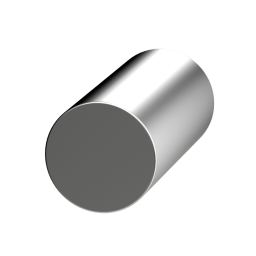
Billet
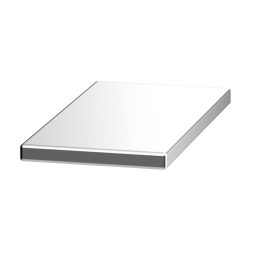
Flat Bar
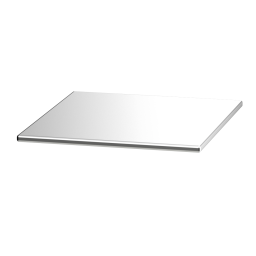
Foil
Ingot
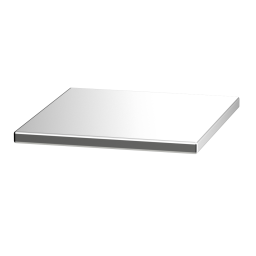
Plate
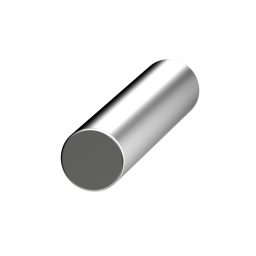
Rod
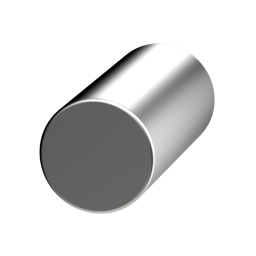
Round Bar
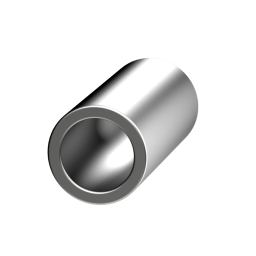
Round Tube
Sheet
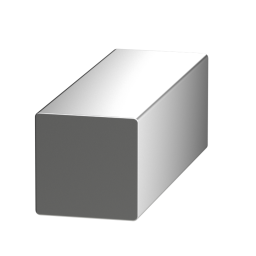
Square Bar
Strip
Wire Round
Additional Data
Specifications
F1684,K93500Chemical Elements
| Carbon | 0.05 max |
| Cobalt | 5.5 nom |
| Iron | Balance |
| Manganese | 0.5 max |
| Nickel | 32 nom |
| Silicon | 0.25 max |
Physical Properties
Density: 0.294lb/in³
Electrical Resistivity: 80µΩ·cm
Melting Point: 2610°F
Modulus of Elasticity: 21MSI
Specific Heat: 0.12BTU/lb·°F
Mechanical Properties
Poisson's Ratio: 0.2
Thermal Conductivity
| Condition | Temperature | Conductivity |
|---|---|---|
| Annealed | 70 °F | 6.05 BTU/hr·ft·°F |
Thermal Expansion
| Condition | Min | Max | Expansion Coefficient |
|---|---|---|---|
| Annealed | -67 °F | 203 °F | 0.35 μin/in·°F |
Mechanical Test Data
| Form | Round Bar |
| Condition | Annealed |
| Temperature | 70°F |
| Elongation | 40% |
| Rockwell Hardness | B75 |
| Tensile Strength | 70 KSI |
| Yield Strength | 40 KSI |
| Form | Strip |
| Condition | Annealed |
| Temperature | 70°F |
| Elongation | 40% |
| Rockwell Hardness | B75 |
| Tensile Strength | 70 KSI |
| Yield Strength | 40 KSI |
| Form | Plate |
| Condition | Annealed |
| Temperature | 70°F |
| Elongation | 40% |
| Rockwell Hardness | B75 |
| Tensile Strength | 70 KSI |
| Yield Strength | 40 KSI |
| Form | Sheet |
| Condition | Annealed |
| Temperature | 70°F |
| Elongation | 40% |
| Rockwell Hardness | B75 |
| Tensile Strength | 70 KSI |
| Yield Strength | 40 KSI |