Nickel
Nickel ThermoAlloy 1
Annealing Procedure
Anneal at 1950 F and air cool.
Applications
Alumel is intended for use with Chromel alloy to form a thermocouple that conforms to the Instrument Society of America Type K designation.
Cold Workability
The alloy has good ductility and is easily cold worked. Note that cold working and/or subsequent annealing may alter the emf-thermal response so that the end product does not conform to Type K calibration as a thermocouple.
Forgeability
May be forged at temperatures in the 2100 F range.
Formability
Forming characteristics are good.
Hardening Procedure
Not applicable.
Heat Treatability
Anneal at 1950 F and air cool. Note that annealing temperature and cooling rate can affect the emf-thermal response and thus affect thermocouple calibration accuracy.
Hot Workability
May be hot worked in the 1900 F t0 1300 F range. Note that hot working and cooling will affect the emf-thermal response and the result may not meet Type K thermocouple calibration.
Machinability
The alloy is readily machinable, but "gummy" due to the high nickel content.
Other Comments
Alumel is intended for use with Chromel alloy to form a thermocouple that conforms to the Instrument Society of America Type K designation.
Principle Design Features
Alumel is a high nickel alloy intended as the negative side of a thermocouple when joined to Chromel alloy. As such the joined pair are used to measure temperature as a result of the emf generated at the joined area.
Weldability
May be welded by conventional means.
Known Forms
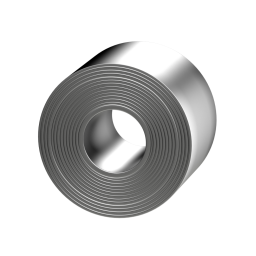
Coil
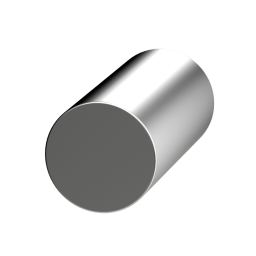
Disc
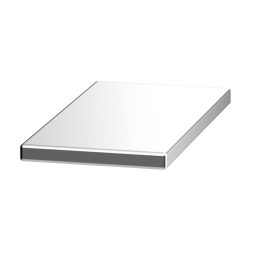
Flat Bar
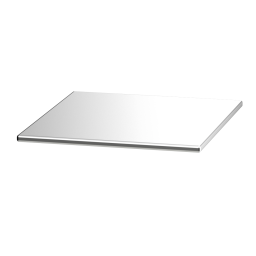
Foil
Hollow Bar
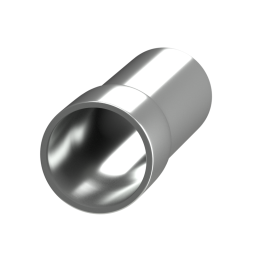
Pipe
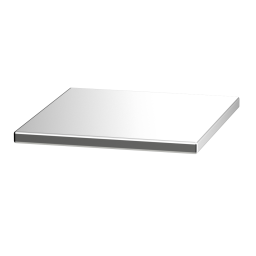
Plate
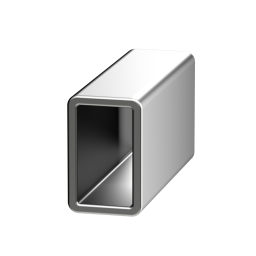
Rectangle Tube
Ring
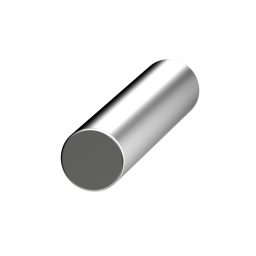
Rod
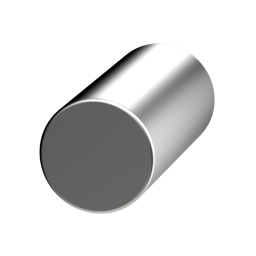
Round Bar
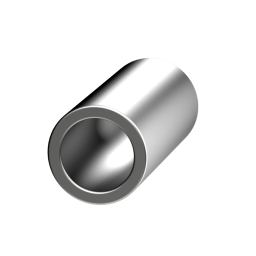
Round Tube
Sheet
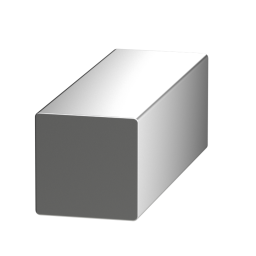
Square Bar
Strip
Additional Data
Chemical Elements
| Aluminum | Balance |
| Nickel | 95 nom |
Physical Properties
Density: 0.307lb/in³
Electrical Resistivity: 191µΩ·cm
Melting Point: 2550°F
Specific Gravity: 8.47
Specific Heat: 0.12BTU/lb·°F