Pure Element
Pure Element Niobium - Columbium
Annealing Procedure
Heat thoroughly at 1200 C in inert gas or vacuum at pressure below 1 x 10 -4 Torr.
Applications
The largest user of niobium was and is the nuclear power industry, however the alloy has successfully been employed in a variety of other applications including jet engine components. It is commonly used as an alloying element in many of the high temperat
Cold Workability
Niobium possesses excellent cold working properties and can be forged rolled or swaged from ingot at room temperature.
Corrosion Resistance
Niobium is resistant to most common acids at even high concentrations below 100 C, with the exception of hydrofluoric acid.
Forgeability
Niobium can be cold forged from ingot at room temperature.
Formability
Niobium, because of its low work hardening rate can readily be formed and stamped, although great care must be taken with lubrication.
Machinability
In general, niobium has a strong tendency to gall.
Principle Design Features
Niobium (also occasionally called Columbium) is a relatively light metal that maintains high mechanical properties at extreme temperatures. Niobium is extremely similar in many ways to Tantalum. They were discovered almost simultaneously and many metallur
Weldability
TIG welding is the preferred method for niobium, with a few notable modifications. The weld pool must be covered with inert gas both on the face and back of the weld area.
Known Forms
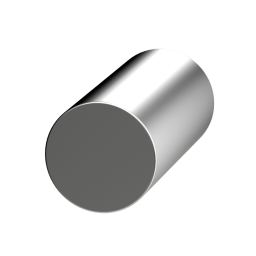
Disc

Foil
Ingot
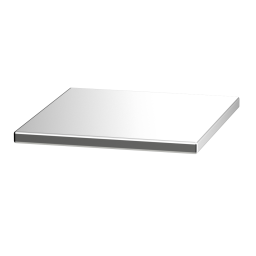
Plate
Ribbon
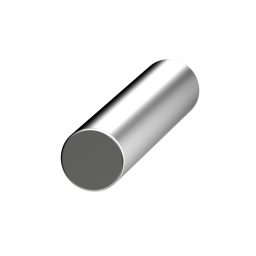
Rod
Sheet
Shim Stock
Additional Data
Physical Properties
Density: 0.309lb/in³