Refractory
Refractory Molybdenum
Annealing Procedure
Recrystallization temperature is dependent upon prior working and condition, however the average required temp is in the range of 2100 F. Stress relieving temperature is 1600 - 1800 F.
Applications
Moly is commonly employed in high temperature applications such as heating elements in furnaces, filament supports in electric lamps, heat shields and in hearth trays, plates and racks.
Formability
Moly can be successfully formed, but a word of caution is recommended. The material will form most efficiently when bending transverse or against its grain or rolling direction. Cracking is a common and costly problem. Heating the workpiece prior to forming can minimize these problems
Heat Treatability
See annealing; moly cannot be hardened by any heat treatment.
Machinability
Machinists describe machining moly as similar to machining cast iron. High speed or carbide tools have been successfully employed with a general preference towards carbide. Moly is a very abrasive material and rigid set-ups and sharp tools are key. The alloy can have a tendency to "tear" if positive feeds are not used.
Principle Design Features
Molybdenum is a metallic element, like iron or aluminum. While most commonly employed as an alloying element, it is also used in its pure form. It possesses excellent high temperature strength, has a very high melting point (4730 F) and is a good thermal and electrical conductor. Additionally, moly has a relatively low coefficient of thermal expansion.
Weldability
Welding moly can best be performed in an argon or helium atmosphere. Best welds are obtained using electron beam methods. Resistance methods are possible, however the resulting weld "nuggets" will be hard and brittle and the weld itself will not be as strong as could be obtained with EB.
Known Forms
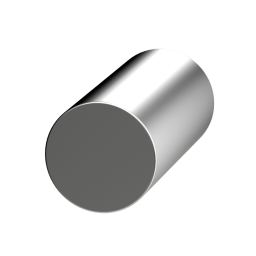
Billet
Disc
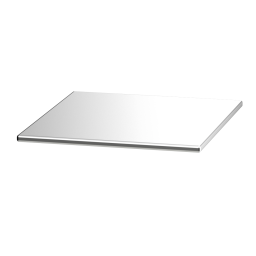
Foil
Ingot
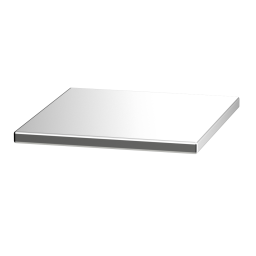
Plate
Powder
Ribbon
Ring
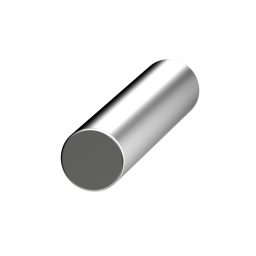
Rod
Sheet
Specialty Form
Wire Flat
Wire Round
Additional Data
Specifications
B386,B387Physical Properties
Density: 0.37lb/in³
Electrical Resistivity: 31µΩ·cm
Melting Point: 4730°F
Mechanical Properties
Thermal Conductivity: 7.0417BTU/hr·ft·°F
Thermal Expansion: 2.8µin/in·°F
Mechanical Test Data
| Form | Wire Round |
| Condition | Annealed |
| Temperature | 70°F |
| Elongation | 24% |
| Tensile Strength | 78 KSI |
| Form | Sheet |
| Condition | Annealed |
| Temperature | 70°F |
| Elongation | 18% |
| Tensile Strength | 100 KSI |
| Yield Strength | 80 KSI |