Refractory
Refractory Tantalum
Annealing Procedure
Recrystalization occurs in tantalum between 2000 and 2500 F. A high vacuum furnace is strongly recommended.
Applications
Applications for tantalum fall into two major categories: electronic and metallurgical. The electronics industry is the largest single user, where it is employed in capacitors, filaments and various other high temperature components. The chemical process equipment industry commonly employs tantalum in heat exchangers, heaters, vessels, etc.
Forgeability
Forge at 2200 down to 1500 F.
Formability
With fully annealed material, spinning, deep drawing, blanking and punching can easily be performed. The material has a relatively low work hardening rate.
Hardening Procedure
Tantalum can only he hardened through cold work.
Heat Treatability
Tantalum is not heat treatable.
Machinability
Tantalum has a tendency to gall, very similar to pure copper. This can cause welding of tooling to the workpiece if proper procedures are not followed. Heavy roughing cuts with M2 high speed or C2 carbide tooling is recommended. To minimize galling, high speed tooling with generous lubricant flooding is recommended. Speeds of 40-60 fpm are recommended.
Principle Design Features
Tantalum is a refractory metal, falling between tungsten and molybdenum in terms of melting point (5425 F). It is widely available in EB cast and powder metallurgy mill forms an it applications fall into two major categories: electronic and metallurgical. Excellent additional data available at http://www.rembar.com/tant.htm.
Weldability
Tantalum can be fusion and resistance welded successfully. Resistance welding should be performed under water. Fusion welding is most successful when the material to be joined is absolutely clean.
Known Forms
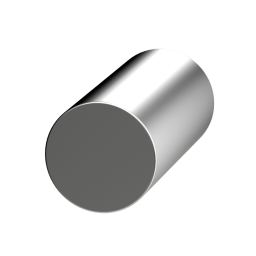
Billet
Disc
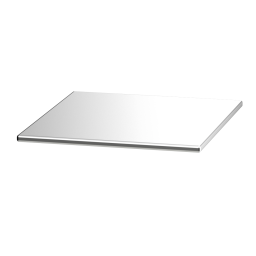
Foil
Ingot
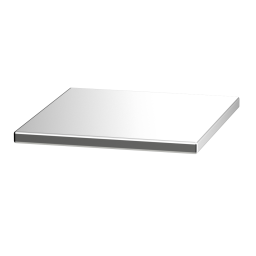
Plate
Powder
Ribbon
Ring
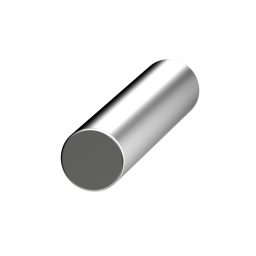
Rod
Sheet
Specialty Form
Wire Round
Additional Data
Physical Properties
Density: 0.6lb/in³
Poissons Ratio: 0.35
Mechanical Properties
Thermal Expansion: 6.6µin/in·°F
Mechanical Test Data
| Form | Plate |
| Condition | Annealed |
| Temperature | 70°F |
| Elongation | 20% |
| Tensile Strength | 30 KSI |
| Yield Strength | 20 KSI |