Refractory
Refractory Zirconium
Applications
Employed in applications requiring low neutron absorption, high melting point (3350 F) and high resistance to corrosion. Found in the linings of jet engines and knife blades, as well as in a variety of nuclear components.
Formability
Zirconium and its alloys are very ductile and easily workable. Due to its tendency towards galling, however, proper lubricant must be used.
Machinability
Caution must be taken in machining zirconium , as the powder and shavings are flammable. For this reason, slow speeds, heavy feed and a flood cooling system are required. The material has a very high tendency to gall and work harden
Principle Design Features
Zirconium is a hard, silvery metal extracted from ore. The metal is extremely corrosion resistant and possesses a high melting point (3350 F). It is commonly employed in nuclear reactor components because of its low rate of neutron absorption.
Weldability
Zirconium and its alloys are best welded by the gas tungsten arc method, although plasma arc, EB and resistance methods have been successfully employed. Proper shielding is essential in welding this alloy, due to its relatively to gases at welding temperatures. Without proper shielding, weak, brittle welds will occur.
Known Forms
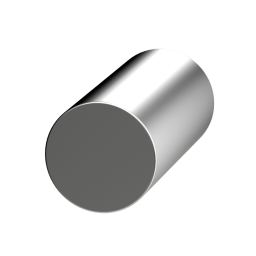
Billet
Disc
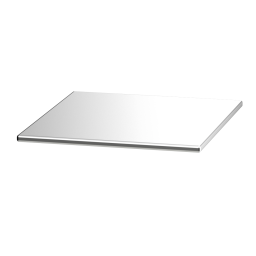
Foil
Ingot
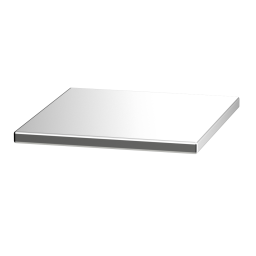
Plate
Powder
Ribbon
Ring
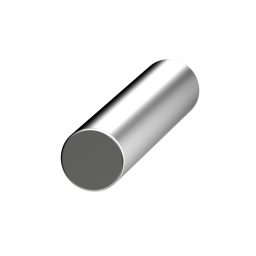
Rod
Sheet
Specialty Form
Additional Data
Specifications
B493,B494,B523,B550,B551,B653,B658,A5.24Physical Properties
Density: 0.235lb/in³
Electrical Resistivity: 13µΩ·cm
Melting Point: 3350°F
Poissons Ratio: 0.38
Mechanical Properties
Thermal Expansion: 5.89µin/in·°F
Mechanical Test Data
| Form | Round Tube |
| Condition | Annealed |
| Temperature | 70°F |
| Tensile Strength | 52 KSI |
| Yield Strength | 30 KSI |
| Form | Plate |
| Condition | Annealed |
| Temperature | 70°F |
| Elongation | 16% |
| Tensile Strength | 55 KSI |
| Yield Strength | 30 KSI |