Stainless
Stainless 13-8
Applications
This alloy has been used in aircraft components such as landing gear and structural sections, valves, shafts, and components in the petrochemical and nuclear industries.
Cold Workability
Despite its high initial yield strength, this alloy can be satisfactorily cold worked.
Forgeability
Soak at 2150 F(1177 C) for 1 hour prior to forging. Do not work below 1750 F(954 C). All forgings should be solution treated prior to final hardening. Air cool to room temperature after forging.
Formability
This alloy can be formed using conventional techniques with the degree of formability being limited only by its high initial yield strength.
Heat Treatability
CONDITION A--Soak at 1700 F (927 C) and cool below 60 F (16 C) for 1 hour. CONDITION RH 950- Treat Condition A material at -100 F(-73C) for 2 hours, air warm to room temperature (within 24 hours of solution treatment). Then heat cold treated material to 950 F(510 C) for 4 hours and air cool. CONDITION H950, H1000, H1050, H1100, H1150- Soak solution treated material for 4 hours at specified temperature, air cool, CONDITION H1150M- Soak solution treated material at 1400 F (760 C) for 2 hours, air cool, then re-heat to 1150 F (620 C) for 4 hours and air cool.
Hot Workability
13-8 can be satisfactorily hot worked. Hot worked material must be solution annealed prior to hardening for reliable results.
Machinability
This is a tough machining stainless steel. Although it can be machined in all conditions, best results can be obtained in condition H1150M. Compared to type 304 stainless, speeds should be roughly 25 % lower for optimum tool life and finish.
Principle Design Features
13-8 MO is a precipitation, age hardenable stainless steel. It's principal features are high transverse toughness, good resistance to general and stress corrosion cracking, and high strength that is developed by a single low temperature heat treatment.
Weldability
Best welded in the solution annealed condition, using 13-8 MO filler material. Both resistance and inert gas shielded methods are acceptable.
Known Forms
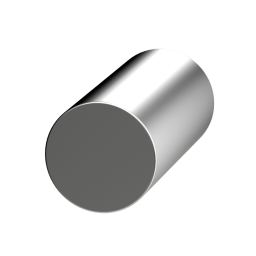
Angle
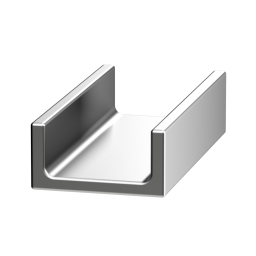
Channel
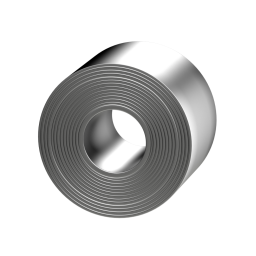
Coil
Disc
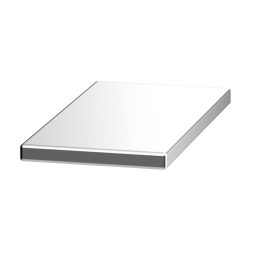
Flat Bar
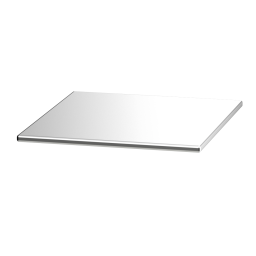
Foil
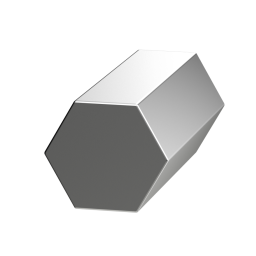
Hexagon Bar
Hollow Bar
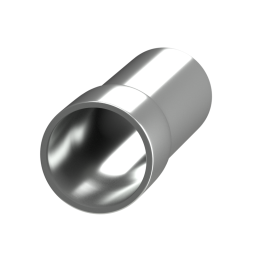
Pipe
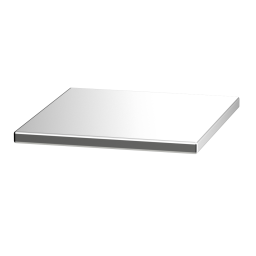
Plate
Precision Ground Bar
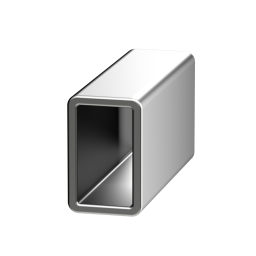
Rectangle Tube
Ring
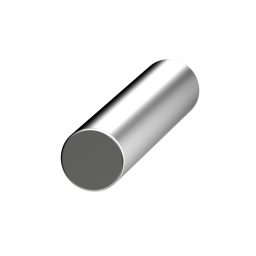
Rod
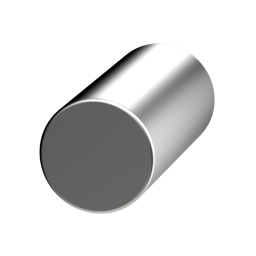
Round Bar
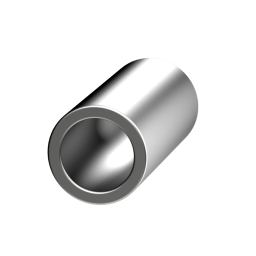
Round Tube
Sheet
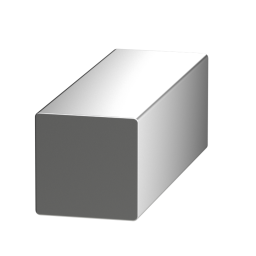
Square Bar
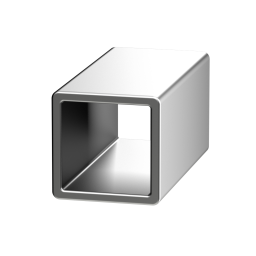
Square Tube
Standard Beam
Strip
Tee
Additional Data
Specifications
632,5629,5864,A564 (XM-13),A693 (XM-13),A705 (XM-13),1.4534,S13800Chemical Elements
| Aluminum | 0.9 - 1.35 |
| Carbon | 0.05 max |
| Chromium | 12.25 - 13.25 |
| Iron | Balance |
| Manganese | 0.2 max |
| Molybdenum | 2 - 2.5 |
| Nickel | 7.5 - 8.5 |
| Nitrogen | 0.01 max |
| Phosphorus | 0.01 max |
| Silicon | 0.1 max |
| Sulphur | 0.008 max |
Physical Properties
Density: 0.28lb/in³
Electrical Resistivity: 613µΩ·cm
Specific Gravity: 7.76
Specific Heat: 0.11BTU/lb·°F
Mechanical Properties
Modulus of Elasticity – Tension: 28.3MSI
Thermal Conductivity
| Condition | Temperature | Conductivity |
|---|---|---|
| Annealed | 212 °F | 9.72 BTU/hr·ft·°F |
Thermal Expansion
| Condition | Min | Max | Expansion Coefficient |
|---|---|---|---|
| H 950 | 70 °F | 200 °F | 5.9 μin/in·°F |
| H 950 | 70 °F | 600 °F | 6.2 μin/in·°F |
| H 950 | 70 °F | 900 °F | 6.6 μin/in·°F |
| H 1100 | 70 °F | 200 °F | 6 μin/in·°F |
| H 1100 | 70 °F | 600 °F | 6.4 μin/in·°F |
| H 1100 | 70 °F | 900 °F | 6.8 μin/in·°F |
| H 1050 | 70 °F | 600 °F | 6.2 μin/in·°F |
| H 1050 | 70 °F | 900 °F | 6.6 μin/in·°F |
| H 1000 | 70 °F | 200 °F | 5.7 μin/in·°F |
| H 1000 | 70 °F | 600 °F | 6.2 μin/in·°F |
| H 1000 | 70 °F | 900 °F | 6.6 μin/in·°F |