Stainless
Stainless 17-4 (PH)
Annealing Procedure
1900 F (1038 C), hold for 1/2 hour, rapid cool.
Applications
Commonly used in both aircraft and gas turbines, nuclear reactor, paper mill, oil field, and chemical process components.
Cold Workability
Despite its high initial yield strength, 17-4 can be cold worked successfully by most common methods.
Forgeability
Soak for 1 hour at 2150 F (1177 C) prior to forging. Do not work below 1850 F (1010 C). Post-work solution treatment is required prior to final hardening.
Formability
This alloy is capable of being only mildly formed. If forming is required, do so in the overaged condition for best results.
Hardening Procedure
This alloy has good ductility and may be readily formed by all conventional methods. Because the alloy is stronger than regular steel it requires more powerful equipment to accomplish forming. Heavy-duty lubricants should be used during cold forming.
Heat Treatability
CONDITION A--Soak at 1900 F (1038 C) for 30 minutes and cool below 60 F (16 C) for complete martensite transformation. CONDITION H 950- Treat Condition A material at 900 F(482 C) for 1 hour, air cool.. CONDITION H925, H1025, H1075, H1100, H1150- Soak solution treated material for 4 hours at specified temperature, air cool, CONDITION H1150M- Soak solution treated material at 1400 F (760 C) for 2 hours, air cool, then re-heat to 1150 F (620 C) for 4 hours and air cool.
Hot Workability
17-4 PH can be easily hot worked using most of the common processes. It is suggested that material be solution treated at 1900 F(1038 C) then formed during cooling while the material is still austenitic. Post-work solution treatment is required prior to final hardening.
Machinability
Long, gummy chips characterize this alloys machinability. It can be machined in the annealed condition, however condition H1150M will yield best results. Post machining solution treatment of parts will be required prior to final hardening if machining in this condition.
Principle Design Features
One of the most widely used precipitation hardening grades in the business. While soft and ductile in the solution annealed condition, it is capable of high properties with a single precipitation or aging treatment. Characterized by good corrosion resistance, high harness, toughness and strength.
Weldability
Successfully welded by common fusion and resistance methods, this alloy should not be joined by oxyacetylene welding. AWS E/ER630 filler metal is recommended if required.
Known Forms
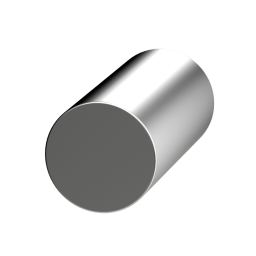
Angle
Bolt
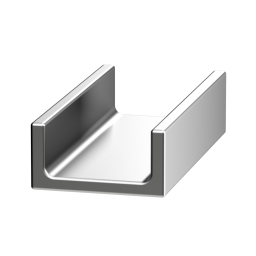
Channel
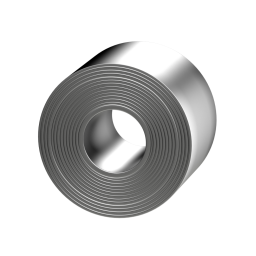
Coil
Disc
Flange
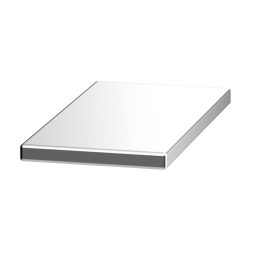
Flat Bar
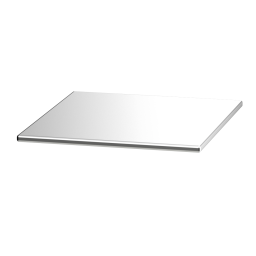
Foil
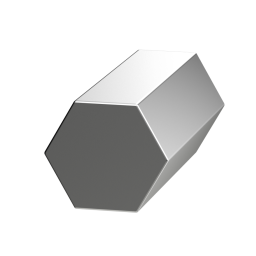
Hexagon Bar
Hollow Bar
Nut
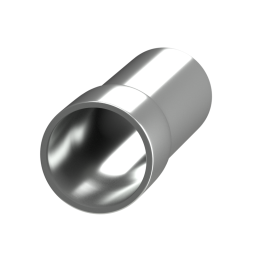
Pipe
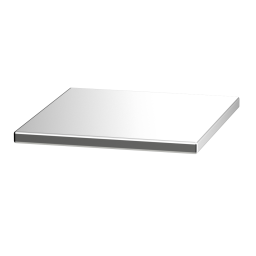
Plate
Powder
Precision Ground Bar
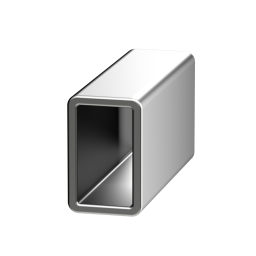
Rectangle Tube
Ring
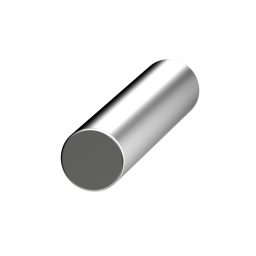
Rod
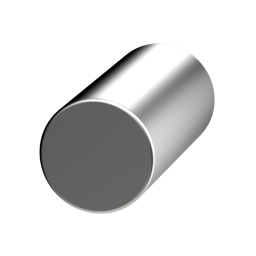
Round Bar
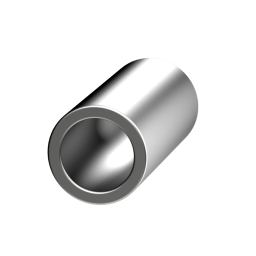
Round Tube
Screw
Sheet
Specialty Form
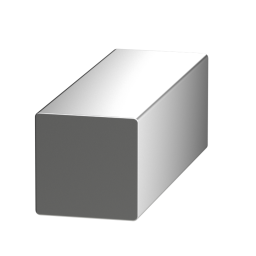
Square Bar
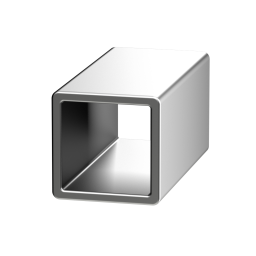
Square Tube
Standard Beam
Strip
Tee
Threaded Rod
Valve
Washer
Wire Flat
Wire Round
Additional Data
Specifications
630,5604,5622,5643,A564 (630),A693 (630),A705 (630),C-24111,P-47183,S-81591,S17400Chemical Elements
| Carbon | 0.07 max |
| Chromium | 15 - 17.5 |
| Copper | 3 - 5 |
| Iron | Balance |
| Manganese | 1 max |
| Nickel | 3 - 5 |
| Niobium | 0.15 - 0.45 |
| Niobium+Tantalum | 0.15 - 0.45 |
| Phosphorus | 0.04 max |
| Silicon | 1 max |
| Sulphur | 0.03 max |
Physical Properties
Density: 0.28lb/in³
Electrical Resistivity: 588µΩ·cm
Specific Gravity: 7.74
Specific Heat: 0.11BTU/lb·°F
Thermal Conductivity
| Condition | Temperature | Conductivity |
|---|---|---|
| H 900 | 300 °F | 12.4 BTU/hr·ft·°F |
| H 900 | 500 °F | 13.5 BTU/hr·ft·°F |
| H 900 | 900 °F | 15.6 BTU/hr·ft·°F |
Thermal Expansion
| Condition | Min | Max | Expansion Coefficient |
|---|---|---|---|
| H 900 | 70 °F | 212 °F | 6 μin/in·°F |
| H 900 | 70 °F | 392 °F | 6.1 μin/in·°F |
| H 900 | 70 °F | 572 °F | 6.3 μin/in·°F |
| H 900 | 70 °F | 752 °F | 6.5 μin/in·°F |
| Annealed | 70 °F | 212 °F | 6 μin/in·°F |
| Annealed | 70 °F | 392 °F | 6 μin/in·°F |
| Annealed | 70 °F | 572 °F | 6.1 μin/in·°F |
| Annealed | 70 °F | 752 °F | 6.2 μin/in·°F |