Stainless
Stainless 17-7 (PH)
Aging Procedure
Solution anneal at 2150 F for 4 hours and air cool. Follow with 1975 F for 4 hours and air cool, then 1550 F for 24 hours, air cool and 1400 F for 16 hours, air cool to complete precipitation hardening process. Resistant to liquid oxygen and hydrogen and ammonia. For optimum performance, material must be clean and free of scale and impurities.
Annealing Procedure
1950 F (1066 C) for 3 minutes for each .1 inch (2.5 mm) of thickness, air cool.
Applications
Used for applications requiring good strength, corrosion resistance and mechanical properties up to 800 F in service. It is often used for very detailed, intricate parts due to its low distortion in heat treatment. Very stable. Commonly found in a variety of springs and washers.
Cold Workability
In Condition A, this material can be easily formed using most common procedures.
Formability
Forming characteristics of this alloy are similar to 301 stainless steel. Intermediate annealing may be necessary for radical forming operations.
Heat Treatability
CONDITION C - Results from heavy cold working (generally 45-50% reduction) of solution treated material. CONDITION CH900- Heat Condition C material to 900 F(482 C), hold for 1 hour, air cool. CONDITION A1750- After fabrication, heat solution treated material to 1750 F(955 C), hold for 10 minutes, cool rapidly to room temperature. CONDITION R100- Within 1 hour of treating to Condition A1750, cool to -100 F(-73 C) and hold for 8 hours. Air warm to room temperature. CONDITION RH 950- From Condition R100 material, heat to 950 F( 510 C), hold for 90 minutes, air cool. CONDITION T- After fabrication, heat to 1400 F (760 C) and hold for 90 minutes. Within 60 minutes, cool to 55 F (13 C), and hold for 1/2 hour. CONDITION TH1050- From Condition T, heat to 1050 F (565 C) and hold for 90 minutes, air cool
Machinability
Rated at 75 % of B1112. This alloy displays long gummy chips that require chip breakers to overcome. Slow speeds and constant feeds are recommended for best results.
Principle Design Features
A precipitation hardenable chromium-nickel-aluminum stainless steel combining high strength, moderate corrosion resistance and properties well suited for flat springs.
Weldability
Most common arc and resistance methods have been successfully employed with 17-7 PH. It is recommended that inert gas shielding be employed during fusion welding to reduce the oxidation of aluminum during the process. Pre-heating and post-weld annealing are not necessary with this alloy.
Known Forms
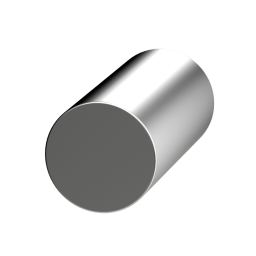
Angle
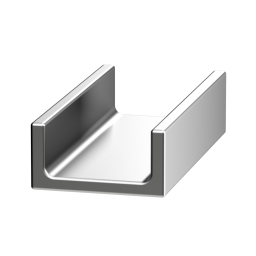
Channel
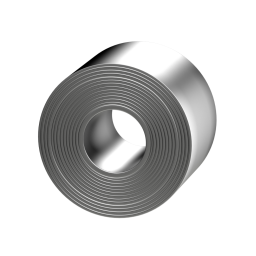
Coil
Disc
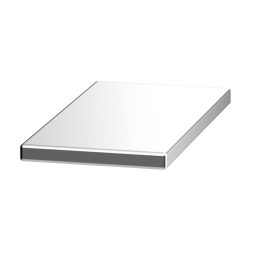
Flat Bar
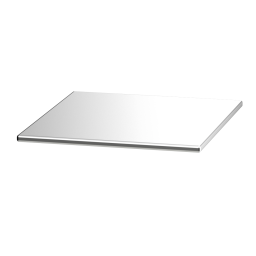
Foil
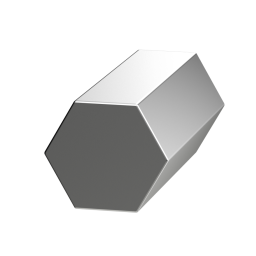
Hexagon Bar
Hollow Bar
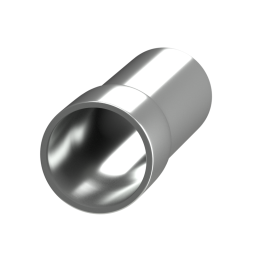
Pipe
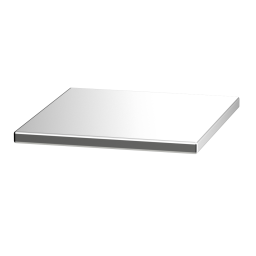
Plate
Precision Ground Bar
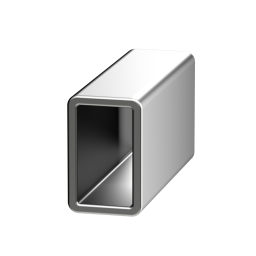
Rectangle Tube
Ring
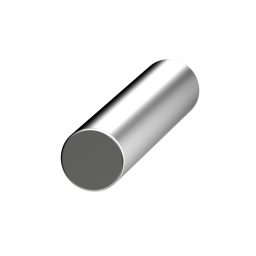
Rod
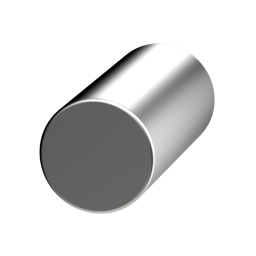
Round Bar
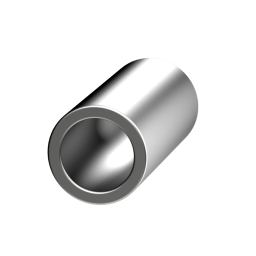
Round Tube
Sheet
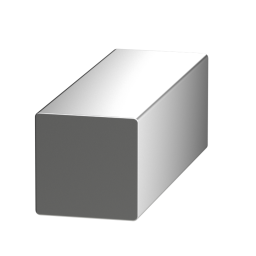
Square Bar
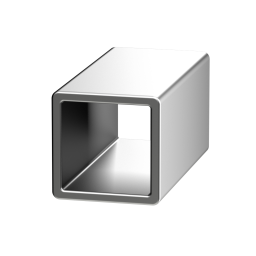
Square Tube
Standard Beam
Strip
Tee
Wire Flat
Wire Round
Wire Square
Additional Data
Specifications
631,5528,5529,5568,5644,5678,A313 (631),A564 (631),A579 (631),A693 (631),A705 (631),1.4568,S-25043,S17700Chemical Elements
| Aluminum | 0.75 - 1.5 |
| Carbon | 0.09 max |
| Chromium | 16 - 18 |
| Iron | Balance |
| Manganese | 1 max |
| Nickel | 6.5 - 7.75 |
| Phosphorus | 0.04 max |
| Silicon | 1 max |
| Sulphur | 0.04 max |
Physical Properties
Density: 0.282lb/in³
Specific Gravity: 7.81
Specific Heat: 0.11BTU/lb·°F
Thermal Expansion
| Condition | Min | Max | Expansion Coefficient |
|---|---|---|---|
| Annealed | 70 °F | 200 °F | 8.5 μin/in·°F |
Mechanical Test Data
| Form | Sheet |
| Condition | Annealed |
| Temperature | 70°F |
| Elongation | 30% |
| Rockwell Hardness | B85 |
| Tensile Strength | 130 KSI |
| Yield Strength | 45 KSI |