Stainless
Stainless 201
Annealing Procedure
Anneal at 1850-200 F(1010-1093 C). To avoid scaling, do not exceed 2000 F. Rapid cooling is recommended to avoid the crystallization of carbides.
Applications
Applications include structural members, siding and roofing for railway cars and trailers and a variety of severely formed parts.
Formability
This alloy can be satisfactorily formed using all of the commonly employed forming methods using techniques and pressures similar to those employed in other 300 series stainless steels.
Hot Workability
Hot work in the range of 2100-2250 F (1149-1232 C).
Principle Design Features
201 combines good mechanicals, corrosion resistance, formability and fabricability. It is similar in many respects to 301 stainless steel. 201 has been successfully used in a variety of low temperature environments, down to -425 F.
Weldability
All conventional welding methods are applicable here. Filler metal of similar composition, or of standard 18-8 stainless steels may be used. 201 is sensitive to intergranular attack along weld boundaries. If heavy welding is required, many producing mills can provide a low carbon version of the alloy.
Known Forms
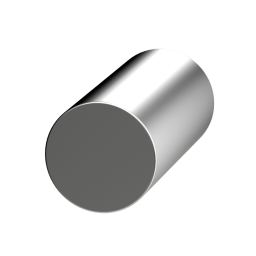
Angle
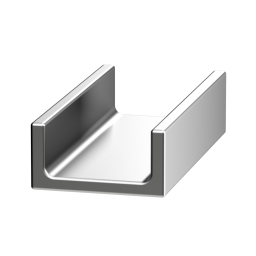
Channel
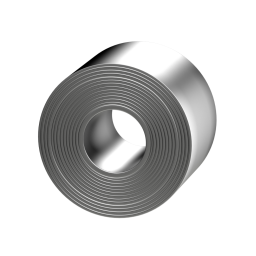
Coil
Disc
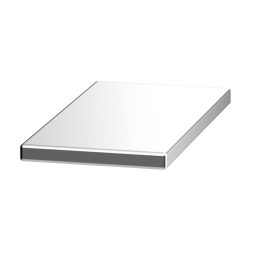
Flat Bar
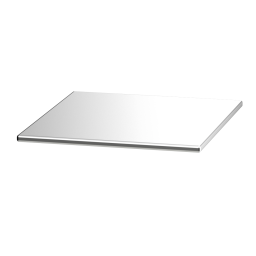
Foil
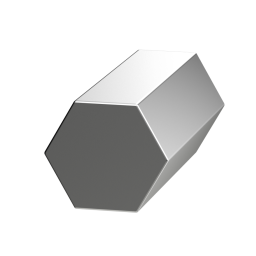
Hexagon Bar
Hollow Bar
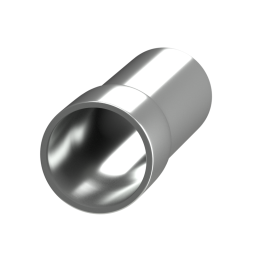
Pipe
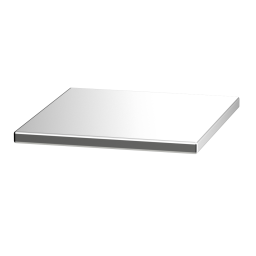
Plate
Precision Ground Bar
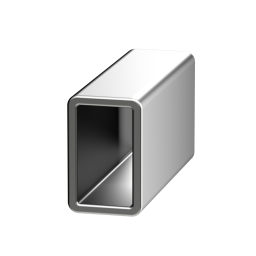
Rectangle Tube
Ring
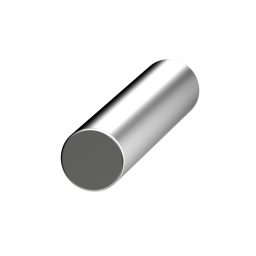
Rod
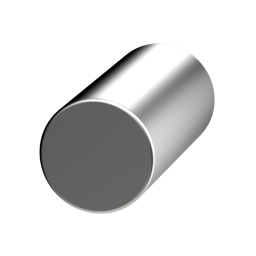
Round Bar
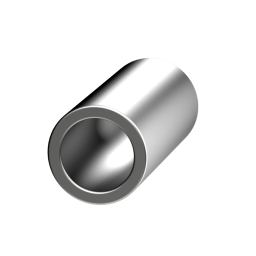
Round Tube
Sheet
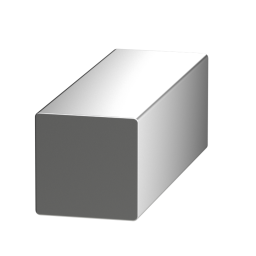
Square Bar
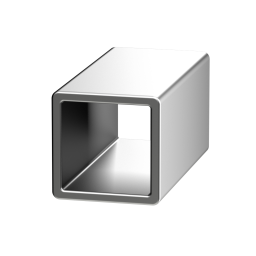
Square Tube
Standard Beam
Strip
Tee
Additional Data
Specifications
201,A213,A240,A249,A276,A412,A666,S766,S20100Chemical Elements
| Carbon | 0.15 max |
| Chromium | 16 - 18 |
| Iron | Balance |
| Manganese | 5.5 - 7.5 |
| Nickel | 3.5 - 5.5 |
| Nitrogen | 0.25 max |
| Phosphorus | 0.06 max |
| Silicon | 1 max |
| Sulphur | 0.03 max |
Physical Properties
Density: 0.287lb/in³
Specific Gravity: 7.94
Specific Heat: 0.12BTU/lb·°F
Thermal Conductivity
| Condition | Temperature | Conductivity |
|---|---|---|
| Annealed | 212 °F | 9.4 BTU/hr·ft·°F |
Thermal Expansion
| Condition | Min | Max | Expansion Coefficient |
|---|---|---|---|
| Annealed | 70 °F | 600 °F | 10 μin/in·°F |
| Annealed | 70 °F | 1000 °F | 10.9 μin/in·°F |
| Annealed | 70 °F | 1600 °F | 11.3 μin/in·°F |
Rupture Test Data
| Condition | Form | Temperature | Time | Rupture Strength |
|---|---|---|---|---|
| Annealed | Sheet | 1500 °F | 1000 hrs | 4 KSI |
| Annealed | Sheet | 1200 °F | 1000 hrs | 22.5 KSI |
Mechanical Test Data
| Form | Sheet |
| Condition | Annealed |
| Temperature | 200°F |
| Elongation | 61% |
| Tensile Strength | 98 KSI |
| Yield Strength | 39 KSI |
| Form | Sheet |
| Condition | Annealed |
| Temperature | 600°F |
| Elongation | 43% |
| Tensile Strength | 79 KSI |
| Yield Strength | 27 KSI |
| Form | Sheet |
| Condition | Annealed |
| Temperature | 1000°F |
| Elongation | 33% |
| Tensile Strength | 70 KSI |
| Yield Strength | 23 KSI |
| Form | Sheet |
| Condition | Annealed |
| Temperature | 1200°F |
| Form | Sheet |
| Condition | Annealed |
| Temperature | 1400°F |
| Elongation | 27% |
| Tensile Strength | 26 KSI |
| Yield Strength | 20 KSI |
| Form | Sheet |
| Condition | Annealed |
| Temperature | 1500°F |
| Form | Sheet |
| Condition | Extra Full Hard |
| Temperature | 70°F |
| Elongation | 4% |
| Rockwell Hardness | C45 |
| Tensile Strength | 229 KSI |
| Yield Strength | 218 KSI |
| Form | Sheet |
| Condition | Full Hard |
| Temperature | 70°F |
| Elongation | 12% |
| Rockwell Hardness | C42 |
| Tensile Strength | 192 KSI |
| Yield Strength | 155 KSI |
| Form | Sheet |
| Condition | Half Hard |
| Temperature | 70°F |
| Elongation | 19% |
| Rockwell Hardness | C32 |
| Tensile Strength | 164 KSI |
| Yield Strength | 120 KSI |
| Form | Sheet |
| Condition | Quarter Hard |
| Temperature | 70°F |
| Elongation | 34% |
| Rockwell Hardness | C27 |
| Tensile Strength | 138 KSI |
| Yield Strength | 90 KSI |
| Form | Sheet |
| Condition | Three Quarter Hard |
| Temperature | 70°F |
| Elongation | 15% |
| Rockwell Hardness | C37 |
| Tensile Strength | 187 KSI |
| Yield Strength | 145 KSI |