Stainless
Stainless 203 EZ
Annealing Procedure
1900 F (1038 C), water quench.
Applications
Screw machine parts including valve components, automotive and electronic hardware.
Cold Workability
Cold working will result in substantial increases in magnetic permeability and hardness. It should therefore be subjected to only minor deformation.
Hardening Procedure
This alloy does not respond to heat treatment. Hardening can be performed through cold reduction only.
Hot Workability
Heat thoroughly to 2200 F. Do not work below 1750 F. Large sections should be air cooled and annealed while smaller sections may be water cooled.
Machinability
Easily machined using all common methods. Chips break easily due to the high concentration of sulfur.
Principle Design Features
NO LONGER COMMERCIALLY AVAILABLE - An alternative to type 303 stainless, this alloy substitutes high manganese and copper for nickel, resulting in a low magnetic permeability in a stable austenitic structure. Resistant to scaling in temperatures up to 1550 F. This alloy should not be used to contain gases or liquids under high pressure.
Weldability
Not recommended for welding due to its high sulfur content.
Known Forms
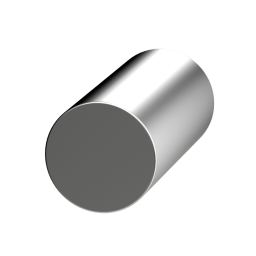
Angle
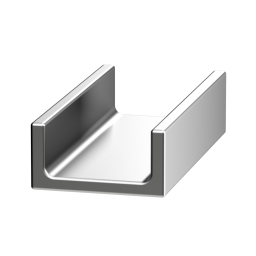
Channel
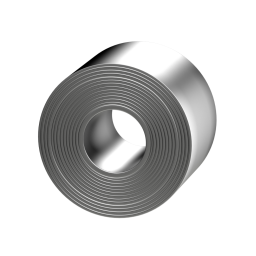
Coil
Disc
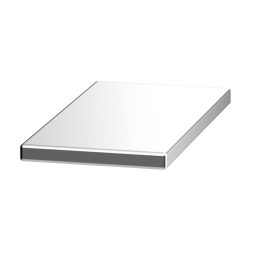
Flat Bar
Foil
Hexagon Bar
Hollow Bar
Pipe
Plate
Precision Ground Bar
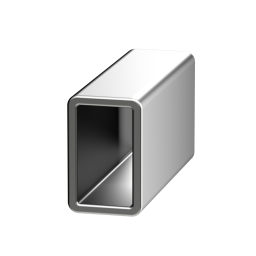
Rectangle Tube
Ring
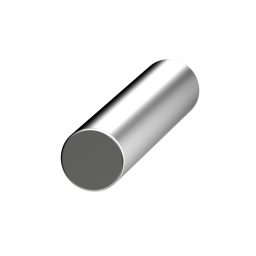
Rod
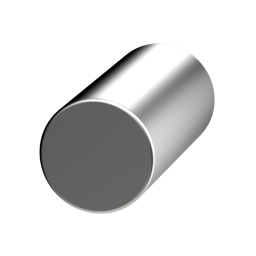
Round Bar
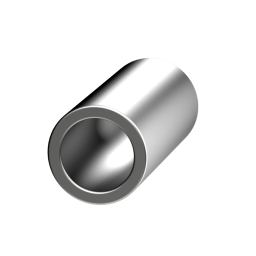
Round Tube
Sheet
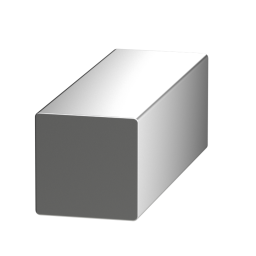
Square Bar
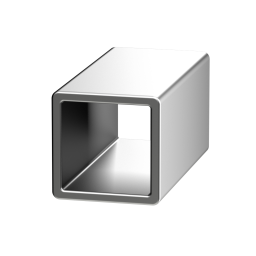
Square Tube
Standard Beam
Strip
Tee
Additional Data
Specifications
5762,A581 (XM-1),A582 (XM-1),S20300Chemical Elements
| Carbon | 0.08 max |
| Chromium | 16 - 18 |
| Copper | 1.75 - 2.25 |
| Iron | Balance |
| Manganese | 5 - 6.5 |
| Molybdenum | 0.5 max |
| Nickel | 5 - 6.5 |
| Phosphorus | 0.04 max |
| Silicon | 1 max |
| Sulphur | 0.18 - 0.35 |
Physical Properties
Density: 0.285lb/in³
Electrical Resistivity: 435µΩ·cm
Specific Gravity: 7.85
Specific Heat: 0.12BTU/lb·°F
Thermal Expansion
| Condition | Min | Max | Expansion Coefficient |
|---|---|---|---|
| Annealed | 32 °F | 1200 °F | 11.2 μin/in·°F |