Stainless
Stainless 21-6-9
Annealing Procedure
1800-2150 F (982-1177 C), air cool.
Applications
Aircraft components, steam and autoclave parts, chemical and pollution control equipment.
Cold Workability
Although higher forces will be required when compared with other austenitic stainless steels, this alloy is readily formed employing most of the common methods.
Forgeability
Material can be forged at 1700-1800 F(927-982 C), followed by air or water quenching. {For heavy sections (over 4"), material should be charged at 1600 F(871 C), equalized at 2000 F(1093 C) and soaked at 2200 F(1204 C) for 1 minute for each inch of thickness.}
Formability
The yield strength of this alloy is nearly double that of conventional 304 stainless. This should be taken into consideration when choosing techniques and required forming pressures.
Hardening Procedure
This alloy does not respond to heat treatment. It can only be hardened through cold reduction.
Heat Treatability
Stress relieving should be performed to optimize performance in operating environments below 1300 F (705 C). Care should be taken in choosing the appropriate temperatures for this operation to protect the properties of cold reduced/ hardened parts. Stress relieving at a temperature between 900-1250 F should have little affect on mechanical properties.
Hot Workability
This alloy can be successfully forged, upset and headed at temperatures of 2100-2200 F (1149-1204 C).A post-work annealing is recommended to retain properties.
Machinability
Due to its relatively high work hardening rate, 21-6-9 is more difficult to machine than most of the austenitic/ 300 series stainless grades. It is quite similar to type 316 stainless. Slow speeds, positive feeds and ample cutting fluids are recommended to overcome work hardening.
Principle Design Features
High manganese and nitrogen strengthening result in a combination of high temperature oxidation resistance, excellent toughness at cryogenic temperatures and above average corrosion properties. Maximum temperature for continuous service is less than 1600 F (871 C). This alloy retains excellent toughness down to -423 F(-230 C).
Weldability
TIG, MIG and SMAW methods have been successfully employed. To obtain optimum service performance, AWS E/ER219 filler metal is recommended. Post-weld annealing is required to maximize corrosion resistance.
Known Forms
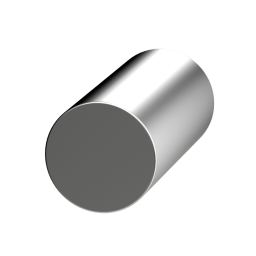
Angle
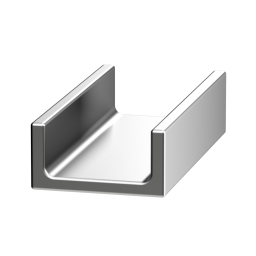
Channel
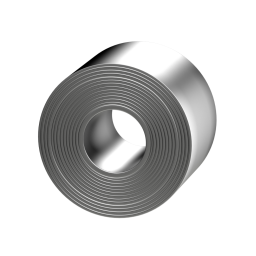
Coil
Disc
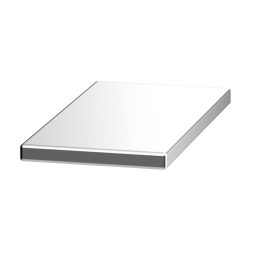
Flat Bar
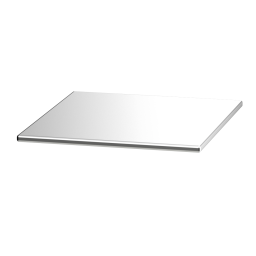
Foil
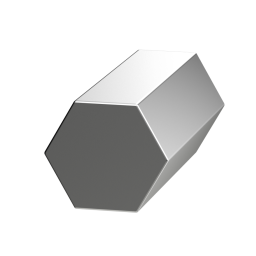
Hexagon Bar
Hollow Bar
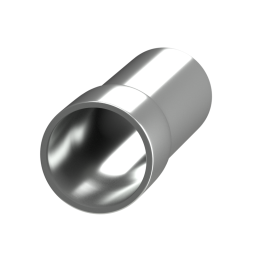
Pipe
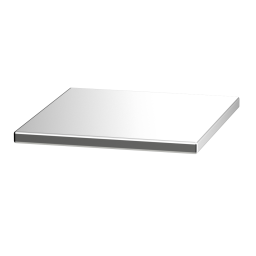
Plate
Precision Ground Bar
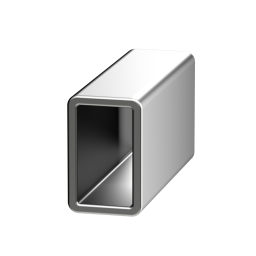
Rectangle Tube
Ring
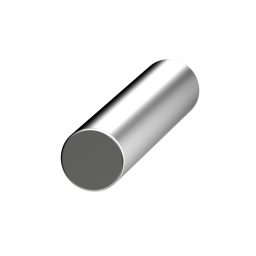
Rod
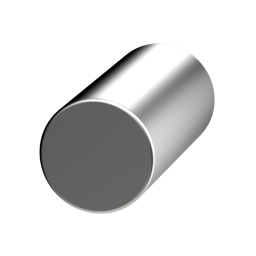
Round Bar
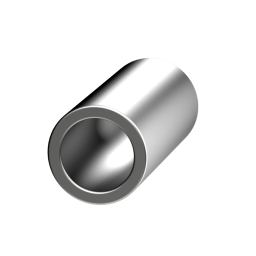
Round Tube
Sheet
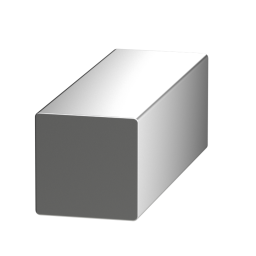
Square Bar
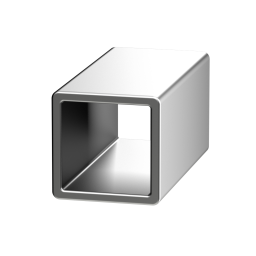
Square Tube
Standard Beam
Strip
Tee
Additional Data
Specifications
5561,5562,5656,A269 (XM-10),A276 (XM-10),A312 (XM-10),A314 (XM-10),A412 (XM-10),A479 (XM-10),A580 (XM-10),A813 (XM-10),A814 (XM-10),S21900Chemical Elements
| Carbon | 0.08 max |
| Chromium | 19 - 21.5 |
| Iron | Balance |
| Manganese | 8 - 10 |
| Nickel | 5.5 - 7.5 |
| Nitrogen | 0.15 - 0.4 |
| Phosphorus | 0.06 max |
| Silicon | 1 max |
| Sulphur | 0.03 max |
Physical Properties
Density: 0.282lb/in³
Poissons Ratio: 0.285
Specific Gravity: 7.84
Specific Heat: 0.12BTU/lb·°F
Mechanical Properties
Modulus of Elasticity – Tension: 28.9MSI
Thermal Conductivity
| Condition | Temperature | Conductivity |
|---|---|---|
| Annealed | -290 °F | 5.4 BTU/hr·ft·°F |
| Annealed | -100 °F | 7.6 BTU/hr·ft·°F |
| Annealed | 200 °F | 9.6 BTU/hr·ft·°F |
| Annealed | 600 °F | 12.6 BTU/hr·ft·°F |
| Annealed | 1000 °F | 15.6 BTU/hr·ft·°F |
Thermal Expansion
| Condition | Min | Max | Expansion Coefficient |
|---|---|---|---|
| Annealed | 80 °F | 200 °F | 9.3 μin/in·°F |
| Annealed | 80 °F | 600 °F | 10.1 μin/in·°F |
| Annealed | 80 °F | 1400 °F | 11.1 μin/in·°F |
| Annealed | 80 °F | 1800 °F | 11.4 μin/in·°F |