Stainless
Stainless 2205
Annealing Procedure
Solution anneal at 1868-2012°F (1020-1100°C) followed by rapid cooling. This also relieves embrittlement from exposure at 650-1000°F or above 1200°F (sigma and other phases).
Applications
Chemical processing, transport and storage (pressure vessels, tanks, piping, heat exchangers); oil and gas exploration and processing; marine and high-chloride environments; effluent and FGD scrubbing; pulp and paper digesters and bleaching equipment; ship and truck cargo tanks; food processing; biofuels plants.
Corrosion Resistance
Pitting, crevice and chloride stress corrosion resistance is superior to 316/316L and 317L in most environments. Critical pitting temperature is about 95°F (35°C). Resistant to chloride SCC at temperatures up to about 300°F (150°C). Good general corrosion and erosion resistance.
Formability
Good formability, but high strength means higher forming loads and more springback than austenitic grades. Ductility is lower than austenitics, and cold heading needs intermediate annealing.
Heat Treatability
Cannot be hardened by heat treatment; it hardens only by cold work.
Hot Workability
Recommended maximum hot-forming temperature is 2010-2100°F (1100-1150°C). Cool edges on non-compact shapes risk cracking.
Machinability
More difficult than 300-series austenitics: higher cutting forces and faster tool wear, with cutting speeds about 20% lower than for 304. Use rigid setups and keep cutting below the work-hardened layer.
Other Comments
Not recommended for service above about 600°F (316°C) because of 885°F (475°C) embrittlement; Penn Stainless gives 572°F (300°C). UNS S31803 is the older, wider range (Cr 21-23, Mo 2.5-3.5, N 0.08-0.20). S32205 is the tighter, higher-alloy range adopted later, and most 2205 now meets both. Typical ATI 2205 minimums: Cr 22.0, Mo 3.1, Ni 5.5, N 0.15.
Other Mechanical Properties
Endurance limit at room temperature is about 45% of tensile strength. ASTM A923 requires a minimum Charpy of 54 J (40 ft-lb) at -40°F. Flat-rolled products show some anisotropy.
Principle Design Features
Nitrogen-enhanced duplex (austenitic-ferritic) stainless steel with about 50% ferrite and 50% austenite when annealed. Yield strength is about double that of 304/316 austenitics, which often allows lighter wall sections. Typical PREN is about 35. Good fatigue strength and notch toughness down to about -40°F.
Weldability
Good weldability by most standard methods. Weld with ER2209/E2209 filler; do not weld autogenously, as this leaves excess ferrite. Keep heat input low and avoid preheat and post-weld heat treatment.
Known Forms
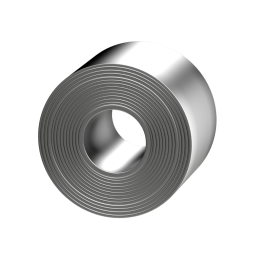
Coil
Fitting
Flange
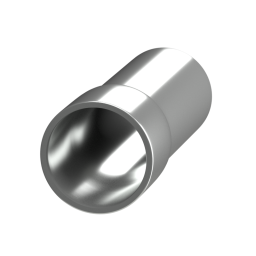
Pipe
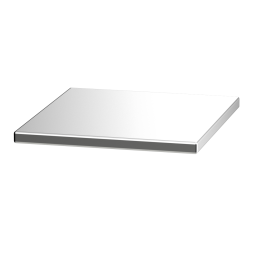
Plate
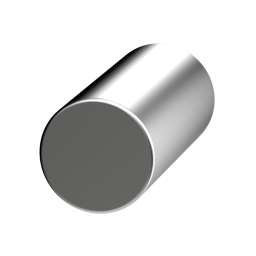
Round Bar
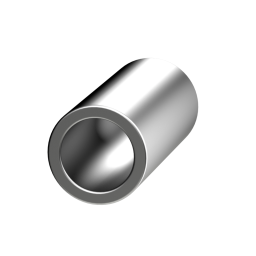
Round Tube
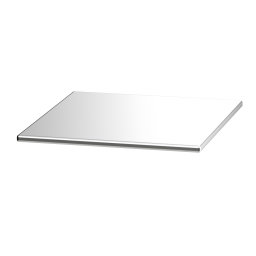
Sheet
Strip
Additional Data
Specifications
A182,A240,A276,A479,A789,A790,A815,1.4462,S31803,SA-240,SA-479,SA-182,SA-276,S32205,A923,SA-789,SA-790Chemical Elements
| Carbon | 0.03 max |
| Chromium | 22 - 23 |
| Iron | Balance |
| Manganese | 2 max |
| Molybdenum | 3 - 3.5 |
| Nickel | 4.5 - 6.5 |
| Nitrogen | 0.14 - 0.2 |
| Phosphorus | 0.03 max |
| Silicon | 1 max |
| Sulfur | 0.02 max |
Physical Properties
Density: 0.28lb/in³
Electrical Resistivity: 74µΩ·cm
Melting Point: 2525°F
Modulus of Elasticity: 29MSI
Specific Heat: 0.112BTU/lb·°F
Thermal Conductivity
| Condition | Temperature | Conductivity |
|---|---|---|
| Solution Annealed | 68 °F | 8 BTU/hr·ft·°F |
| Solution Annealed | 200 °F | 9 BTU/hr·ft·°F |
| Solution Annealed | 400 °F | 10 BTU/hr·ft·°F |
| Solution Annealed | 600 °F | 11 BTU/hr·ft·°F |
| Solution Annealed | 800 °F | 12 BTU/hr·ft·°F |
Thermal Expansion
| Condition | Min | Max | Expansion Coefficient |
|---|---|---|---|
| Solution Annealed | 86 °F | 200 °F | 7 μin/in·°F |
| Solution Annealed | 86 °F | 400 °F | 7.5 μin/in·°F |
| Solution Annealed | 86 °F | 600 °F | 8 μin/in·°F |
| Solution Annealed | 86 °F | 800 °F | 8 μin/in·°F |
Mechanical Test Data
| Form | Plate |
| Condition | Solution Annealed |
| Temperature | 70°F |
| Brinell Hardness | 293 HB |
| Elongation | 25% |
| Rockwell Hardness | C31 |
| Tensile Strength | 95 KSI |
| Yield Strength | 65 KSI |
| Form | Sheet |
| Condition | Solution Annealed |
| Temperature | 70°F |
| Brinell Hardness | 293 HB |
| Elongation | 25% |
| Rockwell Hardness | C31 |
| Tensile Strength | 95 KSI |
| Yield Strength | 65 KSI |
| Form | Coil |
| Condition | Solution Annealed |
| Temperature | 70°F |
| Brinell Hardness | 293 HB |
| Elongation | 25% |
| Rockwell Hardness | C31 |
| Tensile Strength | 95 KSI |
| Yield Strength | 65 KSI |
| Form | Strip |
| Condition | Solution Annealed |
| Temperature | 70°F |
| Brinell Hardness | 293 HB |
| Elongation | 25% |
| Rockwell Hardness | C31 |
| Tensile Strength | 95 KSI |
| Yield Strength | 65 KSI |
| Form | Round Bar |
| Condition | Solution Annealed |
| Temperature | 70°F |
| Brinell Hardness | 290 HB |
| Elongation | 25% |
| Tensile Strength | 95 KSI |
| Yield Strength | 65 KSI |
| Form | Plate |
| Condition | Solution Annealed |
| Temperature | 212°F |
| Tensile Strength | 85.5 KSI |
| Yield Strength | 52.2 KSI |
| Form | Plate |
| Condition | Solution Annealed |
| Temperature | 302°F |
| Tensile Strength | 82.6 KSI |
| Yield Strength | 48.5 KSI |
| Form | Plate |
| Condition | Solution Annealed |
| Temperature | 392°F |
| Tensile Strength | 79.7 KSI |
| Yield Strength | 45.6 KSI |
| Form | Plate |
| Condition | Solution Annealed |
| Temperature | 482°F |
| Tensile Strength | 78.3 KSI |
| Yield Strength | 43.5 KSI |
| Form | Plate |
| Condition | Solution Annealed |
| Temperature | -40°F |
| Charpy Impact | 54 J |