Stainless
Stainless 2304
Annealing Procedure
Solution anneal at 1900–2000°F (1038–1093°C) followed by rapid quenching in water or air. The minimum annealing temperature per ASTM A480 is 1800°F (980°C). Annealing restores the duplex microstructure to approximately 50% ferrite and 50% austenite, optimizes corrosion resistance, and relieves stresses from cold working or welding.
Applications
2304 duplex stainless steel is used in applications where 304L and 316L are traditionally specified, offering weight and cost savings due to its higher strength. Typical applications include: pressure vessels and storage tanks; chemical processing and transport equipment; oil and gas exploration and processing equipment; pulp and paper digesters and liquor tanks; marine and high-chloride environments; structural components such as bridges; water treatment and potable water piping systems; food and beverage processing; coal handling and potash industry equipment; heat exchangers and evaporators.
Corrosion Resistance
2304 duplex stainless steel has general corrosion resistance approximately equivalent to that of Type 316L due to its high 23% chromium content. Its combined chromium and nitrogen content (approximately 0.1% N) gives it better pitting and crevice corrosion resistance than 316L, with a Pitting Resistance Equivalent Number (PREN) of approximately 24–26. The duplex microstructure with low nickel and high chromium provides significantly improved resistance to chloride-induced stress corrosion cracking (SCC) compared to Types 304L and 316L. It successfully passes standard intergranular corrosion test procedures such as ASTM A262 Method E and C. Its corrosion rate in boiling 65% nitric acid is higher than that of 316L. The alloy performs well in abrasion-corrosion applications due to its high yield strength.
Formability
2304 duplex stainless steel can be cold-formed using the same equipment as used for 304L and 316L grades. Due to its higher yield strength, greater forming forces are required, and allowances must be made for increased springback. Bend radii of at least two times the material thickness are recommended. A final solution annealing heat treatment at 1742–1922°F (950–1050°C) is recommended after cold forming to restore mechanical properties and corrosion resistance.
Heat Treatability
2304 duplex stainless steel cannot be hardened by heat treatment. Mechanical properties are a function of chemistry and thermomechanical processing. Hardening can only be achieved through cold working. The alloy can be solution annealed to restore properties after forming or welding operations.
Hot Workability
Hot forming of 2304 duplex stainless steel should be performed in the temperature range of 1650–2100°F (900–1150°C). After hot forming, solution annealing at 1742–1922°F (950–1050°C) followed by rapid cooling (water quench or air cool) is required to fully restore corrosion resistance and mechanical properties. Parts must be adequately supported during heating to prevent creep deformation.
Machinability
2304 duplex stainless steel has improved machinability compared to many other stainless grades, particularly in drilling operations, and its machinability is considered equivalent to that of 316LEZ (a free-machining variant of 316L). Machining should be performed at low cutting speeds with constant, high feed rates to reduce work hardening tendency. Chip breakers are recommended, as the material tends to produce long, stringy chips. Adequate lubrication and cooling are essential to reduce heat generation. High-quality carbide-tipped tools are recommended.
Other Comments
2304 is also known by the European designation EN 1.4362 (X2CrNiN23-4). It carries a PREN (Pitting Resistance Equivalent Number) of ≥24. The microstructure of 2304 is more stable than molybdenum-containing duplex grades; intermetallic phases appear only after approximately 10 hours of exposure in the 1382–1562°F (750–850°C) temperature range. An enhanced version of this grade with PREN ≥28 is also available from some producers when higher chromium or nitrogen contents are specified within the permitted range. The alloy is approved for use in NSF/ANSI Standard 61 drinking water systems and is listed in API Standard 650 Appendix X.
Other Physical Properties
2304 duplex stainless steel is ferromagnetic in both the annealed and hot-rolled conditions due to the presence of the ferritic phase, unlike fully austenitic stainless steels. Its thermal conductivity is higher than that of austenitic stainless steels, making it suitable for heat transfer applications. Its coefficient of thermal expansion is lower than that of austenitic grades, reducing the risk of thermal fatigue and distortion. The ASME Boiler and Pressure Vessel Code limits the maximum design temperature for 2304 to 600°F (315°C) due to the risk of 475°C (885°F) embrittlement.
Principle Design Features
2304 (UNS S32304) is a lean duplex stainless steel with a dual-phase microstructure of approximately equal proportions of ferrite and austenite. It contains 23% chromium and 4% nickel but is essentially molybdenum-free, making it more economical than standard duplex grades. Its duplex microstructure provides yield strength nearly double that of conventional austenitic grades such as 304L and 316L, while maintaining comparable corrosion resistance. The alloy is suitable for service temperatures from -58°F to 572°F (-50°C to 300°C). Prolonged exposure above 572°F (300°C) should be avoided due to the risk of 475°C embrittlement and precipitation of brittle intermetallic phases.
Weldability
2304 duplex stainless steel can be successfully welded using most standard processes including gas-tungsten arc welding (GTAW), submerged arc welding (SAW), and gas-metal arc welding (GMAW). The duplex microstructure makes it less sensitive to hot cracking than austenitic grades. Welding parameters must be optimized to maintain a controlled ferrite level of 20–70% in the weld zone. Recommended heat input is 10–25 kJ/cm with a maximum interpass temperature of 302°F (150°C). The recommended filler metal is a balanced ferrite/austenite type such as 2209 or 2304. Pre- and post-weld heat treatments are not recommended; if heat treatment is performed, full solution annealing is the only acceptable option. Post-weld annealing at 1742–1922°F (950–1050°C) followed by rapid cooling restores optimal corrosion resistance and mechanical properties.
Known Forms
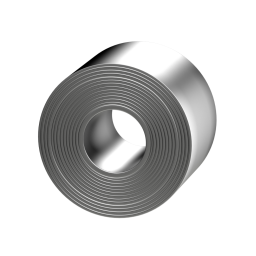
Coil
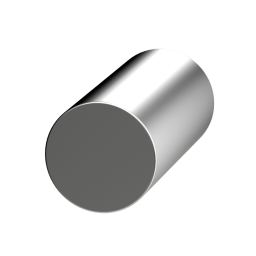
Fitting
Flange
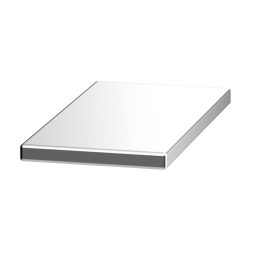
Flat Bar
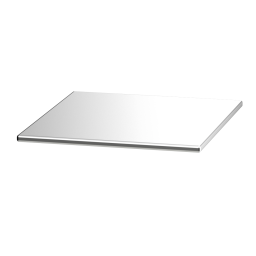
Foil
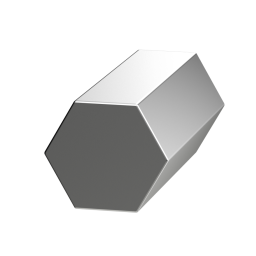
Hexagon Bar
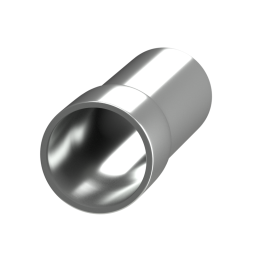
Pipe
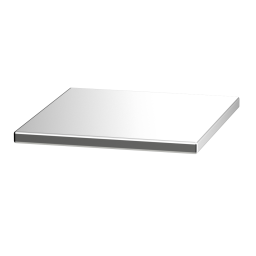
Plate
Ribbon
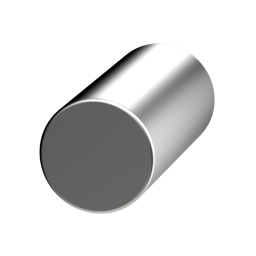
Round Bar
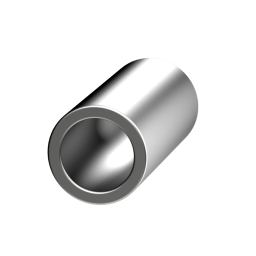
Round Tube
Sheet
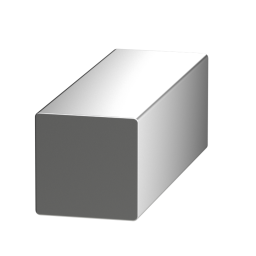
Square Bar
Strip
Wire Round
Additional Data
Specifications
A240,A276,A479,A480,A789,A790,S32304,A928,SA240,SA479,J405Chemical Elements
| Carbon | 0.03 max |
| Chromium | 21.5 - 24.5 |
| Copper | 0.05 - 0.6 |
| Iron | Balance |
| Manganese | 2.5 max |
| Molybdenum | 0.05 - 0.6 |
| Nickel | 3 - 5.5 |
| Nitrogen | 0.05 - 0.2 |
| Phosphorus | 0.04 max |
| Silicon | 1 max |
| Sulfur | 0.03 max |
Physical Properties
Density: 0.281lb/in³
Electrical Resistivity: 80µΩ·cm
Melting Point: 2570°F
Modulus of Elasticity: 29MSI
Thermal Conductivity
| Condition | Temperature | Conductivity |
|---|---|---|
| Annealed | 68 °F | 9.8 BTU/hr·ft·°F |
Thermal Expansion
| Condition | Min | Max | Expansion Coefficient |
|---|---|---|---|
| Annealed | 32 °F | 212 °F | 6.97 μin/in·°F |
Mechanical Test Data
| Form | Plate |
| Condition | Annealed |
| Temperature | 70°F |
| Brinell Hardness | 290 HB |
| Elongation | 25% |
| Rockwell Hardness | C32 |
| Tensile Strength | 87 KSI |
| Yield Strength | 58 KSI |
| Form | Sheet |
| Condition | Annealed |
| Temperature | 70°F |
| Brinell Hardness | 290 HB |
| Elongation | 25% |
| Rockwell Hardness | C32 |
| Tensile Strength | 87 KSI |
| Yield Strength | 58 KSI |
| Form | Coil |
| Condition | Annealed |
| Temperature | 70°F |
| Brinell Hardness | 290 HB |
| Elongation | 25% |
| Rockwell Hardness | C32 |
| Tensile Strength | 87 KSI |
| Yield Strength | 58 KSI |
| Form | Strip |
| Condition | Annealed |
| Temperature | 70°F |
| Elongation | 30% |
| Tensile Strength | 110 KSI |
| Yield Strength | 65 KSI |
| Form | Round Bar |
| Condition | Annealed |
| Temperature | 70°F |
| Brinell Hardness | 290 HB |
| Elongation | 25% |
| Rockwell Hardness | C32 |
| Tensile Strength | 87 KSI |
| Yield Strength | 58 KSI |