Stainless
Stainless 302
Annealing Procedure
1850-2050 F (1010-1121 C) with cooling at a rapid rate to avoid the precipitation of chromium carbides.
Applications
Primarily used in the stamping, spinning and wire forming industry. This alloy is formed into all types of washers, springs, screens and cables.
Cold Workability
Cold working will dramatically increase the hardness of this material, however it is quite ductile and may readily be drawn, spun and upset. Any cold work will cause this alloy to become magnetic. Post-fabrication annealing is necessary to reattain maximum corrosion resistance and a non-magnetic condition.
Forgeability
Commence forging at 2100-2300 F(1149-1260 C). Do not forge below 1700 F(927 C).
Hardening Procedure
This alloy does not respond to heat treatment.
Hot Workability
Uniform heating to 2100 F(1149 C) will allow this allow to be forged, upset and headed successfully. Do not work 302 below 1700 F (927 C). Forgings should be fully annealed after all operations to reattain maximum corrosion resistance.
Machinability
Slow speeds and high feeds will overcome this alloys tendency to work harden. Due to gummy chips, it is recommended that chip breakers are used on all tooling.
Principle Design Features
Type 302 is a slightly higher carbon version of type 304, most commonly found in strip and wire forms. While still used in a variety of industries, many applications have shifted to 304 and 304L due to advances in melting technology, availability and cost.
Weldability
This alloy can best be welded by resistance or shielded fusion methods. Filler metals should be AWS E/ER308 or 312. Post weld annealing dissolves the chromium carbide and is recommended for maximum resistance to intergranular attack.
Known Forms
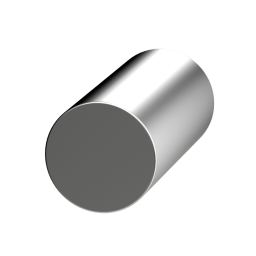
Angle
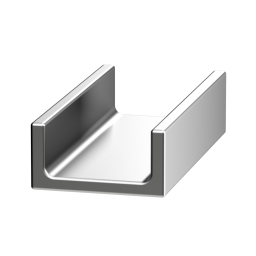
Channel
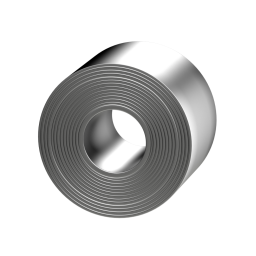
Coil
Disc
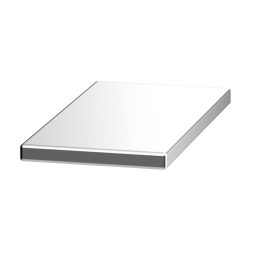
Flat Bar
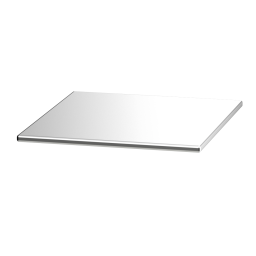
Foil
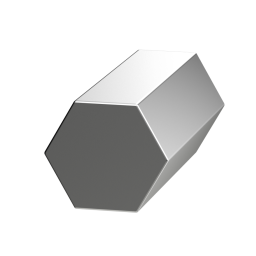
Hexagon Bar
Hollow Bar
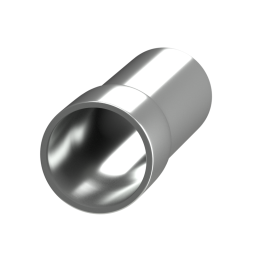
Pipe
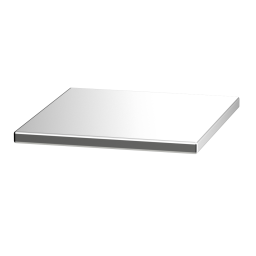
Plate
Precision Ground Bar
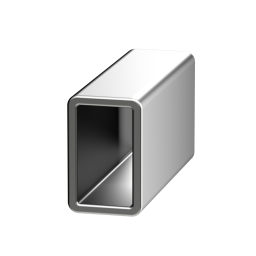
Rectangle Tube
Ring
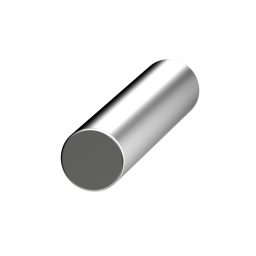
Rod
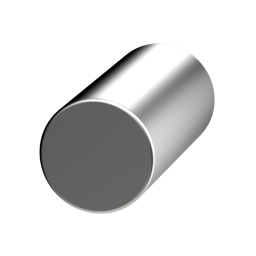
Round Bar
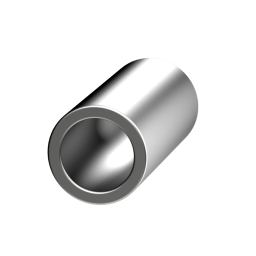
Round Tube
Sheet
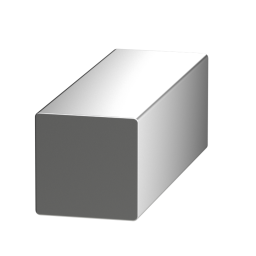
Square Bar
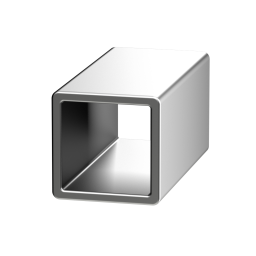
Square Tube
Standard Beam
Strip
Tee
Wire Flat
Wire Round
Wire Square
Additional Data
Specifications
302,5515,5516,5788,A167,A240,A276,A313,A314,A368,A473,A478,A479,A492,A493,A511,A554,A580,A666,1.4319,S-7720,S763,S766,S30200Chemical Elements
| Carbon | 0.15 max |
| Chromium | 17 - 19 |
| Iron | Balance |
| Manganese | 2 max |
| Nickel | 8 - 10 |
| Phosphorus | 0.045 max |
| Silicon | 1 max |
| Sulphur | 0.03 max |
Physical Properties
Density: 0.287lb/in³
Electrical Resistivity: 432µΩ·cm
Melting Point: 2590°F
Specific Gravity: 7.94
Specific Heat: 0.12BTU/lb·°F
Mechanical Properties
Modulus of Elasticity – Tension: 28MSI
Thermal Conductivity
| Condition | Temperature | Conductivity |
|---|---|---|
| Annealed | 212 °F | 11.3 BTU/hr·ft·°F |
| Annealed | 932 °F | 14.9 BTU/hr·ft·°F |
Thermal Expansion
| Condition | Min | Max | Expansion Coefficient |
|---|---|---|---|
| Annealed | 32 °F | 600 °F | 9.9 μin/in·°F |
| Annealed | 32 °F | 1000 °F | 10.2 μin/in·°F |