Stainless
Stainless 303 Se
Annealing Procedure
1850-1950 F (1010-1066 C), followed by rapid cooling is the recommended practice.
Applications
Used in an incredibly wide variety of parts both in screw and general machining industries. Applications include hardware, fasteners, valve parts, nozzles and trim.
Cold Workability
Minor deformation is possible with this alloy, although it is not its strong point.
Hardening Procedure
This alloy does not respond to hardening by heat treatment. Cold work will raise both the hardness and strength characteristics.
Hot Workability
Forging and upsetting may commence once the workpiece has been thoroughly heated to 2100-2300 F (1149-1260 C). It is not recommended to work this material below 1700 F (927 C). Rapid post-work cooling will optimize corrosion performance.
Machinability
Excellent speeds and feeds are capable with this material. The addition of selenium causes a very brittle chip.
Principle Design Features
303 Se is a modification of basic 303 that substitutes selenium for sulfur as an aid to machining. It offers good strength, corrosion resistance and great machinability. It will resist scaling at temperatures up to 1600 F(871 C). Commonly employed in parts requiring cold forming after machining.
Weldability
Although not recommended, welding may be performed if low temperatures are employed. Recommended filler metal is AWS E/ER312. At high temperature, the selenium in 303 tends to precipitate at the weld boundary resulting in weak and brittle joints.
Known Forms
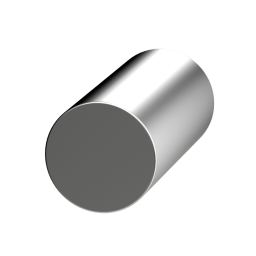
Angle
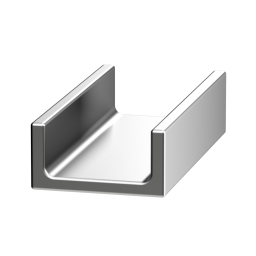
Channel
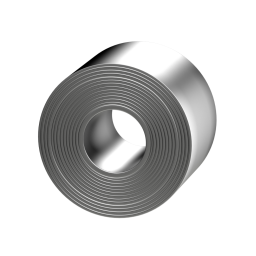
Coil
Disc
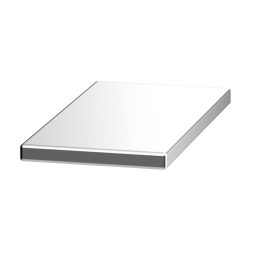
Flat Bar
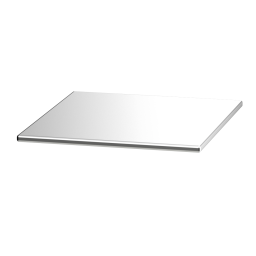
Foil
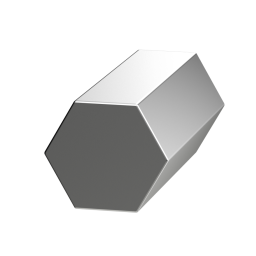
Hexagon Bar
Hollow Bar
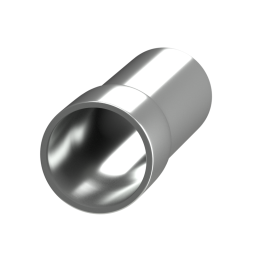
Pipe
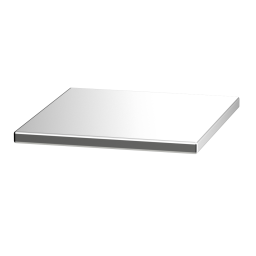
Plate
Precision Ground Bar

Rectangle Tube
Ring
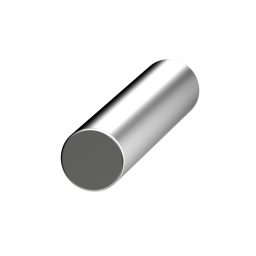
Rod
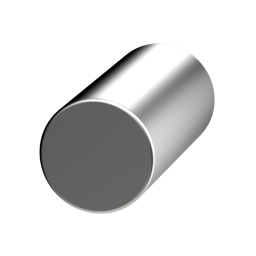
Round Bar
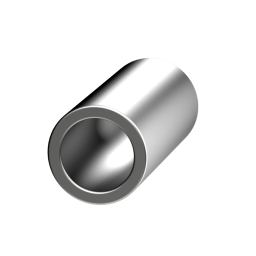
Round Tube
Sheet
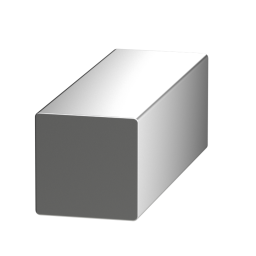
Square Bar
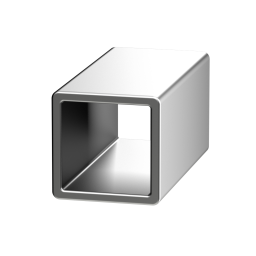
Square Tube
Standard Beam
Strip
Tee
Additional Data
Specifications
5640 (TYPE 2),A276,A314,A320,A473,A581,A582,S30323Chemical Elements
| Carbon | 0.15 max |
| Chromium | 17 - 19 |
| Iron | Balance |
| Manganese | 2 max |
| Nickel | 8 - 10 |
| Phosphorus | 0.2 max |
| Selenium | 0.15 nom |
| Silicon | 1 max |
| Sulphur | 0.06 max |
Physical Properties
Density: 0.282lb/in³
Electrical Resistivity: 432µΩ·cm
Melting Point: 2590°F
Specific Gravity: 7.84
Specific Heat: 0.12BTU/lb·°F
Mechanical Properties
Modulus of Elasticity – Tension: 28MSI
Thermal Conductivity
| Condition | Temperature | Conductivity |
|---|---|---|
| Annealed | 70 °F | 11.3 BTU/hr·ft·°F |
Thermal Expansion
| Condition | Min | Max | Expansion Coefficient |
|---|---|---|---|
| Annealed | 32 °F | 212 °F | 9.6 μin/in·°F |
| Annealed | 32 °F | 1200 °F | 10.4 μin/in·°F |