Stainless
Stainless 305
Annealing Procedure
1850-2050 F (1010-1121 C) followed by rapid cooling.
Applications
Any application requiring maximum formability such as spun or deep drawn eyelets, barrels, shells, cold headed rivets or screws will work well.
Cold Workability
Cold work is one of the design strengths of this alloy. It can be drawn, spun, headed and blanked readily due primarily to its low work hardening rate.
Hardening Procedure
This alloy does not respond to heat treatment. Cold work will cause an increase in both hardness and strength.
Hot Workability
Forging, heading and other hot working should follow uniform heating to 2100-2300 F (1149-1260 C). Rapid cooling is necessary to attain maximum corrosion resistance in finished parts.
Machinability
Slow speeds and heavy feeds are recommended to combat the material's tendency to glaze during machining.
Principle Design Features
305 has the lowest work and strain hardening rate of all the austenitic stainless steels. It was designed for maximum formability. It combines good strength and corrosion resistance and is readily available in strip and some bar sizes from the mills.
Weldability
Most of the common fusion and resistance methods can be used here. Filler metal, if necessary, should be AWS E/ER308. Oxyacetylene welding is not recommended.
Known Forms
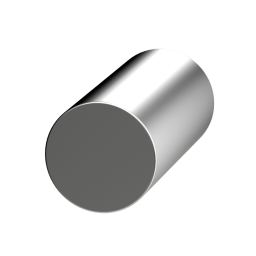
Angle
Bolt
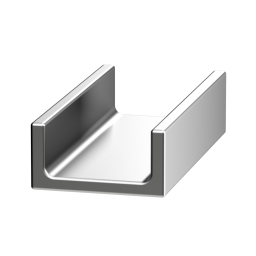
Channel
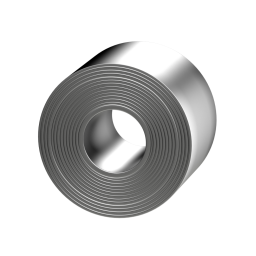
Coil
Disc
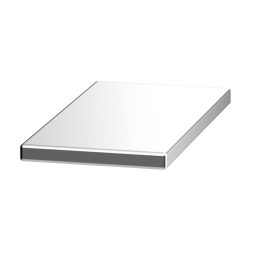
Flat Bar
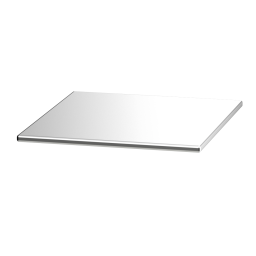
Foil
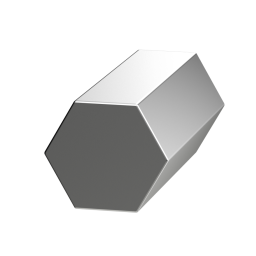
Hexagon Bar
Hollow Bar
Nut
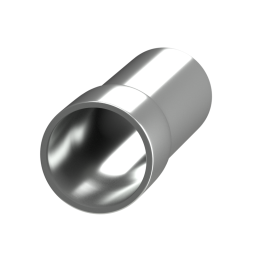
Pipe
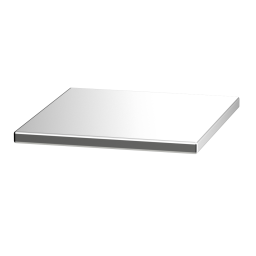
Plate
Precision Ground Bar
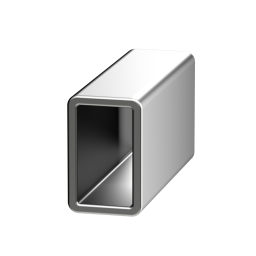
Rectangle Tube
Ring
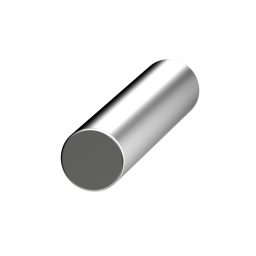
Rod
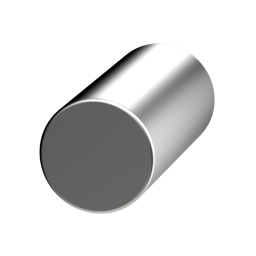
Round Bar
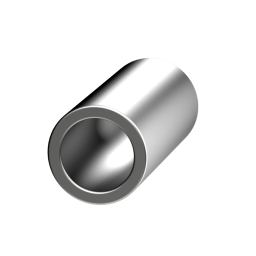
Round Tube
Screw
Sheet
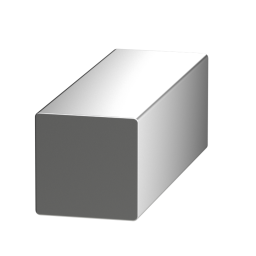
Square Bar
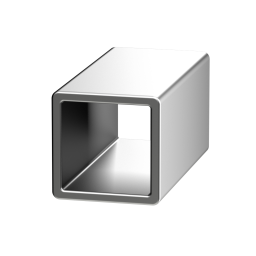
Square Tube
Standard Beam
Strip
Tee
Threaded Rod
Washer
Additional Data
Specifications
305,5514,A167,A193 (B8P, B8PA),A194 (8P, 8PA),A240,A249,A276,A313,A314,A320 (B8P, B8PA),A368,A473,A478,A492,A493,A511,A554,A580,1.4303,S763,S766,S30500Chemical Elements
| Carbon | 0.12 max |
| Chromium | 17 - 19 |
| Iron | Balance |
| Manganese | 2 max |
| Nickel | 10 - 13 |
| Phosphorus | 0.045 max |
| Silicon | 1 max |
| Sulphur | 0.03 max |
Physical Properties
Density: 0.29lb/in³
Electrical Resistivity: 432µΩ·cm
Melting Point: 2650°F
Specific Gravity: 7.9
Specific Heat: 0.12BTU/lb·°F
Mechanical Properties
Modulus of Elasticity – Tension: 28MSI
Relative Magnetic Permeability: 1.003μᵣ
Thermal Conductivity
| Condition | Temperature | Conductivity |
|---|---|---|
| Annealed | 212 °F | 9.4 BTU/hr·ft·°F |
| Annealed | 932 °F | 12.4 BTU/hr·ft·°F |
Thermal Expansion
| Condition | Min | Max | Expansion Coefficient |
|---|---|---|---|
| Annealed | 32 °F | 1200 °F | 10.5 μin/in·°F |
| Annealed | 70 °F | 212 °F | 9.2 μin/in·°F |
| Annealed | 70 °F | 1600 °F | 11 μin/in·°F |